
Submissions
Armbar
One of the few submissions available from guard, from mount and from the back, which is what makes it worth learning early and keeps it useful for years.
An armbar is a lever. Their elbow is the point you are trying to open, your hips are the fulcrum underneath it, and their wrist is the far end of the lever you control. Almost everything that goes wrong with an armbar goes wrong because one of those three parts is missing, and almost everything that makes one feel effortless is a detail about keeping them lined up.
The formal name is a straight armlock — juji gatame in judo, where it came from. It attacks the elbow in the one direction the joint does not travel: you extend the arm past straight and rotate it so the point of the elbow faces your hips.
Where it is available
The armbar is unusual in how many places it appears. In this library’s own model it is reachable from seven positions: closed guard, mount, technical mount, S-mount, side control, knee on belly and back control. That breadth is the reason it is worth learning early. Most submissions belong to one area of the game and lose relevance when you leave it. This one follows you.
The two you will meet first are opposites, and it is worth seeing them as one technique rather than two:
- From the bottom, in guard, you are pulling an arm across and bringing your leg over their head while they try to posture up and pull away.
- From the top, in mount, you are already above them, and the job is to isolate one arm and sit back without giving up the position on the way.
The mechanics of the finish are identical. What differs is how you get the arm and what they can do about it while you are getting it.
The three things that hold it
The knees
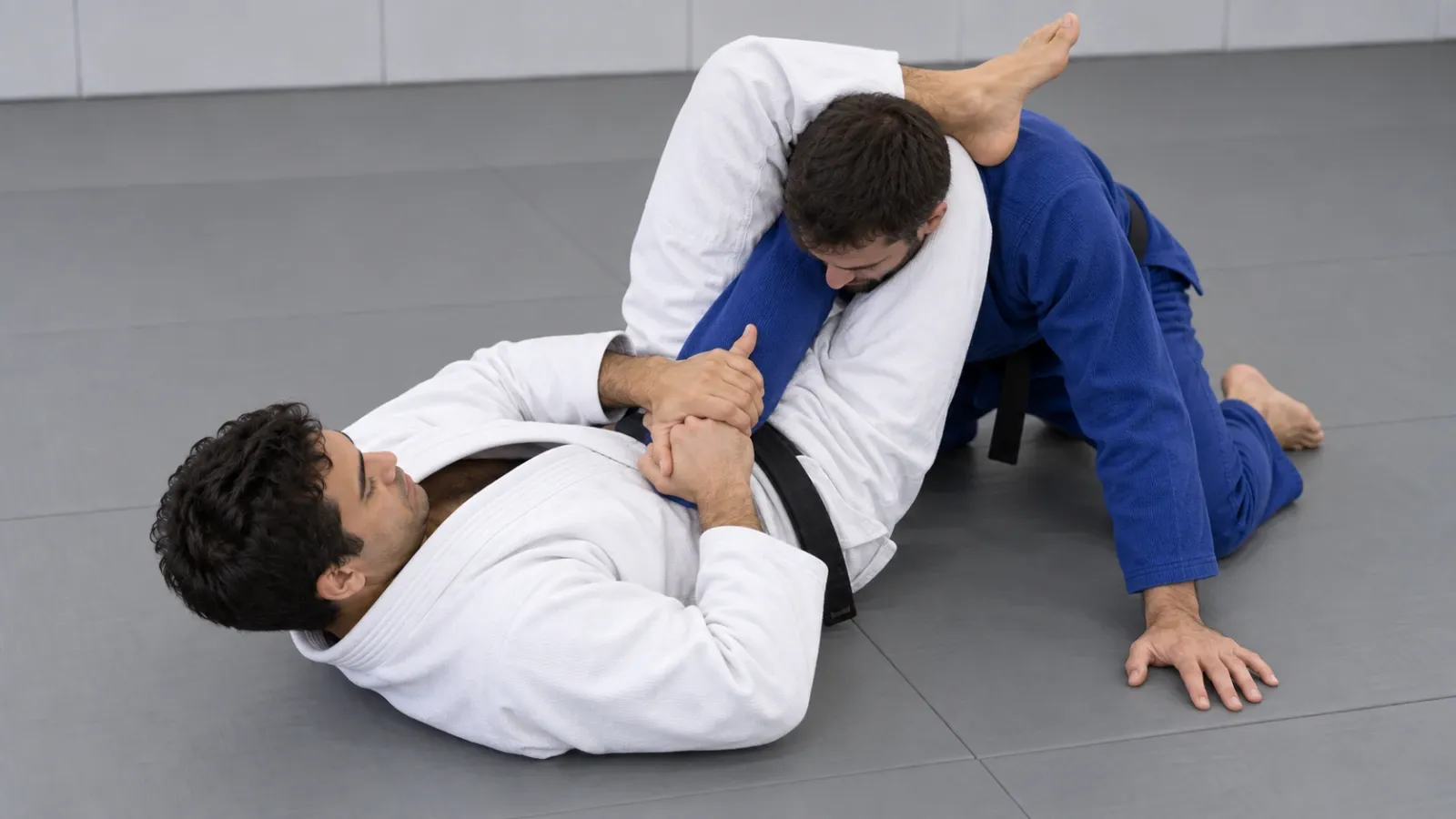
Your knees stay pinched together, and this is the detail that survives every variation. The gap between your thighs is the only route their arm has out of the lever. A hand’s width of space there is enough for them to bend the elbow, turn the thumb, and start pulling the arm back through — and once the elbow bends, you no longer have a straight armlock, you have a grip on an arm.
The wrist
Control the wrist, not the forearm and not the sleeve alone. The wrist is what sets the rotation of the arm, and rotation is half the submission. Their thumb should point towards the ceiling, which puts the elbow joint in line with your hips. Let the arm rotate so the thumb turns down and the same extension now loads a much stronger part of the joint; strong people escape that version with nothing but a bicep curl.
The head and shoulder line
Their head has to stay on the far side of your leg, and their shoulders have to stay flat. If they can bring their head under your leg or roll their shoulders towards you, the angle of the lever collapses and your hips are no longer under the elbow.
Finishing it
Lift the hips. That is the whole finish, and the mistake almost everyone makes for their first year is pulling with the arms instead.
Your arms are there to hold the position — the wrist, the elbow tight to your chest. The break comes from driving your hips up into the elbow while their shoulder stays pinned by your legs. Arms are a much weaker motor than hips, and pulling with them tends to drag their arm towards you rather than opening it, which is exactly the direction that lets them bend it.
Go slowly, and with a training partner go slowly on purpose. An elbow does not have much travel past straight before something in it gives, and there is no useful warning between “tight” and “too far”. Apply the pressure gradually enough that they can tap, and stop the moment they do.
Why it fails
The common failures are all versions of losing one of the three:
- Space between the knees. They pull the elbow through the gap.
- The arm rotates. Thumb turns down, they stack and pull it out.
- You sit too far back. Sitting away from them feels like extension but actually moves your hips away from the elbow, which is the one place they need to be.
- They stack you. From the top they drive their weight over your hips, walk towards the trapped side, and take the angle away. This is the standard escape, and the reason competitors finish the armbar quickly or let it go and take the sweep instead.
- They join their hands. Once their free hand grips the trapped arm, you are fighting both arms with your two. Break the grip before you commit to extending — a common answer is to attack the gripping hand with your legs or to switch to a different attack entirely.
When they defend
A defended armbar is rarely a dead end, because the defence itself gives something up. Pulling the arm back and turning in exposes the other side; joining the hands to fight the extension often means the head is available. The two attacks this library records as interchangeable with the armbar are the triangle choke and the omoplata, and both come from the same configuration: one of their arms is in, the other is out, and their defence to one of the three tends to open another.
That relationship is worth training as a unit rather than as three separate techniques. The choice between them is usually made by what they do, not by what you planned.
Defending and escaping it
The two answers this model records are the armbar escape (the stack) and the hitchhiker escape.
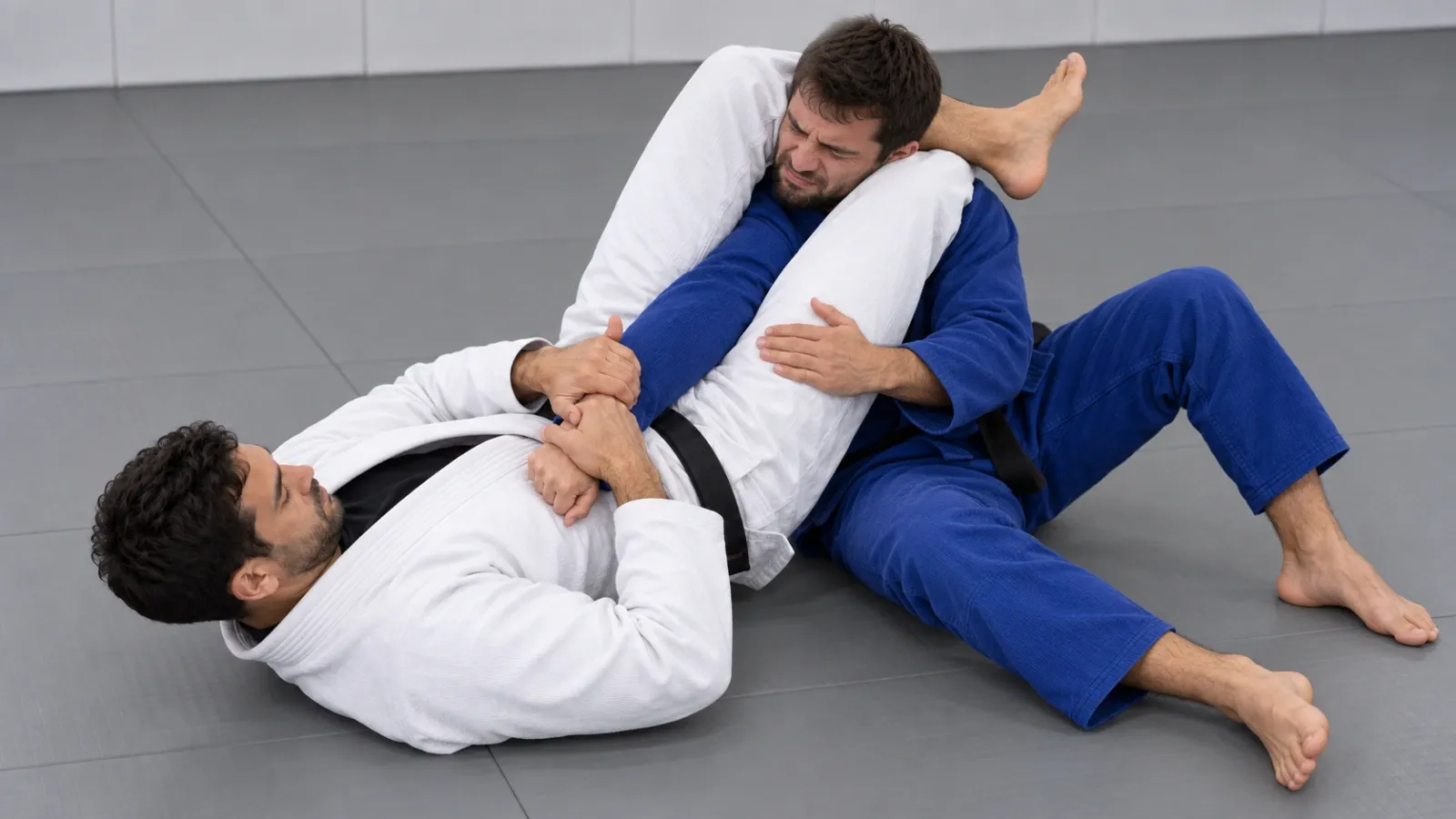
The stack is the more general of the two: clear your elbow to the safe side, join your hands, and drive your weight over their hips so they cannot extend. The race is to get the hands connected before your elbow crosses their centre line. The hitchhiker turns the thumb down and rotates the arm out in the direction the shoulder allows — effective, and worth learning under supervision, because it works by rotating a joint that is already loaded.
The universal first principle is earlier than either: do not let the arm straighten. A bent elbow is not yet an armbar.
Drilling it
Drill the finish position before the entry. Start with the arm already isolated and your leg already over the head, and practise the small things — pinching the knees, turning the thumb, lifting the hips — against a partner giving graduated resistance. Most people can enter an armbar long before they can hold one.
Then drill the transition out of it. Going from a failed armbar to a sweep, to the back, or to the triangle is the skill that turns the armbar from a gamble into a position you are happy to be in.
Those transitions only appear under live resistance, which is the half of the work drilling on its own cannot do.
Safety
The elbow does not have much travel available past straight, and unlike a choke there is no long warning between “tight” and “too far”.
Apply the extension gradually rather than snapping your hips up, and release the moment your partner taps. Do not add a final pull after the tap to “finish it properly”. Be particularly careful when your legs are heavy on their chest, because the same hip drive that breaks the arm also compresses them.
If you are the one caught, tap early. An elbow that has been hyperextended once tends to be a recurring problem, and there is nothing to be learned from the last few degrees.
Technique varies with your body and your training partner. Ask your coach or instructor to watch your finish — hip-driven versus arm-driven is obvious from the outside and hard to feel.
An armbar also arrives faster than it feels like it is going to, which is why it comes up so often in knowing when to tap.
Gi and no-gi
The lever is identical. What changes is the grip fight on the way in: in the gi you can hold a sleeve, which makes isolating the arm easier and slows their escape; in no-gi a sweaty arm slides, so the bite has to be on the wrist itself and the finish tends to be faster and more committed.
The lever staying identical while the grip fight changes completely is a small version of the whole gi and no-gi question.
Common questions
How does an armbar actually work? It hyperextends the elbow. Your hips sit under the joint as a fulcrum while their shoulder is held in place by your legs, so raising your hips forces the arm past straight.
Can you armbar from guard and from mount? Yes — and from side control, knee on belly, technical mount, S-mount and back control. It is one of the most transferable submissions in the sport.
Why does my opponent always escape my armbar? Nearly always one of two things: there is space between your knees, or their arm has rotated so the thumb points down. Both let them bend the elbow, and a bent elbow is not an armbar.
Should I pull with my arms to finish? No. Hold with the arms, finish with the hips. Pulling drags their arm towards you instead of opening the joint.
How do you defend an armbar? Before it is locked, keep the elbow bent and the hands connected. Once it is on, the standard answer is to clear the elbow to the safe side and stack your weight over their hips.
Is the armbar legal in Brazilian Jiu Jitsu? Straight armlocks are permitted at every belt level under the major sport rulesets, including for juveniles in most organisations — unlike many leg locks and spinal attacks. Rules vary between organisations and age divisions, so check the ruleset you are competing under.