
Submissions
Arm Triangle
Their shoulder closes one carotid, your arm closes the other. Also called the head and arm choke or kata gatame, and finished with the hips rather than the arms.
The arm triangle is unusual among chokes in that the person being choked supplies half of it. Their own shoulder is pressed into one side of their neck; your arm and chest close the other. That is where the name comes from — a triangle made of their arm, their shoulder and your arms — and it is also why it finishes people who are comfortable defending everything else. It is known as the head and arm choke, and in judo as kata gatame.
How it closes
Their arm ends up across their own face or neck, usually because they pushed at you and you trapped it there. Your head goes to the same side as their trapped arm, low against their shoulder. Your arms join — a gable grip, palm to palm, never joined around their neck like a headlock — and your chest drives down.
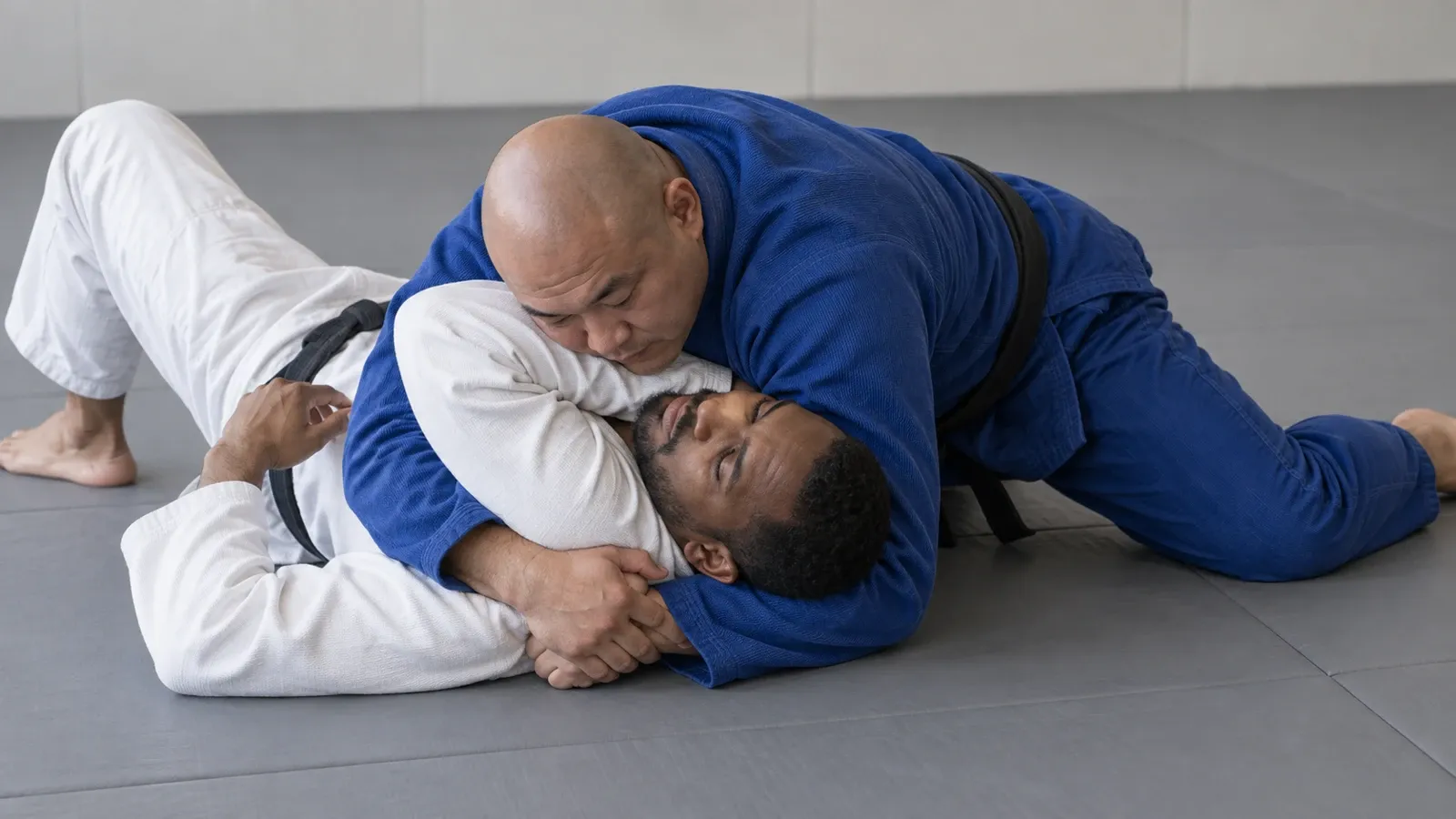
Now their shoulder is a wedge against one carotid and your bicep and chest are a wedge against the other. Both sides are closed and neither of them is your hand.
The finish is in the hips
Walk your hips towards their head.
This is the detail that separates people who finish arm triangles from people who squeeze and get nowhere. Locked hands and a hard squeeze from directly beside somebody is not enough: the angle is wrong and their shoulder is not being driven into the right place.
Stepping your hips towards their head, or moving off to the far side so your body is at an angle to theirs, is what tightens it. Many people finish this by coming off to the side entirely and driving in from there, with the knee on the far side stepping over their head. If the choke is not working, the answer is almost never “squeeze harder” — it is “change the angle”.
Where it comes from
Mount, when they push up into your chest and you trap the arm across. This is the common entry in jiu jitsu and it follows naturally from the same reaction that gives you the americana — an arm pushing is an arm available.
Side control, where the arm ends up across as they frame or turn towards you.
A failed guard pass, where their arm is already across their face as you settle.
As a follow-on from the cross face, since cross facing and the arm triangle put your body in almost the same place.
The usual sequence is that you arrived in a dominant position first and the choke appeared, rather than that you hunted it from a scramble — which is arriving before attacking doing exactly what it says.
Why it fails
- Squeezing without the angle. The most common by a distance. Hips towards the head, then squeeze.
- The head too high. Your head has to be tight against their shoulder, driving it into their neck. A head resting on the mat next to theirs does nothing.
- Their arm not properly across. If their elbow is still on their own chest rather than past their face, it is not closing anything.
- Losing the position to get the choke. Stepping off to finish is right; sliding off and losing the pin entirely is not.
- Joining the hands around the neck. That is a headlock, and it is both ineffective and a different thing entirely.
- Holding it too long once it is clearly on. See safety.
How it is defended
Get the elbow back. Before it closes, driving the trapped elbow back down to your own chest ends it.
Turn into them. Turning towards the choking side creates the small amount of space the choke cannot survive.
Bridge and walk your hips away, taking the angle from them the same way they were trying to take it from you.
Tap. Once it is properly set with the angle, an arm triangle is very hard to escape and it works quickly. This is one of the submissions when to tap is written for.
Drilling it
From mount, off the push. Partner frames into your chest, you trap the arm and settle. Ten repetitions each side without finishing.
Then the hip walk, slowly, so the angle becomes the thing you look for rather than the squeeze. Have your partner tell you at which point it starts to close; it is usually later in the movement than you expect.
Then from side control and as a transition from the cross face, so it becomes an option that appears rather than a technique you chase.
Safety
A blood choke, applied by two large surfaces, and one that can close very quickly once the angle is right.
Apply it gradually rather than dropping your weight into it, and release the instant your partner taps. Be aware that a person in a well-set arm triangle often cannot move their arms to tap — their near arm is trapped and the other is usually pinned by your body — so watch for a foot tapping the mat or a verbal signal, and stop at anything that looks like one. If a partner goes quiet or stops responding, let go immediately.
If you are the one caught, tap early. There is no useful information in the last seconds of a choke that is already set, and this is a choke that does not give much warning before it works.
Always ask your coach or instructor to check your technique and practise safely at your academy.
Common questions
What is an arm triangle choke? A head and arm choke in which the opponent’s own shoulder closes one side of their neck while your arm and chest close the other, usually finished from mount or side control.
Why is it called a triangle? Because the closure is formed by their arm and shoulder together with your arms, making a triangle around their neck — the same principle as a leg triangle with different limbs.
Why can I not finish my arm triangle? Almost always the angle. Walking your hips towards their head, or stepping off to the far side, is what closes it. Squeezing harder from beside them rarely works.
Is an arm triangle the same as kata gatame? Yes. Kata gatame is the judo name for the same head-and-arm control, and the terms are used interchangeably in most gyms.
Should my hands join around the neck? No. Hands join palm to palm or in a gable grip around their head and your own arm. Joining around the neck makes it a headlock, which is a different and much weaker thing.
Does the arm triangle work in no-gi? Yes, and it is very common there. Nothing in it depends on grips, so it transfers unchanged.