
Sweeps
Hip Bump Sweep
The closed guard sweep that needs no grips at all — which is exactly why it still works when someone has stripped everything else.
Almost every attack from closed guard depends on a grip. This one depends on a decision. You sit up, you post, and you drive your hip through them — and because none of that requires holding anything, the hip bump is available in situations where the rest of your guard game has been shut down.
That is its real value. It is not the highest-percentage sweep in the sport, but it is the one that is still there when your sleeves have been ripped off your hands and your collar grip is gone.
Where it comes from
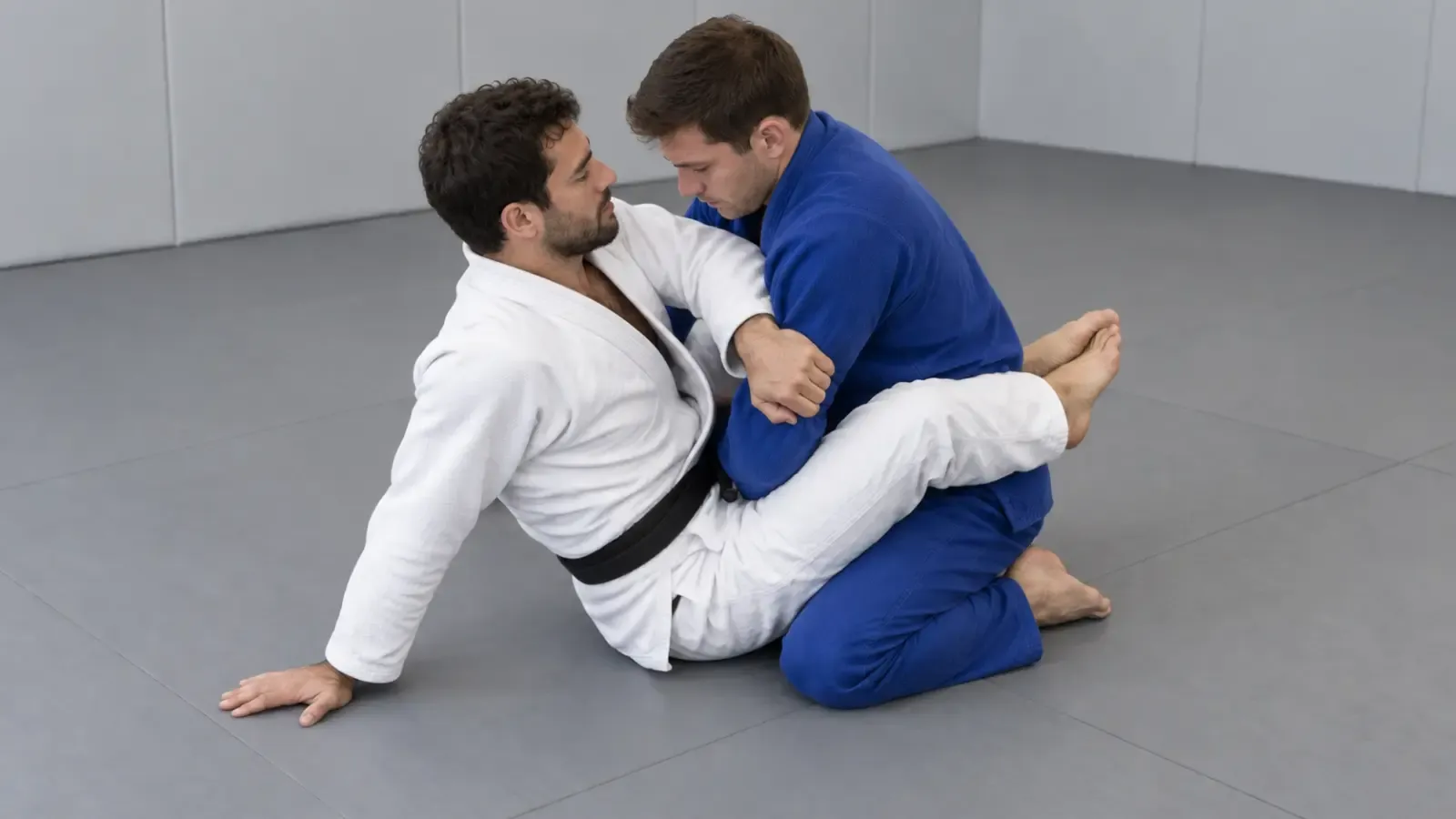
Closed guard, bottom. One source, and the technique is specific to it: you need your legs locked around them so that when you sit up, your hips have something to rotate against.
It is usually taught in the first month or two, alongside the scissor sweep, and the two make a natural pair for reasons covered below.
The mechanics
The hip bump is a rotation, not a lift. You are not pushing them over backwards with your arms — you are turning your own body ninety degrees and taking their base with your hip on the way round.
The sit-up. From flat on your back, you sit up sharply towards them. This is not a crunch — it is a hip-driven movement, closer to standing up than to a sit-up, and it has to be committed. A slow sit-up simply announces the technique and lets them posture back.
The post. One hand goes behind you, flat on the mat, elbow reasonably straight. This is the pivot the whole sweep turns around. Without it you have nothing to rotate against and you fall back down.
The over-hook or the shoulder. Your free arm goes over their arm, or your shoulder drives into their chest on that side. This is what stops them from simply sitting back and leaving you sitting up on your own.
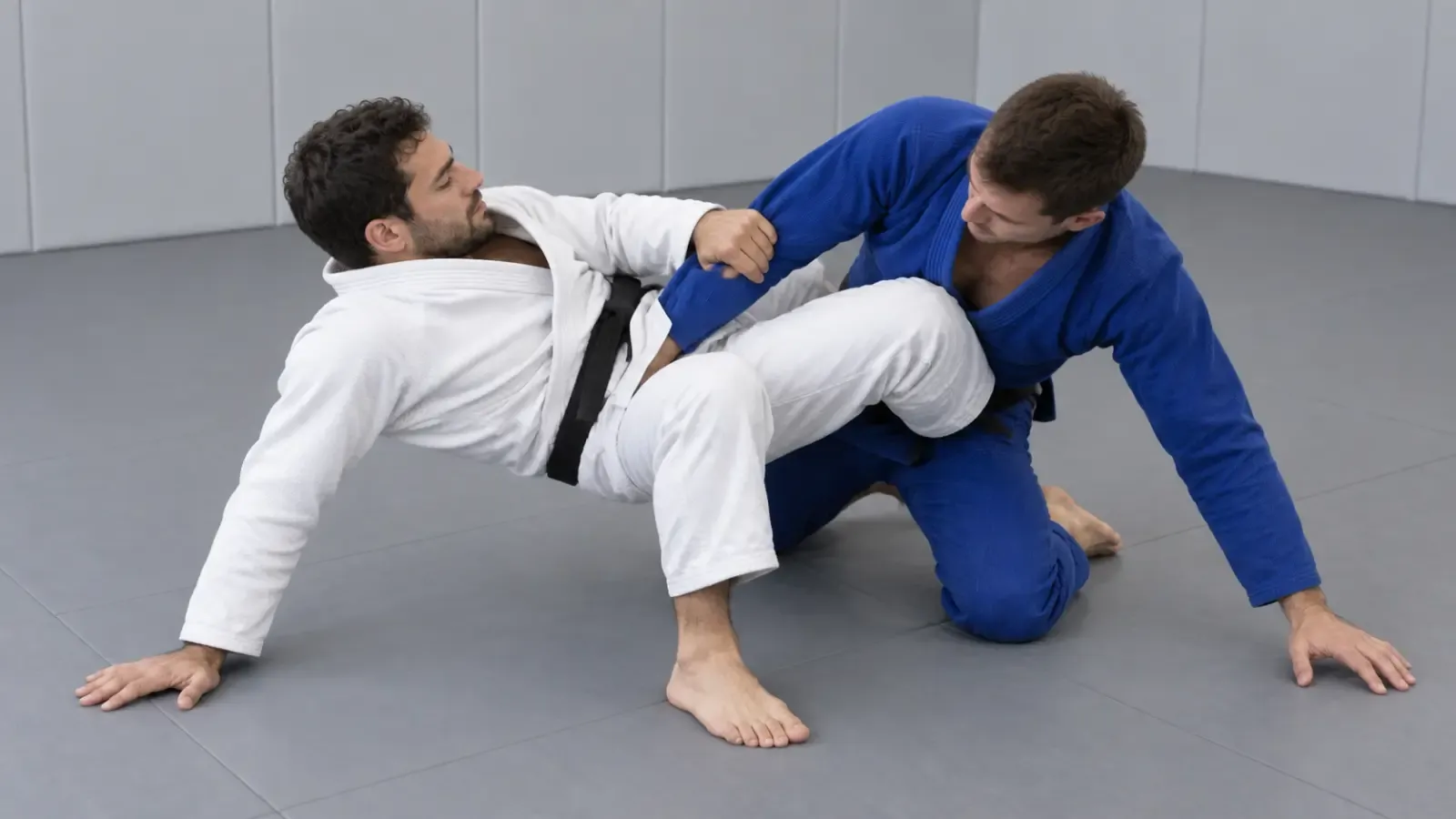
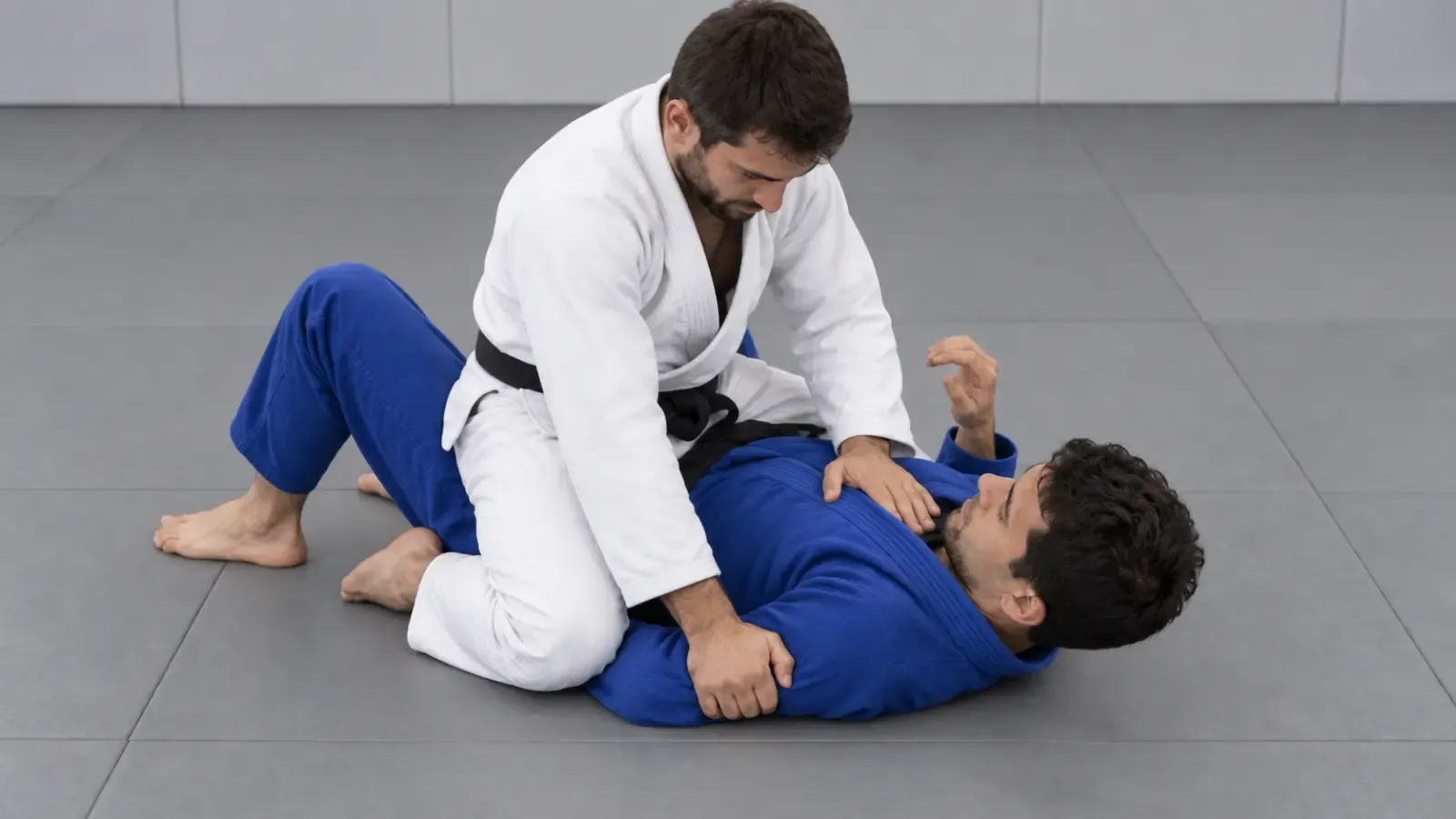
The bump. Your hip on the posting side comes up and over, driving through their thigh and across, while your upper body rotates over your posted hand. Their base goes and they roll.
Follow it up. You arrive in mount. As with every sweep, you have to come up and finish — a hip bump that stops halfway leaves you sitting in front of somebody.
Why explosiveness matters here
Most of this library’s techniques improve when you slow them down. This one does not.
The taxonomy’s own note is that the sit-up has to be explosive and committed, and that a slow one just tells them what you want. The reason is mechanical: you are attempting to move somebody’s base before they can adjust it, with no grip holding them in place. The only thing that beats their reaction is speed of entry.
This has a practical training consequence. If you drill the hip bump slowly and carefully like an armbar, it will not work in a roll — you have to drill the commitment as well as the shape.
What happens when they defend
They post. That is the standard, near-universal reaction: as your hip drives through, they put a hand down on the far side to stop themselves being turned over.
And the moment they do, their arm is straight, extended and in front of you — which is the kimura.
This library records the hip bump sweep and the kimura as a combination, and the taxonomy’s own note is exactly this: it pairs naturally with the kimura, since posting to defend the bump hands you the arm.
The pair works both ways:
- Bump first. They post, you take the figure-four grip on the posted arm.
- Kimura first. They defend the shoulder by driving their weight forward and down, which is the weight distribution the hip bump wants.
Trained together, the two give you a genuine either-or from closed guard against an opponent who has taken away all your grips — which is the situation the hip bump exists for.
Why it fails
- Not explosive enough. The biggest one. They feel it coming and posture back.
- No post, or a post too close to your hips. Nothing to rotate around, so you sit up and sit back down.
- You kept the guard closed. The legs have to open as the hip comes through; a closed guard blocks your own rotation.
- No over-hook or shoulder pressure. They sit back out of range and you are left upright with your legs open.
- You tried it from flat with no posture break. From a long way underneath somebody, the sit-up covers too much distance.
- You did not finish. Landing in half mount or sitting in front of them is a common three-quarters-finished outcome.
Where it sits among closed guard sweeps
This library records the hip bump and the scissor sweep as interchangeable — both first attacks from closed guard bottom — and the practical difference is the grip requirement.
The scissor needs a broken posture, a collar and a sleeve. The hip bump needs none of those and wants, if anything, an opponent who has postured up. So they cover each other: when you have grips and they are low, scissor; when they have stripped your grips and postured, bump.
Add the kimura and you have a small three-way system from one position with one set of reactions deciding between them. That is a much better use of training time than three unrelated techniques.
Closed guard sweeps are best learned as a small family with shared reactions, which is the approach the shared shape of a sweep takes.
Gi and no-gi
One of the few closed guard techniques that transfers essentially unchanged. Nothing in it grips clothing — the over-hook is on the arm, the post is on the mat, the drive is from your hips.
If anything it is more useful in no-gi, precisely because the grip-dependent alternatives are weaker there. In gi competition it tends to be a secondary threat that opens the kimura; in no-gi it is a legitimate primary sweep.
Being more useful without a jacket than with one is rarer than the reverse; gi and no-gi compared covers which way most techniques fall.
Drilling it
Drill the sit-up on its own first, with no partner: from flat, explode to seated with a hand posted behind you, and feel the hip rotation rather than the abdominal crunch.
Then drill the sweep at full commitment with a cooperative partner, because a tentative hip bump teaches the wrong motor pattern. Slow drilling has its place; here it builds a habit that does not survive contact.
Finally, drill the bump-to-kimura chain as one unit rather than two techniques, with the partner instructed to post. That is the version you will actually use.
Chaining rather than collecting is the habit that turns a pile of techniques into a game.
Safety
Low risk in itself, with two things worth noticing. Your posted arm takes your bodyweight plus some of theirs at an awkward angle — keep the elbow from hyperextending and do not post on a bent wrist. And be mindful of where your partner lands as they go over, particularly in a crowded class.
Technique varies with your body and your partner. Ask your coach to watch your post position in particular; it is the detail that most often causes a sore shoulder afterwards.
Common questions
What is a hip bump sweep? A closed guard sweep where you sit up, post a hand behind you, and rotate your hip through the opponent to take their base — with no grips required.
Why does my hip bump not work? Usually because it is too slow. It relies on beating their reaction rather than on holding them in place, so a tentative sit-up gets stuffed.
Do I need grips for it? No, and that is the point. It is the sweep that still works when your grips have been stripped.
What do I do when they post their hand? Take the kimura. The posted arm is the opening, and the pair is designed to work exactly that way.
Is it better in gi or no-gi? It transfers unchanged, and it is relatively more valuable in no-gi because the grip-based alternatives are weaker there.
Where should my posting hand be? Behind you and reasonably wide, not tucked close to your hips. It is the pivot the sweep rotates around, so it needs to be a proper base.