
Grips and control
Cross Face
The near arm driven across the jaw so their head turns away from where they want to go. A head that cannot face the escape is a body that cannot make it.
Somebody underneath you escapes by moving their hips, and their hips follow their head. The cross face — sometimes written crossface — is the near arm driven across their face into the far side of their jaw, turning the head away from the direction they need to travel. It is the reason good top pressure feels immovable when the person applying it does not appear to be doing much.
The mechanics
Your near arm crosses their face. The contact is the blade of your forearm or your bicep against their cheekbone and jaw, and the hand goes past their head to the mat, to their far shoulder, or to a collar in the gi.
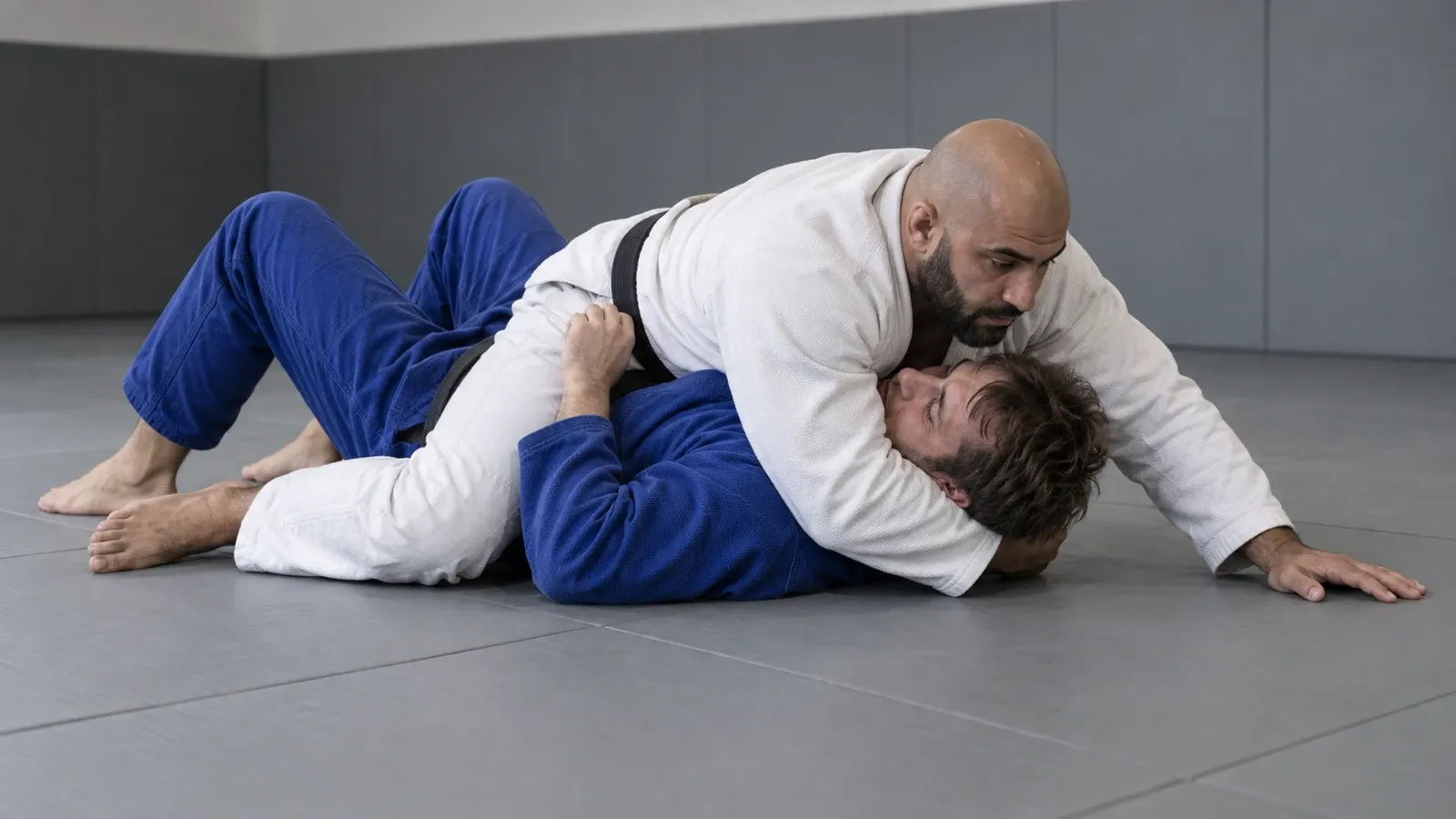
The critical detail is where the force comes from. Your shoulder and chest supply the pressure; the arm only carries it. An arm doing the work alone is a lever somebody can duck under or frame against. A shoulder driving through the arm, with your chest heavy on their upper body, is a wall.
The second detail is direction. You are not pushing their head down into the mat. You are turning it away — rotating their chin towards their far shoulder. Down is uncomfortable; away is what stops the escape.
Why it stops guard recovery before it starts
To recover guard from underneath, somebody has to turn towards you and bring a knee in. That movement begins with facing you.
A head turned to the far side cannot lead that rotation, and the shoulders cannot rotate independently of the head for long. So the hips have nothing to follow, the knee never arrives, and the hip movement that creates space that would have created the space produces a wriggle instead. The bottom player usually experiences this as “my hips would not move”, which is not quite what is happening — their hips would move, but there is nowhere useful for them to go.
This is why why passes keep landing so often comes down to somebody having lost their head position several seconds before they lost the position itself.
The most portable grip in top control
Very little transfers cleanly between positions. This does.
- Side control. The default. Cross face plus an underhook on the far side is the standard pin.
- Half guard, top. The answer to the bottom player’s underhook. They take the arm, you take the head, and the exchange is even until somebody’s control is better.
- North-south. The angle changes, the connection does not.
- Knee on belly. Less common, because posture is the point there, but available.
- Mount, as a way to flatten somebody who is turning to their side.
Because the same connection works everywhere, the cross face is one of the few things worth drilling as a subject rather than as part of a technique.
How it is defended
Frame early, on the bicep. The defender’s near hand goes to the inside of your cross-facing arm before it arrives. Once the arm is past the jaw it is far harder to remove.
Turn into it, not away. The instinct is to turn the face away from the pressure, which is what you wanted. The correct answer is usually to turn the chin back towards the person on top and rebuild the frame.
Get the far underhook. A defender who gets their far arm underneath your chest takes away the shoulder pressure that makes the cross face work.
Do not hunt for the escape while your head is turned. This is the real lesson: escapes attempted under a good cross face fail on the head, not on the hips, so the head is what has to be fixed first. The elbow-knee escape and the bridge and roll both assume you have dealt with it.
Where it goes wrong
- Reaching with the arm and leaving the chest behind. The most common version, and easy to duck.
- Driving the head straight down. Uncomfortable, ineffective, and closer to a face crank than a control.
- Letting the elbow float away from their shoulder. The gap that appears is exactly the one they need to frame into.
- Using it as the whole pin. The cross face controls the upper body. Something has to control the hips, or they will simply shrimp away underneath a very well-turned head.
- Grinding rather than settling. Sawing the forearm across somebody’s face is unpleasant, makes people flinch away rather than settle, and is not more effective.
Drilling it
Positional rounds from side control, top player restricted to maintaining the cross face and the far-side control, bottom player trying to recover guard. No submissions. The constraint teaches both sides quickly.
Then the same with the top player’s arm deliberately reaching rather than the shoulder driving, so you can feel the difference in how easy it is to escape. It is more convincing than being told.
And from the bottom, framing on the bicep before the arm lands. That timing is a skill in itself and it is the one that saves the position.
Safety
Not a submission, but it sits on somebody’s face, and that deserves care.
Pressure goes onto the jaw and cheek, not into the eye socket, the nose or the throat. Settle your weight rather than grinding, and ease off if a partner is turning away in obvious discomfort rather than defending — there is nothing to be learned from making a training partner unwilling to let you pass. With a much smaller partner, remember that shoulder pressure scales with your bodyweight and theirs does not; the same ground is covered in training with bigger, stronger partners.
Always ask your coach or instructor to check your technique and practise safely at your academy.
Common questions
What is a cross face in Brazilian Jiu Jitsu? The near arm driven across the opponent’s face into the far side of their jaw from a top position, turning their head away from the direction they want to escape.
Why does turning the head stop an escape? Because the hips follow the head. A person whose face is turned to the far side cannot lead the rotation that guard recovery needs, so the knee never gets back in.
Where should the pressure come from? Your shoulder and chest, carried through the arm. An arm applying it on its own is easy to frame against or duck under.
Is a cross face legal in competition? Cross facing is standard top control and is broadly accepted, though rulesets differ by organisation, belt level and age division on how much neck pressure is tolerated — check the rules you compete under rather than assuming.
How do I get out of a cross face? Frame on the inside of the arm early, turn your chin back towards them rather than away, and look for the far underhook. Escaping with the head still turned rarely works.
Does the cross face work without a gi? Yes. It depends on shoulder pressure and head position rather than grips, so it changes very little between the two.