
Submissions
Omoplata
A shoulder lock applied with the legs that doubles as one of the strongest sweeping threats from guard — which is what makes it worth more than its finishing rate suggests.
The omoplata is worth learning even if you never tap anybody with it. It is a shoulder lock and a sweep at the same time, and an opponent defending one is usually handing you the other. That double threat is why it occupies so much space in modern guard games despite finishing less often than an armbar or a triangle.
The name is Portuguese for the shoulder blade. In judo it belongs to the ude-garami family — an entangled armlock — but applied with the legs rather than the arms.
Where it comes from
Three positions in this model: closed guard, supine open guard, and S-mount. Guard is where nearly everyone meets it, because the opening is a by-product of ordinary passing pressure.
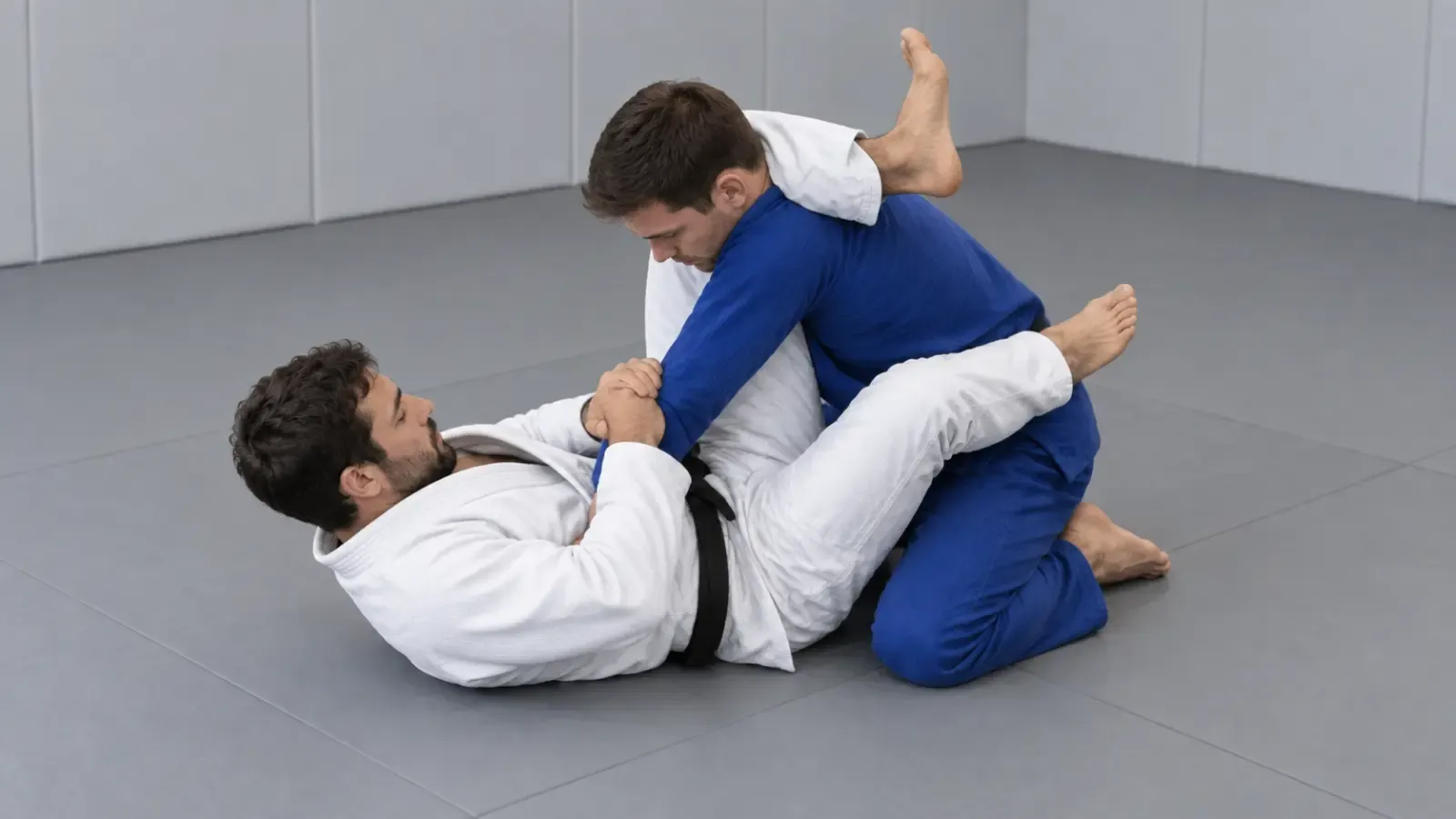
The invitation is an arm that has reached past your hip or been left low while they work to pass. If you can get a leg over that shoulder and bring it behind their back, you have the entry.
Closed guard and its relatives each offer a different set of attacks; the guard families sets out which is which.
How the lock works
The shoulder is rotated internally — the arm is bent and turned behind their back, the same direction the kimura attacks, except your hips and legs supply the force instead of two arms.
Three things have to be true:
- Their arm is behind them, not beside them. An arm trapped alongside their body is a leg draped over a shoulder. Getting it behind is what creates the rotation.
- Your legs are locked. Triangling your legs around the trapped arm stops them pulling it out and stops your own leg sliding off the shoulder.
- You are sitting up. This is the part people skip, and it deserves its own heading.
Sitting up is the whole technique
The omoplata’s most common failure has one cause: the attacker stays flat on their back.
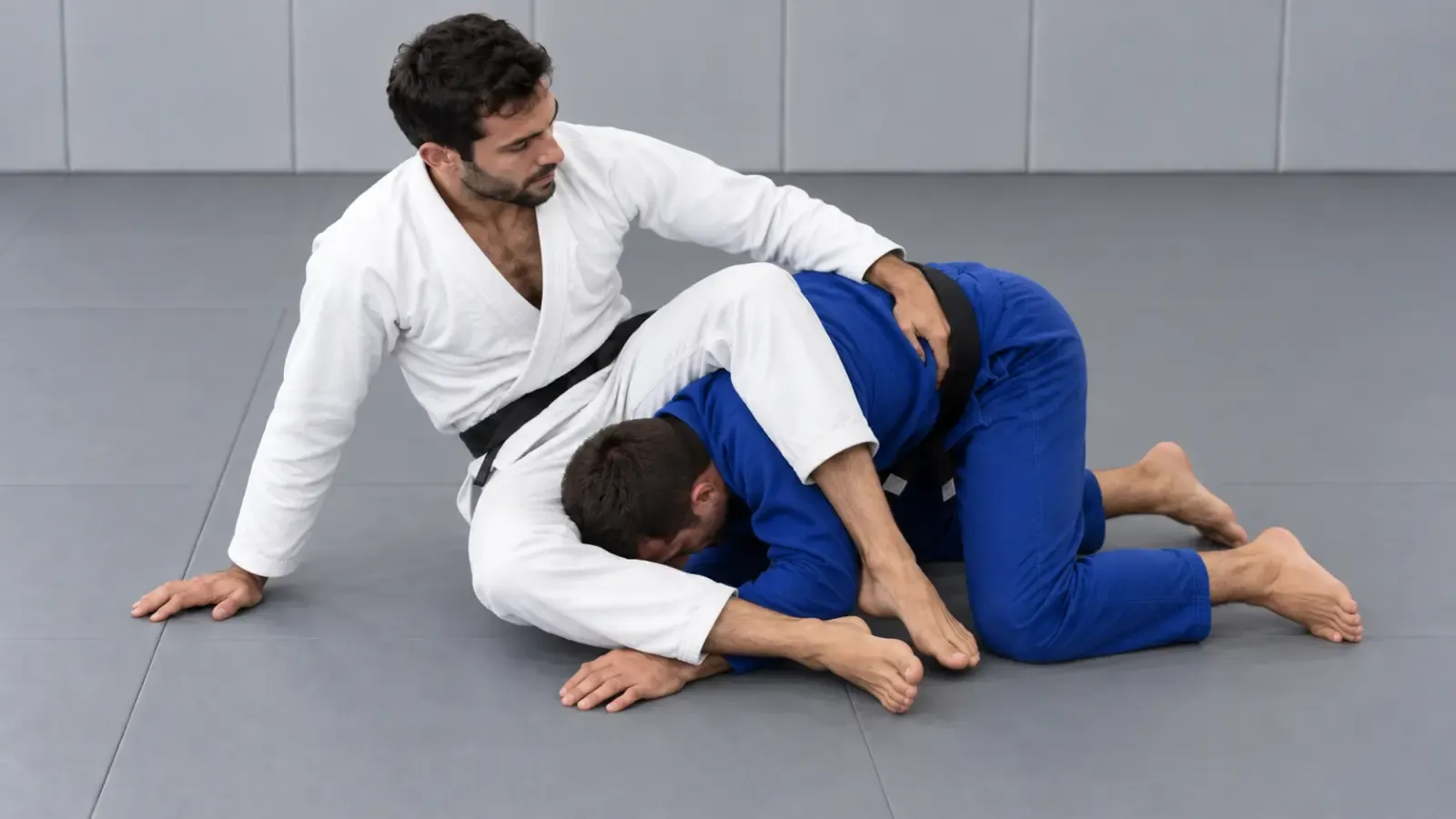
Flat on your back, the opponent simply rolls forward over their own trapped shoulder and comes out the other side. It costs them nothing. Sitting up and reaching across to control their far hip is what removes that escape — you are no longer behind them, you are beside them, and the roll has nowhere to go.
The taxonomy’s own description puts it plainly: sitting up and controlling their hip stops them rolling out, and patience beats speed. It is a position first and a submission second.
The finish
Once the hip is controlled and they cannot roll, the finish is a slow rotation. Lean your weight towards their head while keeping the arm trapped behind them; the shoulder is already loaded and very little movement is needed.
Go gradually. This is a shoulder, and a shoulder reaches its limit sooner and with less warning than an elbow.
When they defend
A defended omoplata is rarely wasted, and this is the real argument for it.
- They roll forward. The classic escape. If you have the hip, it is unavailable; if you do not, you can often follow them and take the position again on the other side.
- They posture up and drive forward. Now their base is committed forward and the omoplata sweep is there — this library records the submission and the sweep as interchangeable for exactly that reason, and the taxonomy’s note is that their defence to one gives you the other.
- They straighten the arm. A straight arm is not an omoplata. It is often an armbar or a triangle instead, both of which come from the same guard and the same trapped-arm configuration.
Treating the four as one system — omoplata, omoplata sweep, armbar, triangle — is what turns a low-percentage submission into a high-percentage position.
Common mistakes
- Staying flat. They roll out. This is the one.
- No hip control. Same result, one beat later.
- The arm is beside them rather than behind. No rotation available.
- Rushing the finish. An omoplata forced before the position is settled is an omoplata they roll out of, and you usually lose the guard doing it.
- Losing the leg off the shoulder. Triangle the legs, or at minimum cross the ankles.
How to drill it
Drill the position, not the finish. Enter the omoplata, sit up, take the hip, and simply hold it against a partner instructed to try to roll out. That is where the technique is won or lost, and most people have never practised it.
Then drill the fork: partner rolls, you follow; partner postures, you sweep. Both answers from one entry.
Only then drill the finish, and drill it slowly.
Gi and no-gi
Both, with a real difference in difficulty.
In the gi, friction helps enormously — a trapped sleeve stays trapped, and the jacket gives you grips to control the hip and to stop them sliding the arm free. The omoplata is a high-percentage gi attack.
In no-gi, a sweaty arm slides out of the leg triangle much more easily, and the roll-out escape is faster. The compensation is that the sweep half becomes proportionally more valuable, and many no-gi players use the omoplata primarily as a sweeping and transitional threat.
A submission that turns into a sweep once the jacket is gone is a neat example of how the two rulesets reshape the same technique.
Safety
A shoulder lock, and shoulders have less travel available than people expect.
Apply the rotation gradually rather than dropping your weight suddenly, and release the moment your partner taps. Do not add a lean at the end to “make sure”. If you are on the receiving end, tap on shoulder pressure rather than waiting for pain in the elbow — they are different joints and the shoulder is the one at risk here.
Always ask your coach or instructor to check your technique and practise safely at your academy.
Shoulder locks give little warning, so tap at the first sign of rotation rather than testing the range.
Common questions
What is an omoplata? A shoulder lock applied with the legs from guard: your leg goes over the opponent’s shoulder and their arm is rotated behind their back.
Why does my opponent always roll out of it? Because you are still flat on your back. Sitting up and controlling their far hip is what removes the forward roll.
Is the omoplata a submission or a sweep? Both, and that is the point. Their defence to the shoulder lock generally hands you the sweep, and vice versa.
Omoplata or kimura? The same shoulder rotated the same direction — the kimura uses two arms, the omoplata uses your legs and hips. Which is available depends on where their arm is and whether you have a leg free.
How well does the omoplata work in no-gi? Yes, but it is harder to hold. Without sleeve friction the arm slides out more easily, so most no-gi players lean on the sweep and transition threats more than the finish.
Where can I attack it from? This model records closed guard, supine open guard and S-mount. In practice any guard where you can get a leg over a reaching arm will do.