
Grips and control
Body Triangle
From the back, the legs form a triangle around the opponent's torso instead of hooking inside their thighs. Less work to hold, much harder to shake off, and not free.
Hooks tire you out and can be peeled one at a time; a body triangle does neither. From back control, instead of putting a foot inside each of their thighs, you cross one leg over the other and lock it behind their far knee, forming a closed triangle around their torso. The hold gets tighter, the effort drops, and your arms are freed up to work. It is the reason high-level back control often looks like somebody resting.
How it is formed
From back control with your hooks in, take the leg on their weaker side — usually the side away from your choking arm — and bring it across their stomach. Your other leg then folds over the instep of that first foot, tucking behind the knee, and the triangle closes.
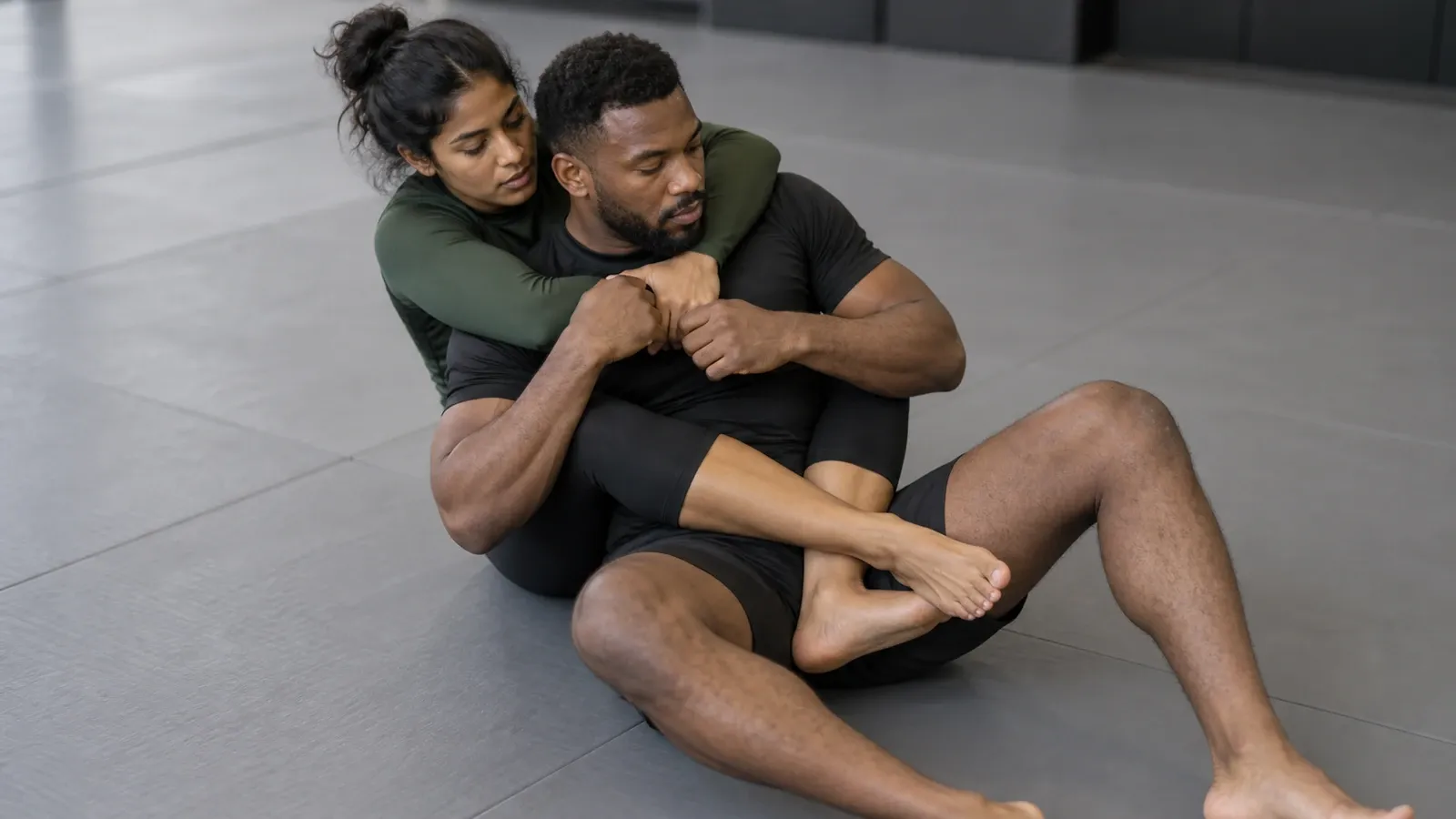
The lock sits on their hip bone or just above it, not on their ribs or their floating ribs, and certainly not on their stomach when you are squeezing hard. Where exactly it sits is the difference between a control and something that hurts your partner for no positional gain.
Why it holds better than hooks
Nothing to peel. A hook is a foot resting inside a thigh, and a defender’s hand can strip it. A closed triangle has no free end — to remove it they have to break the lock itself, which is a much larger job.
It survives rotation. When a defender turns towards you, hooks come out. A triangle stays on, and you rotate with them.
It costs almost nothing to hold. This is the practical argument. Hooks require constant active tension; a triangle is a mechanical lock. Over a long round that difference is enormous, and it is one of the clearest examples of the point technique against strength makes — the better hold is the one that lets you stop working.
Your arms are free. Because the legs are doing the retention on their own, both hands can fight for the collar, the neck or the wrist without the position loosening.
The trade
It is not strictly better, and pretending otherwise gets people stuck.
You lose mobility. Once the triangle is locked, transitioning is slow. If they turn in towards you and start coming to top position, you cannot simply unhook and re-adjust; you have to break the lock first, and that takes a beat you may not have.
It has a side. A body triangle commits you to one side. If their escape develops towards the other one, you are answering it from the wrong place.
It can be walked into. A defender who works towards the open side of the triangle — the side where your feet are, rather than your knee — has more room than they do against hooks.
So the usual advice is sound: learn hooks first, use the triangle when the position is already settled, and do not lock it while you are still fighting to arrive.
What it works with
The body triangle is the legs half of back control. The arms half is the seatbelt, and they are meant to be used together — the harness keeps you attached during the scramble, the triangle keeps you attached afterwards.
With both in place, the rear naked choke becomes a patience exercise rather than a race, which is the point. Nothing about the triangle finishes a fight. It buys the time in which a finish becomes inevitable, and that sequencing is control first, finish second in its most literal form.
Common mistakes
- Locking it too early, before the back is actually controlled, so the whole thing gets rolled over as one unit.
- Squeezing the ribs to make it work. Discomfort is not control, and rib pressure is where training injuries come from here.
- Crossing the ankles instead of triangling. A crossed-ankle lock is weaker and, in many rulesets, exposes you to a foot attack.
- Choosing the wrong side. The triangle should go on the side that leaves your choking arm over their shoulder, not the side that happens to be convenient.
- Treating it as an escape-proof position. Nothing is. Good defenders work towards your feet and towards the mat, and you still have to fight the back escape.
How to practise it
Switch between hooks and the triangle, in both directions, with a passive partner. The entry is the part that goes wrong under pressure, so make it automatic before adding resistance.
Then hold it for time against escape attempts, no submissions permitted. You will find out very quickly whether your lock is on the hip or drifting up the ribs, and whether you chose the right side.
Then defend it, so you learn where the openings are. Most people only understand why the open side matters after spending a few rounds escaping through it.
Safety
The hold itself is positional, but the legs of an adult can generate a great deal of compression around a torso, and the person inside it is often more uncomfortable than they let on.
Keep the lock on the hips rather than the ribcage, and squeeze progressively rather than clamping. Ribs and the lower back are the two places this goes wrong. If a partner taps to the pressure alone, that is a legitimate tap and the right response is to release immediately rather than to argue that it is not a submission. Breathing is genuinely restricted in a tight body triangle, so do not hold somebody in one while they are trying to communicate.
Always ask your coach or instructor to check your technique and practise safely at your academy.
Common questions
What is a body triangle in Brazilian Jiu Jitsu? A back-control hold where your legs form a closed triangle around the opponent’s torso — one leg across the body, the other folded over its instep behind the knee — instead of hooking inside their thighs.
Is a body triangle better than hooks? It is tighter and much less tiring, and it survives rotation that would strip hooks. The trade is mobility and a committed side, so it suits a settled position rather than a live scramble.
Where should the lock sit? On or just above the hip bone. On the ribs it becomes uncomfortable for the wrong reasons and is easier to work against.
Which side should I put it on? The side that keeps your choking arm over their shoulder, so the finish stays one movement away.
Can a body triangle hurt my training partner? It can. Squeezed hard on the ribs or held while somebody is trying to breathe, it is genuinely painful. Keep it on the hips, apply it progressively, and release on a tap.
Should beginners use it? Learn hooks first. The triangle is worth adding once you can already keep the back, because locking it early tends to trade a live position for a stuck one.