
Submissions
Baseball Bat Choke
Two hands on one collar, held like a bat — and one of the most common ways knee on belly turns into a finish.
The grips go on while they are worrying about something else. That is the baseball bat choke’s real weapon. From knee on belly or side control the opponent is occupied with the pressure, the position and the escape, and two hands settling onto one collar does not read as an emergency until the choke is already there.
The name is the grip: both hands on the same collar, thumbs pointing in opposite directions, the way you would hold a bat.
Where it comes from
Two positions in this model: side control top and knee on belly top.
Knee on belly is the classic. The taxonomy’s own note is that this is one of the most common ways knee on belly turns into a submission, and the reason is exactly the camouflage above — the defender’s attention is on the knee, not the hands.
The grips
This is where the technique lives, and it is worth being precise:
First hand: deep in the collar, thumb inside, taken early. As with every gi choke, depth cannot be added later — see the cross collar choke for the longer version of that point.
Second hand: on the same collar, below the first, with the thumb pointing the other way — usually four fingers inside. The two hands now oppose each other, which is what makes the grip behave like a lever rather than a squeeze.
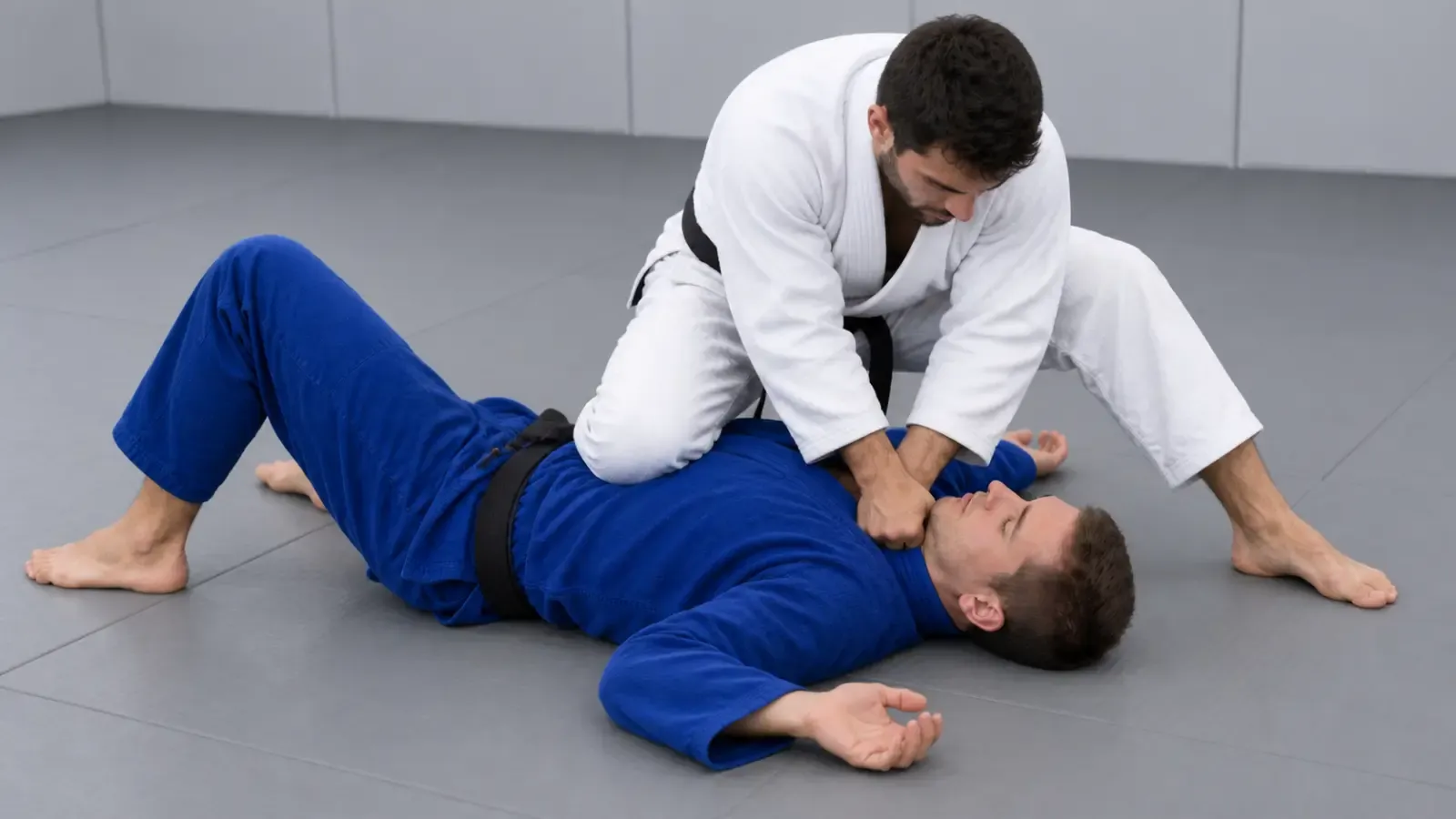
Most people take the first grip while establishing side control and the second as they step into knee on belly. Taking both at once is slower and much more obvious.
The finish
Not a squeeze. A turn.
You step over or spin towards their head — depending on the variation — and drop your weight, so that your own bodyweight and rotation tighten the collar against both sides of their neck. The classic finish takes you into a north–south or a reverse position, chest towards the mat.
The taxonomy’s description is the useful summary: the finish comes from turning your body and dropping your weight rather than from squeezing the hands. If your forearms are burning, you are doing the wrong thing.
Why it fails
- The first grip was shallow. Unrecoverable, as always with collar chokes.
- Both thumbs the same way. That is a different grip and does not produce the same lever.
- You squeezed instead of turning. The most common error, and the one that makes people think the technique does not work.
- You telegraphed the second grip. Reaching across obviously gives them a beat to defend.
- You lost the position while turning. The spin is the moment the pin is loosest; a defender who feels it can sometimes escape into the space rather than being choked.
- You went too early from side control. It is available there, but knee on belly generally gives a better angle.
How it is defended
Prevent the second grip. A defender who notices two hands arriving on one collar has a narrow window to strip one of them, and once both are set with the attacker turning, the choke is difficult to stop.
Beyond that: chin down, hands fighting the grips rather than the arms, and escaping the underlying position early rather than waiting to see what the hands are doing. Knee on belly escapes — framing on the knee, shrimping away — are the real defence, because they remove the platform the choke is built from.
Where it fits
The baseball bat choke is one of the reasons knee on belly is more than a scoring position. It gives the top player a genuine finishing threat from a place the defender wants to escape quickly, which makes their escape rushed.
It sits alongside the other gi chokes in this library and reuses the same first skill — a deep collar grip — as the cross collar, the bow and arrow and the sliding collar. If you already take a good collar grip, most of this technique is available to you.
Gi and no-gi
Gi only, and this model records it as such. The technique is a collar lever; there is no no-gi version, and the no-gi finishes from knee on belly are a different family entirely.
Techniques that exist in only one of the two rulesets are worth knowing about before you decide where your training time goes; gi and no-gi compared covers what else falls on each side.
How to drill it
Drill the grip sequence first, with no finish: from side control, take a deep collar grip, step to knee on belly, and add the second hand — repeatedly, against a partner who is defending the position rather than the choke. If you cannot get both hands on without announcing it, the finish is academic.
Then drill the turn slowly, with a cooperative partner, paying attention to where your weight goes. This one genuinely feels wrong until it suddenly works.
A technique that feels wrong until it suddenly works is the clearest case there is for drilling it before you try it live.
Safety
A blood choke that arrives quickly and, because of the camouflage, sometimes without the defender realising how close it is.
Turn gradually rather than dropping your weight all at once, and release immediately on the tap. Be aware that during the finish your partner may be face-down or have limited ability to signal — watch for a hand on the mat and stop at any sign. Tap early yourself; this is not a choke to test.
Always ask your coach or instructor to check your technique and practise safely at your academy.
As with any choke, tap as soon as you know it is on rather than when it starts to work.
Common questions
What is a baseball bat choke? A gi choke with both hands on the same collar, thumbs opposing, held like a baseball bat. It is usually attacked from knee on belly or side control.
Why is it called that? Because of the grip: two hands on one collar in opposite directions, the way you hold a bat.
How do you finish it? By turning your body and dropping your weight, not by squeezing. If your arms are working hard, the mechanics are wrong.
Where should the second hand go? On the same collar as the first, below it, with the thumb pointing the opposite way.
Is there a no-gi baseball bat choke? No. It is a collar technique and needs the jacket.
Why did my opponent escape before I finished? Most likely the turn — the spin is the loosest moment of the position, and a defender who feels it can sometimes move into the space instead of being choked. Settle the grips first.