
Escapes
Armbar Escape
Turn the thumb up, take the elbow to the safe side, join your hands and stack. The escape is a race that is won or lost in about a second, and pulling backwards loses it.
An armbar escape is a race, and almost everybody loses it by running in the wrong direction. The instinct when somebody isolates your arm is to pull it straight back out. That is precisely the line the joint opens along, so pulling feeds the submission rather than escaping it. The arm is saved by turning it and by getting your hands joined before your elbow crosses their centre line — after that, the technique is stacking.
The race, stated plainly
Get your hands connected before your elbow passes their centre line.
That is the whole early escape in one sentence. Their job is to isolate one arm and extend it past their own hips; yours is to make that arm into two arms before it gets there. Once your hands are joined — hand to wrist, hand to biceps, palm to palm, whichever you can reach — they are no longer extending one limb, they are extending your whole upper body, and that is a much bigger job.
If you are already late, everything below still applies but the margin shrinks quickly.
Turning the arm, not pulling it
The elbow joint bends one way. An armbar works by straightening it against that direction, so what matters is which way your arm is rotated when the pressure arrives.
- Thumb up. Rotate so your thumb points towards the ceiling — towards their far side. This is the classic “hide the thumb” cue, and it turns the joint away from the line of the break.
- Elbow in. Drive the point of your elbow towards your own body and to the safe side, not backwards.
- Then connect. Grab your own belt, your own lapel, your other wrist, their leg — anything that makes your hands one unit.
Pulling straight back does the opposite of all three: it keeps the thumb neutral, leaves the elbow exposed on the line of extension, and uses the arm alone.
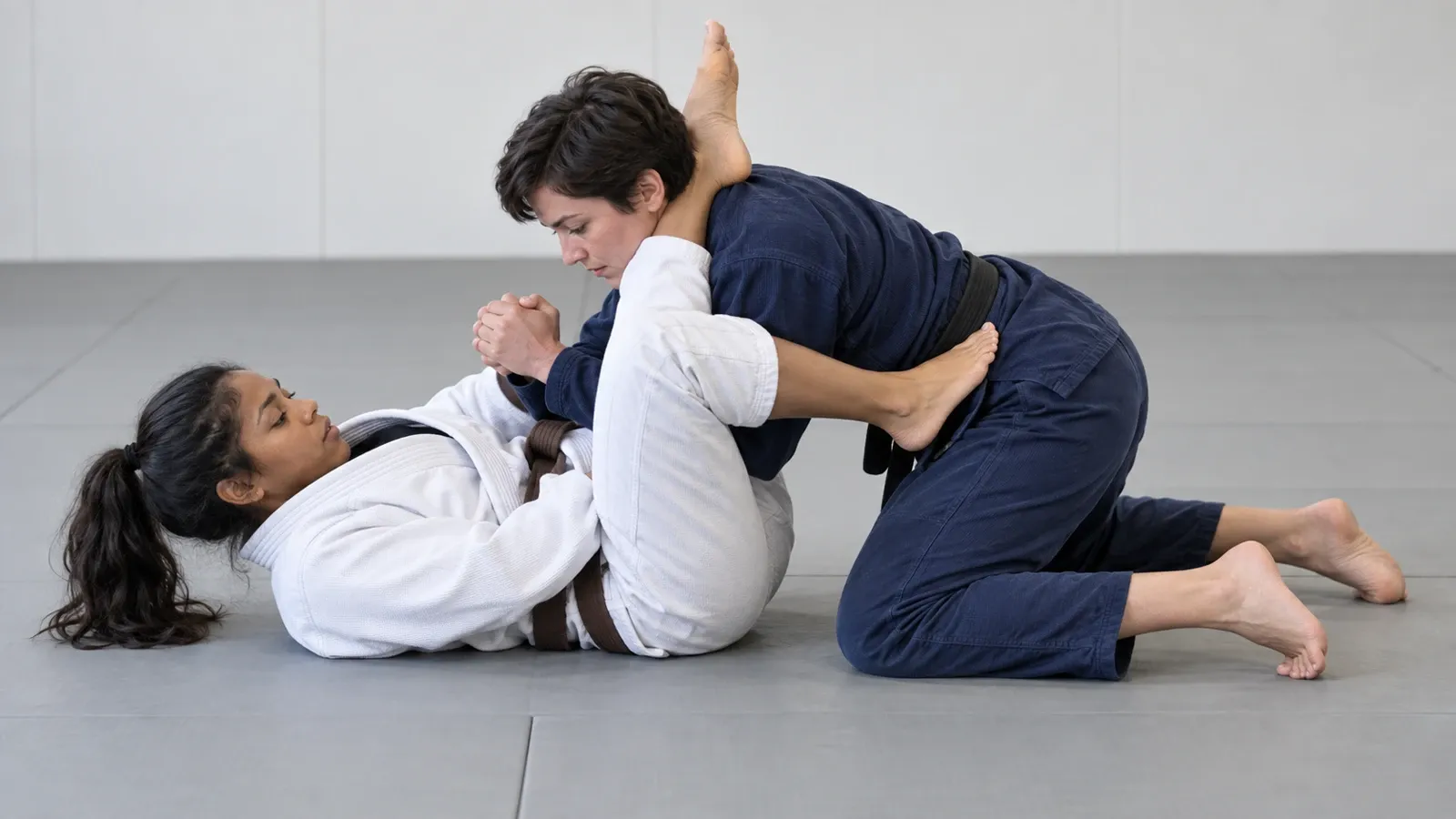
Stacking
Once the hands are joined, the position becomes about angle rather than strength.
Walk your hips forward and drive your weight over their hips, folding them up so their shoulders take their own weight. Stacked, they cannot extend their hips, and an armbar without hip extension is a hold rather than a finish. From there you work the trapped arm free — usually by circling towards the side their leg is crossing your face — and the pass is often available on the way out, because the leg that was over your head has to go somewhere.
That last point matters. A well-defended armbar does not end in a stalemate; it ends with you passing as they lose the leg. Treating the escape as the end of the sequence gives away the best part of it.
Why it goes wrong
- Pulling the arm straight out. The defining error, and the reason most people’s first hundred armbar escapes fail.
- Waiting for the finish to start defending. The escape is cheap before the arm is isolated and expensive afterwards.
- Joining hands with straight arms. A connection you cannot hold under load is not a connection. Bend the elbows and clamp them to your body.
- Standing up without stacking. Standing while they are still attached takes you into a drop-armbar rather than out of one.
- Turning towards the free side. You want to turn towards the trapped arm, not away from it.
- Forgetting it is time-limited. Every second spent in a locked armbar is a second closer to something giving.
Where it belongs in your defence
Armbars come from everywhere — closed guard, mount, technical mount, the back — which makes this one of the escapes worth drilling early rather than when you get caught. Elbows tight to the body, and not offering a straight arm in the first place, is the prevention half; this page is the cure half.
It sits alongside the other defensive fundamentals — the bridge, the hip escape and framing — in the set of things that stop your rounds being spent underneath, which is most of what to focus on as a white belt.
Drilling it
From the isolated arm, before the finish. Partner has your arm, hips not yet extended, and you work the thumb, the elbow and the hands. Ten each side. This is the version you will actually use.
Then from a finished armbar at low intensity, working the stack and the walk-out. Do this slowly and cooperatively — a fully applied armbar escaped at full speed is how elbows get hurt in training, and the drill teaches nothing extra for the risk.
Then live, from a guard-passing start, where the real skill is recognising the arm being isolated two seconds before the leg comes over. That recognition is what separates people who escape armbars from people who explain how they would have.
Safety
Of everything in this batch, this is the technique where the drilling itself needs the most care.
The elbow is a hinge with very little warning before damage, and escape practice by definition involves somebody’s arm being in a submission. Drill escapes from positions that are not yet finished, keep the intensity low when the arm is straight, and never race an escape against a partner applying real pressure — the correct response to a finished armbar in training is to tap and reset, not to prove a point. If you are the one attacking, apply gradually and release the instant they tap or say stop, and never add a jerk at the end. When to tap covers the judgement, and armbars are one of the submissions it exists for.
Always ask your coach or instructor to check your technique and practise safely at your academy.
Common questions
How do I escape an armbar? Turn your thumb towards the ceiling, drive your elbow to the safe side, join your hands so the arm is not alone, then stack your weight over their hips to take away their extension.
Why does pulling my arm out not work? Because the joint opens along that exact line. Pulling straight back gives the armbar the direction it wants; turning the arm takes it away.
What does “hide the thumb” mean? Rotate the arm so the thumb points up rather than out to the side. It turns the elbow away from the line the submission extends along.
Is it too late once they have the leg over my head? Not necessarily, but the margin is small. Join your hands first and stack — and if the hips are already extended and something is being loaded, tap.
What should I do after escaping? Keep going into the pass. Their leg has to leave your head, and the position they are left in is usually one you can pass immediately.
Should I practise escaping fully locked armbars? Only slowly and cooperatively. Racing an escape against a properly applied armbar is one of the more reliable ways to injure an elbow in training.