
Submissions
Kimura
A shoulder lock that rotates the arm behind the opponent's back, and one of the few attacks that is genuinely useful even when it does not finish.
Most submissions are either on or off. The kimura is a position you can hold. That is the reason it occupies so much space in the modern game: a figure-four grip on someone’s arm controls their posture, their ability to turn, and their ability to post — and a finish is one of several things you can do from there, not the only one.
It is named after Masahiko Kimura, the judoka who broke Hélio Gracie’s arm with it in 1951. In judo it is gyaku ude-garami, a reverse entangled armlock.
What it attacks
The kimura rotates the shoulder internally — the arm is bent at ninety degrees and turned behind their back, in the direction a shoulder is least able to travel. The elbow is involved but the shoulder is the joint at risk, which is why the break can arrive with less warning than an armbar and why control of the tempo matters.
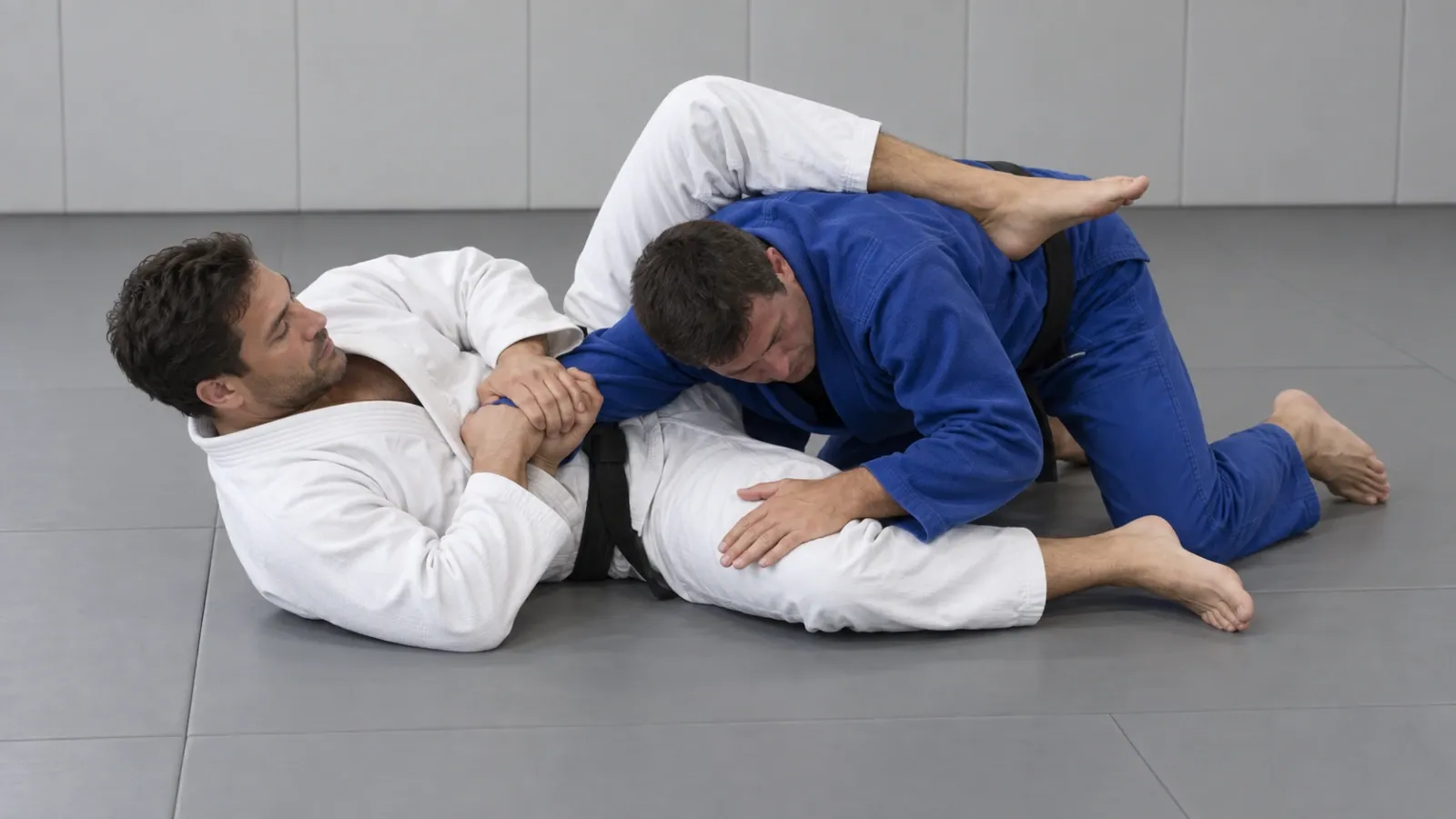
The grip is a figure four: one of your hands holds their wrist, your other arm threads under their arm and grips your own wrist. That structure is why it is so strong. You are using two arms and the mechanical advantage of a closed loop against one arm and one shoulder.
Where it is available
This model records it from four positions: closed guard, half guard top, side control top, and knee shield half guard. In practice it appears wherever an arm is loose and reachable, including north–south and against a turtled opponent — the figure four is a grip, and grips travel.
The two you meet first are opposite sides of the same problem:
- From closed guard (bottom). They post a hand on the mat beside your hip; you sit up, grab the wrist, thread the second arm and lock. Their posted arm is the invitation.
- From side control (top). Their far arm is bent and away from their body, and you trap it against the mat before threading through.
Making the break
The mechanical requirements are short and unforgiving.
Move their elbow away from their body. This is the whole thing. A kimura on an arm that is pinned to the ribs is a strong grip and nothing more — there is no rotation available. Dragging the elbow away from their torso is what creates the angle the shoulder actually has to resist.
Keep the arm bent. A straightening arm has escaped. If they manage to extend, the figure four loses its leverage and you are holding a straight arm you cannot rotate.
Control the rest of them. From the top that means their body cannot follow their arm; from guard it usually means a leg over their back so they cannot roll away from the pressure.
Then the finish is a slow rotation of their hand towards their own head, or towards their far hip, depending on which version you were taught and which way the arm is already pointing. Do it gradually. Shoulders do not have much travel available, and there is little warning before the capsule is at risk.
Why it is a control as much as a finish
Once the figure four is locked, the opponent has a very narrow set of options, and you know most of them in advance. That predictability is worth more than the finish in many exchanges:
- From guard, a defending opponent who posts to stop the rotation is offering the hip bump sweep — this library records the two as a combination, and the taxonomy’s own note is that posting to defend one hands you the arm for the other.
- From the top, an opponent who rolls to relieve the shoulder pressure is giving you the back, or the far side.
- Holding the grip prevents them from framing, posting or turning in, which makes it a way to hold a position while you decide what to do.
This is why experienced players often take the grip with no intention of finishing.
Kimura and americana
They are the same figure-four grip on the same shoulder, rotated in opposite directions, and the choice is decided by where the elbow is already pointing:
- Kimura — hand rotates behind them, towards their back and head. Taken when the arm is bent with the hand towards their hips, or when you can move it there.
- Americana — hand rotates towards their feet, the elbow stays pinned to the mat. Taken from the top when the arm is already bent with the hand up near their head.
Learning them as one grip with two directions is faster than learning them as two techniques, and it means you stop forcing whichever one you happened to be taught first.
Defending it
The kimura escape recorded here has one priority above all: do not let the elbow leave your body. Keeping the arm glued to your own ribs denies the rotation, and everything else follows from that. The common defences are to grip your own belt or shorts with the trapped hand, to straighten the arm, or to turn into them and follow the direction of the rotation so it never loads.
Turning away is the classic error. It hands them the exact rotation the submission is built on.
Drilling it
Two things reward drilling separately.
The grip itself, against progressive resistance, with no finish. Learn to take and hold the figure four while a partner tries to strip it — that is the skill the position rests on.
The same grip also traps a hand, which is why a wrist lock is so often available from it without any extra setup.
The transitions out of it, because a kimura grip that goes nowhere is a stalemate. Practise going from the grip to the sweep, to the back, and to the switch when they defend. The grip’s value is in what it forces, and you only get that value if you know the follow-ups.
A grip whose value is in what it forces is a good example of how positions connect, which is the subject of building a game rather than collecting techniques.
Gi and no-gi
Unusually indifferent to the jacket. Both hands grip you rather than any clothing, so the lock itself is identical. The difference is entry: sweat makes a bent arm harder to trap in no-gi, where gi grips give you a sleeve to control the wrist before threading through. The kimura’s popularity in no-gi is partly because so many other grips are unavailable there and this one never was.
Being indifferent to the jacket is unusual enough to be worth noting against everything that is not.
Safety
A shoulder lock reaches its limit sooner than most people expect and without a long warning. Rotate slowly, stop the moment your partner taps, and do not add a jerk at the end to “finish it properly”. If you are defending, tap on the shoulder rather than on the pain in the elbow — the two are not the same joint and the shoulder is the one at risk.
A shoulder lock reaching its limit without a long warning is precisely the case made in tapping to the position rather than the pain.
Common questions
Is the kimura only a submission? No. It is as much a control as a finish, and many players take the grip to hold posture and force a reaction rather than to tap anybody.
How is it used as a control? The figure four prevents the opponent from posting, framing or turning away, and it narrows their options to a predictable few — which makes it a platform for sweeps, back takes and passes.
Kimura or americana? Same grip, opposite rotation. Kimura sends the hand behind them, americana sends it towards their feet. Which is available depends on where the elbow is already pointing.
Where can you attack it from? This model records closed guard, top half guard, top side control and knee shield half guard; in practice it also shows up in north–south and against turtle.
Why can I not finish my kimura? Almost always because their elbow is still against their ribs. Without moving the elbow away from their body there is no rotation to apply.
How do you escape a kimura? Keep the elbow glued to your body, grip your own belt or shorts, and turn towards them rather than away. Turning away supplies the rotation the lock needs.
Practise one defined version
For assigned hand positions, a closed-guard entry and staged control-to-finish repetitions, use the closed-guard kimura training guide.