
Submissions
Rear Naked Choke
The highest-percentage finish in grappling, and the reason back control is the position everything else is trying to reach.
The rear naked choke is the only submission in Brazilian Jiu Jitsu that requires nothing at all — no jacket, no grips, no equipment, and an opponent who cannot see what you are doing. That is why it finishes more often than anything else in the sport, and why the position it comes from is treated as the top of the positional hierarchy.
“Naked” means ungripped: unlike a collar choke, it uses no clothing. The Japanese name is hadaka jime, which means the same thing.
Where it comes from
There is exactly one place: back control. This model records no other source, and that is not an omission — the choke needs to be behind them, with your chest on their back and your legs or hooks controlling their hips.
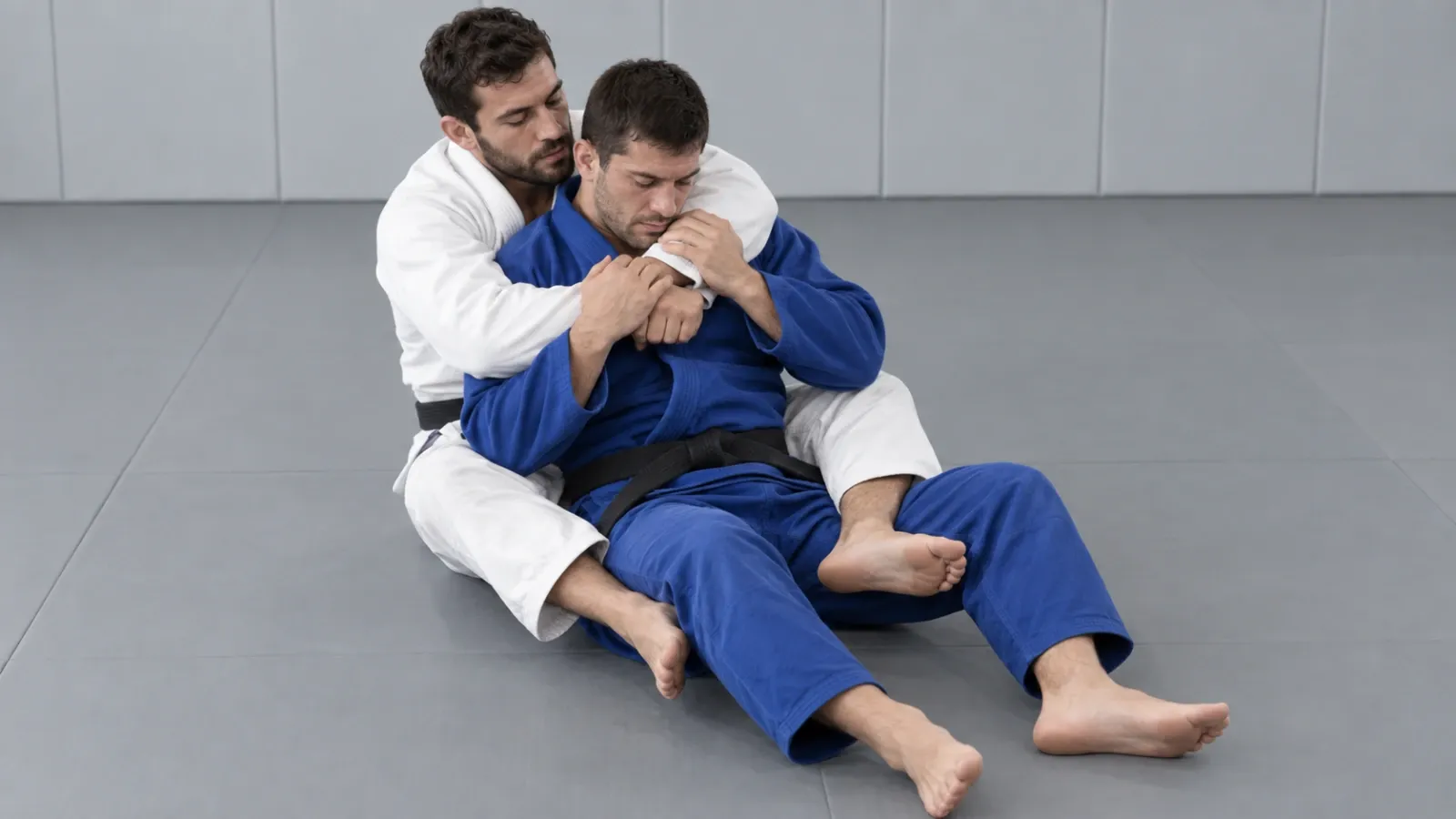
That makes the rear naked choke unusual among submissions. Most are a question of recognising an opening. This one is a question of getting to a position, after which the finish is comparatively straightforward. Everything that makes it high-percentage happens before the arms go anywhere near the neck.
The route in is what this library records as a back take — from mount, from turtle, from half guard, from a front headlock — and the control that holds you there is the seatbelt: one arm over the shoulder, one under the armpit, hands joined, chest glued to their spine.
Arriving at the back before attacking from it is position before submission stated as plainly as the sport ever states it.
How the strangle works
It closes both carotid arteries, one with the bicep and forearm of your choking arm and the other with the bicep of your second arm. It is a blood choke, not an air choke. Done correctly it does not compress the windpipe and does not hurt much — the opponent simply loses consciousness.
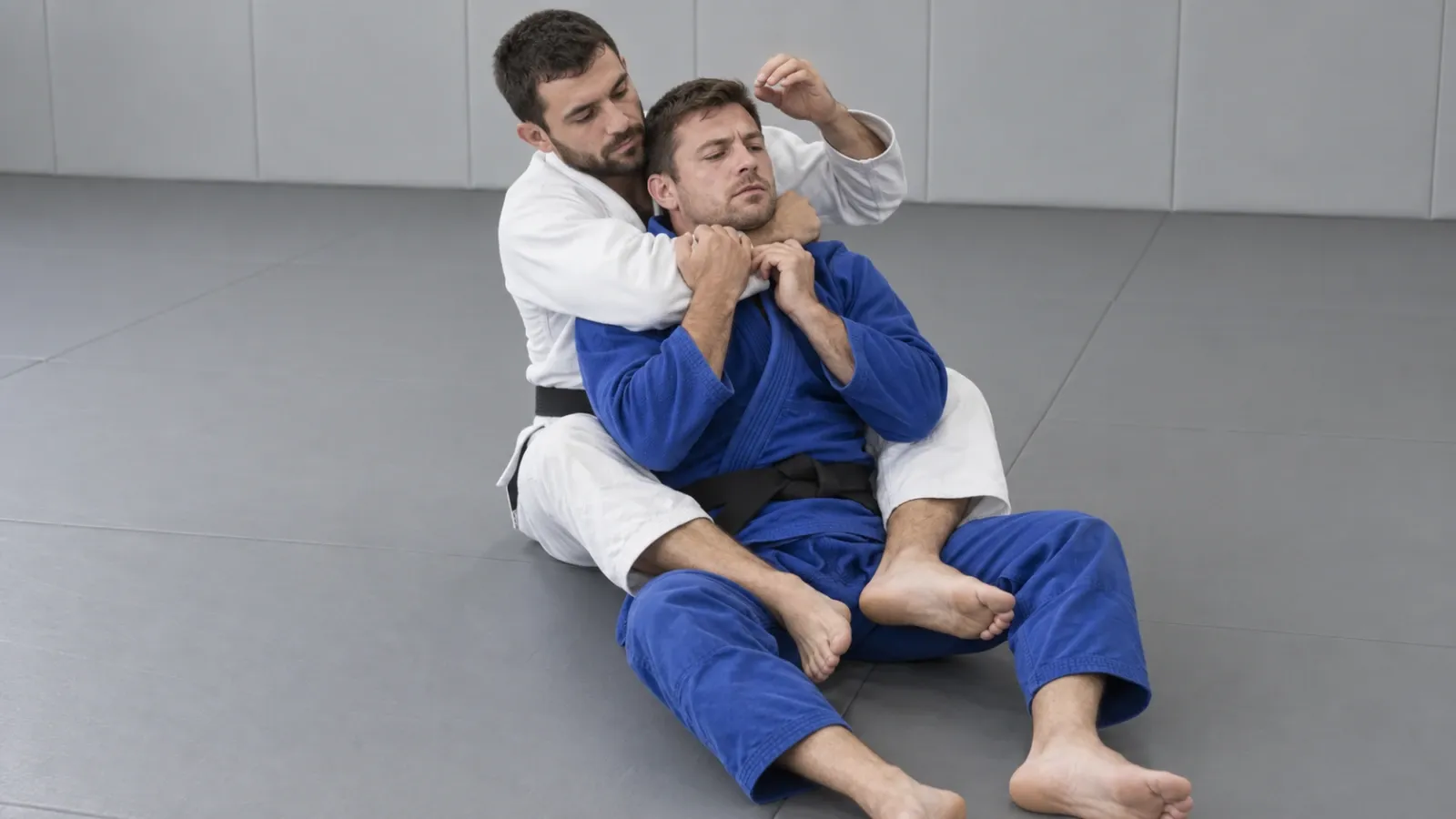
That is the important safety fact about it. A joint lock announces itself with pain and gives a clear signal to tap. A well-placed strangle can be applied with very little discomfort right up until the lights go out.
The mechanical requirements are three:
- The choking arm is deep enough. The crook of your elbow sits under their chin, on their centre line. If your forearm is across the jaw or the mouth, you have a face crank rather than a choke, and it is both less effective and more unpleasant.
- The second arm is behind their head. Your choking hand grips your own bicep, and the second hand goes behind their head, not on top of it. Behind means it can push forward.
- Their back is against your chest. Space between you is the room they need to turn in, and a choke against an opponent who is turning is a choke on nothing.
The two grips
Both are standard, and the choice is usually decided by how much of the neck you managed to get:
Palm-to-bicep. The classic. Choking hand grips your own bicep, second hand behind the head, and you finish by expanding your chest and driving the second hand forwards. Tighter, and the usual first choice.
Gable grip. Palms together, no bicep grip. Used when the choking arm is not deep enough to reach the bicep, often in no-gi where everything is sweating. Less mechanically efficient but available when the classic is not.
There is no need to treat one as correct. They are answers to different amounts of depth.
Why it slips off
- Not deep enough. The most common fault. The elbow is off their centre line, so the forearm is on the jaw. They tuck their chin, turn into the gap and the choke is gone.
- The chin is in the way. A defending opponent tucks their chin hard. Fighting that directly is slow; the usual answers are to use your other hand to pull the head or to attack the chin from the side rather than the front.
- Space between chest and back. Everything gets easier for them. Close the distance before you start reaching.
- Losing the hooks or the body triangle. If your legs stop controlling their hips they can turn, and turning beats any grip you have on the neck.
- Going for the neck too early. The classic beginner error. Reaching for the choke before the seatbelt is settled gives them the arm to fight and the moment to escape. Control first.
Defending it
The defence recorded here is the rear naked choke defence, and its priorities run in order:
- Protect the neck. Two hands on the choking arm, chin tucked hard into your own chest. You cannot escape the position while the choke is being finished — buy time first.
- Fight the hands, not the arm. Peel the grip rather than trying to drag the whole arm out.
- Get the shoulders towards the mat. Slide down and get your back flat; you cannot be choked through the mat.
- Escape the hips last. Only once the neck is safe does the actual back escape begin.
The related entry in this library is the back escape, which takes over once survival is handled. The sequencing matters — beginners reverse it, start escaping the hips, and get choked on the way out.
Safety
Treat this one with more care than any other submission in the library.
Apply it slowly. Release the instant your partner taps, and release if they stop responding at all — a partner who has gone limp is not conceding gracefully. Never hold a strangle “for another second” after a tap. Do not apply it to someone who cannot tap, and do not use it as a way to win a hard roll against a stubborn training partner.
If you are on the receiving end, tap early. There is no lesson in the last two seconds, and going out repeatedly is not part of training.
There is no pain warning before a blood choke works, which is the case that the tap-early rule is built around.
Gi and no-gi
Identical, which is the point of the name. It is the choke that does not care what anybody is wearing, and it is the reason it is equally at home in a gi competition and in grappling with no jacket at all. The only practical difference is grip security: sweat makes the gable grip more common in no-gi.
Being the one technique that does not care what anybody is wearing makes it an obvious place to start if you train both gi and no-gi.
Common questions
Why is the rear naked choke considered the highest-percentage submission? Because it needs no grips, it comes from a position the opponent cannot see, and back control is extremely hard to escape once it is established. The difficulty is getting there, not finishing.
Is it a blood choke or an air choke? A blood choke. Applied correctly it restricts the carotid arteries and should not crush the windpipe. If it hurts a great deal, it is probably on the jaw rather than the neck.
Palm-to-bicep or gable grip? Palm-to-bicep when the arm is deep enough; gable when it is not. They are answers to different amounts of depth rather than competing styles.
Why does my choke keep slipping off? Usually depth. The crook of the elbow needs to be under the chin on their centre line. If the forearm is on the jaw, they can tuck and turn out.
How do you defend the rear naked choke? Chin down, two hands on the choking arm, peel the grip rather than the arm, and get your shoulders to the mat. Escape the position only after the neck is safe.
Can you use it in a gi? Yes. It uses no clothing at all, which is what “naked” refers to, so it works identically in both.