
Submissions

Wrist Lock
Bending or rotating a wrist past its range, available almost anywhere a hand is trapped. Dismissed by beginners, respected permanently after the first one.
Almost every submission requires a position first; the wrist lock barely requires one at all. If a hand is trapped against your body, the mat, or their own gi, the submission is probably available — from mount, from inside somebody’s guard, from side control, from the back, from bottom half guard. That makes it the least positional attack in the sport, and the reason it keeps appearing in places where nothing else would.
The mechanics
A wrist has a limited range in two directions: bending forward and back, and rotating. A wrist lock takes it past one of those limits.
The two you will meet most:
- Flexion, folding the hand towards the inside of the forearm. Their palm is pressed towards their own wrist. This is the version you get when somebody’s hand is flat on your chest or on the mat and you fold it.
- Rotation, twisting the hand out of line with the forearm, usually combined with a little flexion.
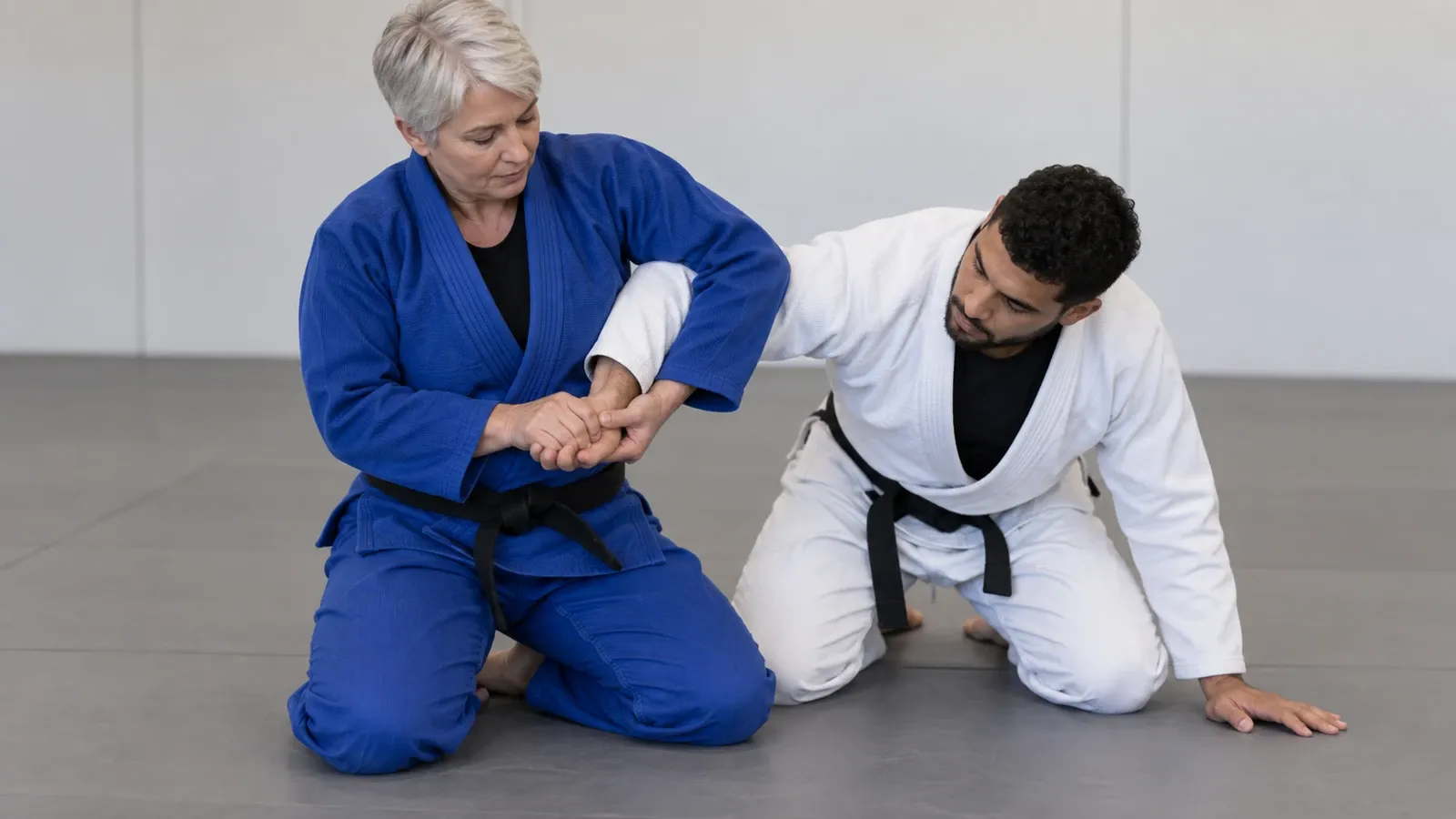
The lever is short. That is the defining property of the whole technique, and everything else on this page follows from it.
Why so little movement finishes it
The elbow and the shoulder are large joints moved by large muscles, and a submission on either requires you to move a whole limb through space. A wrist is small, has almost no muscle protecting it in that direction, and has very little range to give up.
Two consequences:
It finishes from almost nothing. A few degrees of extra rotation, applied to a hand that is already trapped, is enough. People miss them constantly because they are waiting for something that feels like an armbar.
It is very easy to apply too fast. There is no long, slow travel where your partner feels it building. That is why the danger in training is over-rotation rather than failure — which is unusual and worth taking seriously.
Where it turns up
The honest answer is everywhere, but the recurring situations are:
- Somebody posting a hand on you. A hand flat on your chest in guard, or on your hip as they pass, is the most common gift.
- Grip fighting in the gi. A hand gripping your sleeve or lapel is a hand attached to you, and it cannot leave quickly. Gi players meet far more wrist locks than no-gi players for this reason — it is one of the sharper differences described in gi and no-gi.
- Defending other submissions. Somebody stacking out of an armbar, or hiding their hand while defending a choke, is often presenting a trapped wrist.
- From the kimura grip, where the same control that threatens the shoulder also has a wrist inside it.
- Under a cross collar choke, when the defender grabs your wrists and their own wrist becomes available.
Why beginners dismiss it and then stop
Wrist locks have a reputation for being cheap, and the reputation does not survive contact.
The usual arc is that somebody considers them a gimmick, gets caught by one that arrives with no warning at all, and afterwards treats every trapped hand differently. That is a reasonable education to have early, and it is better to have it from a controlled training partner than from a competitor.
It is worth knowing that some gyms discourage them in open rolling, some rulesets restrict them at lower belts, and practice varies widely. Legality and gym etiquette both differ by organisation, belt level and age division, so ask before you start hunting them rather than assuming — and if your academy’s norm is not to use them on white belts, follow it.
Defending them
Keep your hands closed and your wrists straight. An open, flat hand pressed against somebody is the raw material.
Do not post on a person. Post on the mat. A hand on the mat can be pulled away; a hand on a torso is already trapped.
Move the elbow, not the hand. Once one is being applied, taking your elbow away from your own body relieves the angle far more effectively than pulling the hand.
Notice it early. This is the real defence. A wrist lock that you feel is usually already finished, so the useful skill is recognising the hand position that precedes it.
Drilling it
Slowly, and with an agreement. Wrist locks are the one submission where drilling fast is straightforwardly a bad idea. Apply to the first sign of tension and stop there.
From grip-fighting exchanges in the gi, where they occur naturally, rather than from a cooperative isolated setup. The skill is recognition, not application.
Because they arrive with no warning, they are also a good argument for tapping to position rather than to pain — the case when to tap makes.
And from the defensive side, learning what a trapped hand feels like before it becomes a problem. That is the half that actually changes how you roll.
Safety
This is the technique in this batch with the smallest margin for error, and it deserves reading carefully.
The danger is over-rotation, not failure. A wrist has very little range and almost no warning before damage. Apply with a few degrees of movement, not with a pull, and stop the moment your partner taps or their hand stiffens. Never snap, never add a final twist, and never apply one to a partner who cannot see it coming while they are focused on something else.
Tap early if you are caught — there is no heroic escape from a wrist lock, and a damaged wrist stops you training and also stops you typing, driving and carrying things. If your gym restricts them, respect the restriction: the norm exists because these hurt people in ways that are slow to heal.
Always ask your coach or instructor to check your technique and practise safely at your academy.
Common questions
What is a wrist lock in Brazilian Jiu Jitsu? A submission that bends or rotates the opponent’s wrist past its natural range, available from almost any position where their hand is trapped against you, the mat or their own clothing.
Why are wrist locks available from so many positions? Because they do not need a dominant position — only a trapped hand. That is what makes them the least positional submission in the library.
Are wrist locks dangerous? They have a very short range and give little warning, so they are easy to apply too quickly. Applied slowly and released on the tap they are no more dangerous than anything else; rushed, they injure.
Are wrist locks legal in competition? In many rulesets for adults, yes, but restrictions vary by organisation, belt level and age division — they are commonly banned at white belt. Check the rules you are competing under.
Why did I not feel the wrist lock coming? Because almost no movement is needed to finish one. Unlike an armbar there is no long extension phase, which is exactly why they surprise people.
How do I stop giving up wrist locks? Keep your wrists straight and your hands closed, post on the mat rather than on your partner, and pay attention to where your hands are while you are busy defending something else.