
Submissions

Cross Collar Choke
Usually the first gi choke anybody is taught, and one of the few beginner techniques that is still finishing people at black belt.
Almost every failed cross collar choke failed at the first grip, several seconds before anybody noticed. Depth cannot be added later. If your first hand is shallow, no amount of squeezing, adjusting or second-hand technique will rescue it — and that single fact explains most of what is taught about this choke.
It is a gi technique: both hands grip deep in the opponent’s collar, thumbs inside, and the elbows close to strangle the carotid arteries on both sides.
Where it comes from
Two positions in this model: closed guard bottom and mount top. That pairing is unusual and worth noticing — the same choke, from opposite sides of the same fight.
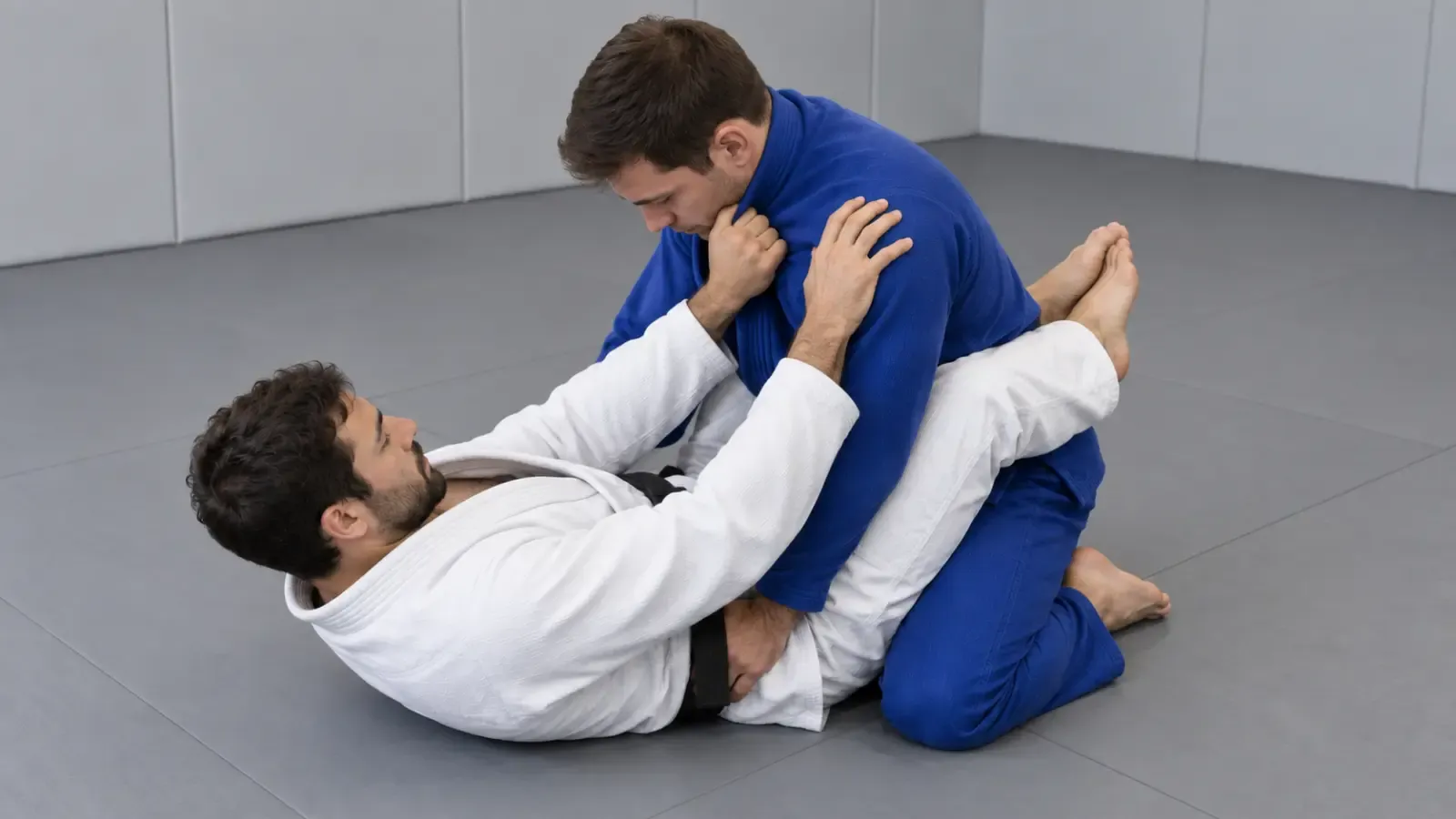
From guard it is an attack you build while they try to posture and pass. From mount it is one of the highest-percentage finishes in the gi, because they have nowhere to go and their hands are busy defending everything else.
The first grip
Reach across and take the collar as deep as you can — behind the neck if possible, thumb inside the collar, four fingers outside. The knuckles of that hand should end up somewhere near the back of their neck rather than near their collarbone.
This is the grip that has to be right. A shallow first grip puts your forearm across their chest instead of their neck, and there is no recovery from it except letting go and starting again.
Take it early, while they are worried about something else. From guard, that usually means taking it before you break their posture, not after.
The second grip and the finish
The second hand comes in under the first, or over it depending on which variation you were taught, and grips the other collar. Both variations are standard.
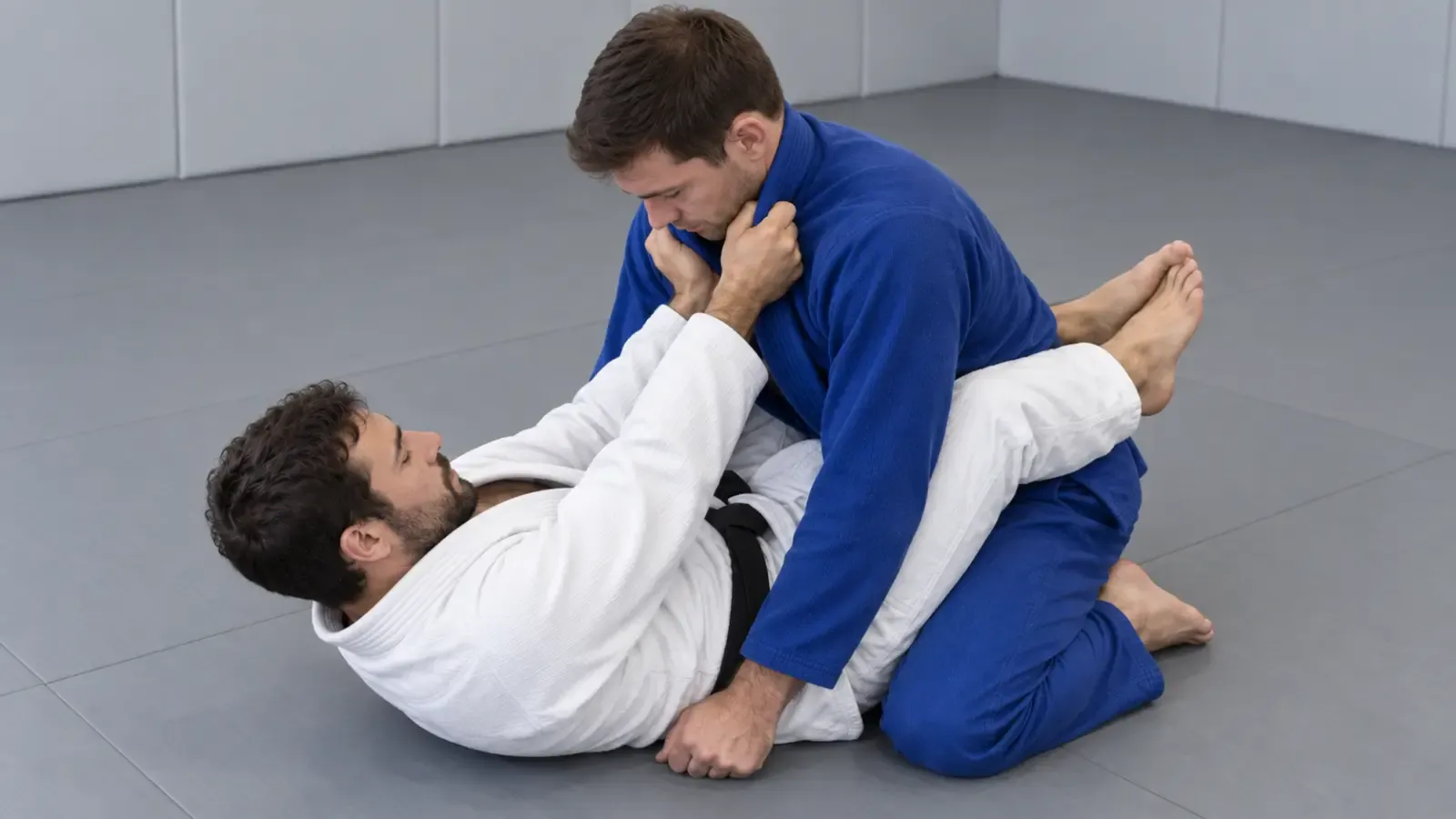
Then the finish, and here is the second thing people get wrong:
Pull them into you. Do not push your arms outward.
The instinct is to force your fists apart, as if prying the collar open. That is weak and it lifts your elbows, which opens the choke. The correct action is closer to a bicep curl into your own chest: draw your elbows down and in, bring their head towards you, and let your forearms do the work against the sides of their neck.
From guard, add your legs — pulling their head down with a broken posture closes the last of the space. From mount, your bodyweight does it.
Why it fails
- The first grip was shallow. The cause of most failures, and unfixable mid-attempt.
- You pushed instead of pulling. Elbows flare, choke opens.
- Your elbows are wide. Wide elbows mean forearms on the jaw rather than the neck.
- You took the second grip too early. Committing both hands before the first is deep leaves you with two bad grips and no free hand.
- You attacked from a posture you had not broken. From guard, an upright opponent has the distance to strip grips at leisure.
- They tucked their chin and turned. The standard defence — see below.
How it is defended
The defences are worth knowing from both sides:
- Chin down, hands fighting the grips. The first line, and the reason depth matters: a deep grip is behind the chin and cannot be blocked by tucking.
- Posture up and away. From guard, standing or posturing out of range makes the choke unavailable. This is why breaking posture is part of the technique rather than a preliminary.
- Turning into the choking arm. Removes the angle.
- Stripping the grip at the wrist or the thumb. Effective if they get to it before the second hand arrives.
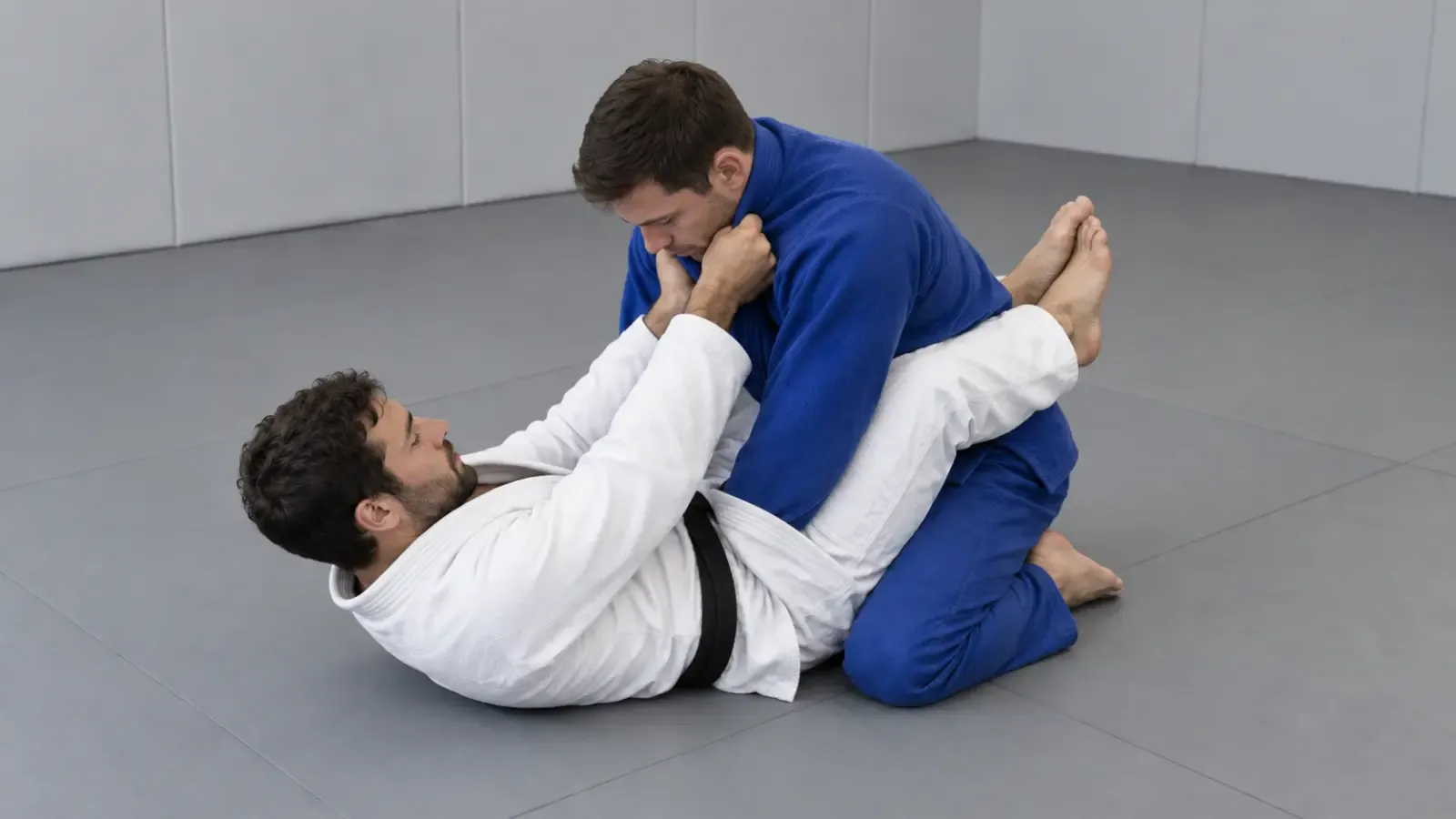
From mount, a defender who successfully strips a cross collar grip has usually created space, which is why the choke pairs so naturally with the americana and with the back take — their defence to one opens another.
Where it fits in a gi game
This is a foundational technique and it stays relevant. It links to the rest of the gi game in several directions:
- From mount, it is the standard finish and the threat that makes other attacks available.
- From closed guard, it pairs with posture-breaking and with the sweeps that punish an opponent who postures up to escape it.
- It belongs to the same family as the other collar chokes in this library — the bow and arrow, the sliding collar, the loop choke — all of which reuse the same first grip.
Learning to take a deep collar grip well is therefore worth more than learning this one choke.
If your week is split between the two, it is worth being deliberate about which half of your game is gi-only and which half travels.
Gi and no-gi
Gi only. The taxonomy records it as a GI technique and that is not a simplification — the choke is made of the jacket. There is no no-gi equivalent of a collar grip.
The nearest no-gi relatives are different techniques with different mechanics: the arm triangle, the rear naked choke, the darce. If you train both, treat the cross collar choke as part of your gi game rather than as something to translate.
How to drill it
Drill the grip alone. Have a partner sit in front of you and practise taking the deepest possible first grip against progressive resistance, with no choke attached. Most people’s cross collar choke improves more from this than from finishing repetitions.
Then drill it from mount with a defending partner, because the choke is easier there and the lesson about pulling rather than pushing lands faster.
Then from guard, with posture-breaking included, because from guard the choke and the posture break are one technique rather than two.
Breaking posture and finishing as one movement only survives if it is drilled as one movement.
Safety
This is a blood choke, and a good one works quickly and without much warning.
Apply it at a controlled tempo and release the moment your partner taps. Do not hold it “for one more second” after the tap, and stop immediately if a partner stops responding. Tap early yourself — there is nothing to be gained from riding out a collar choke.
Always ask your coach or instructor to check your technique and practise safely at your academy.
Collar chokes close quickly and without much warning, so tap when you know it is there.
Common questions
Why will my cross collar choke not finish? Almost certainly the depth of your first grip. Shallow grips put the forearm on the chest instead of the neck, and depth cannot be added after the fact.
Should I push my hands apart to finish? No. Pull them into you — elbows down and in, their head towards your chest. Pushing outward flares your elbows and opens the choke.
Which hand goes on first? The deep one, as early as you can take it. Whether the second hand goes over or under is a variation, and both are standard.
Can you do it from guard as well as mount? Yes — this model records both. From guard you need to break their posture; from mount your weight does that work for you.
Is there a no-gi version of this choke? No. It is made of the collar. The no-gi equivalents are different techniques, not translations.
Is it only a beginner technique? No. It is taught early because the grip is simple to explain, and it continues to finish people at the highest levels because a genuinely deep grip is very hard to defend.