
Sweeps
Flower Sweep
Also called the pendulum sweep — the legs swing to create rotation while a controlled arm takes away the post, and it lands you straight in mount.
Two names, one technique, and the second name is the better description. The pendulum sweep is a swing: your legs travel in opposite directions like a pendulum, and the rotation they generate turns the opponent over. “Flower sweep” is the older Brazilian name; “pendulum” tells you how it works.
It is a staple answer to somebody kneeling in your closed guard, and it lands in mount rather than in a scramble, which is a large part of why it is worth learning.
Where it comes from
Closed guard, bottom. One source in this model, and it wants a specific opponent: one who is kneeling, not standing, with their weight reasonably forward.
It belongs to the same family as the scissor sweep and the hip bump: three answers to a kneeling opponent, chosen by what they have given you.
Closed guard is where most people meet their first sweeps; the main types of guard covers where the others live.
The two ingredients
The arm
You control one of their arms — usually the one on the side you are sweeping towards, held at the sleeve or scooped under the elbow and pulled across.
This is not decoration. Their arm is the post that would stop the sweep dead. The taxonomy’s own note is exactly that: controlling the arm is what stops them posting out. A pendulum sweep against a free arm is a pendulum sweep that fails.
The pendulum
One leg swings up towards their head and the other swings down towards their feet, in opposite directions, while your hips rotate underneath them.
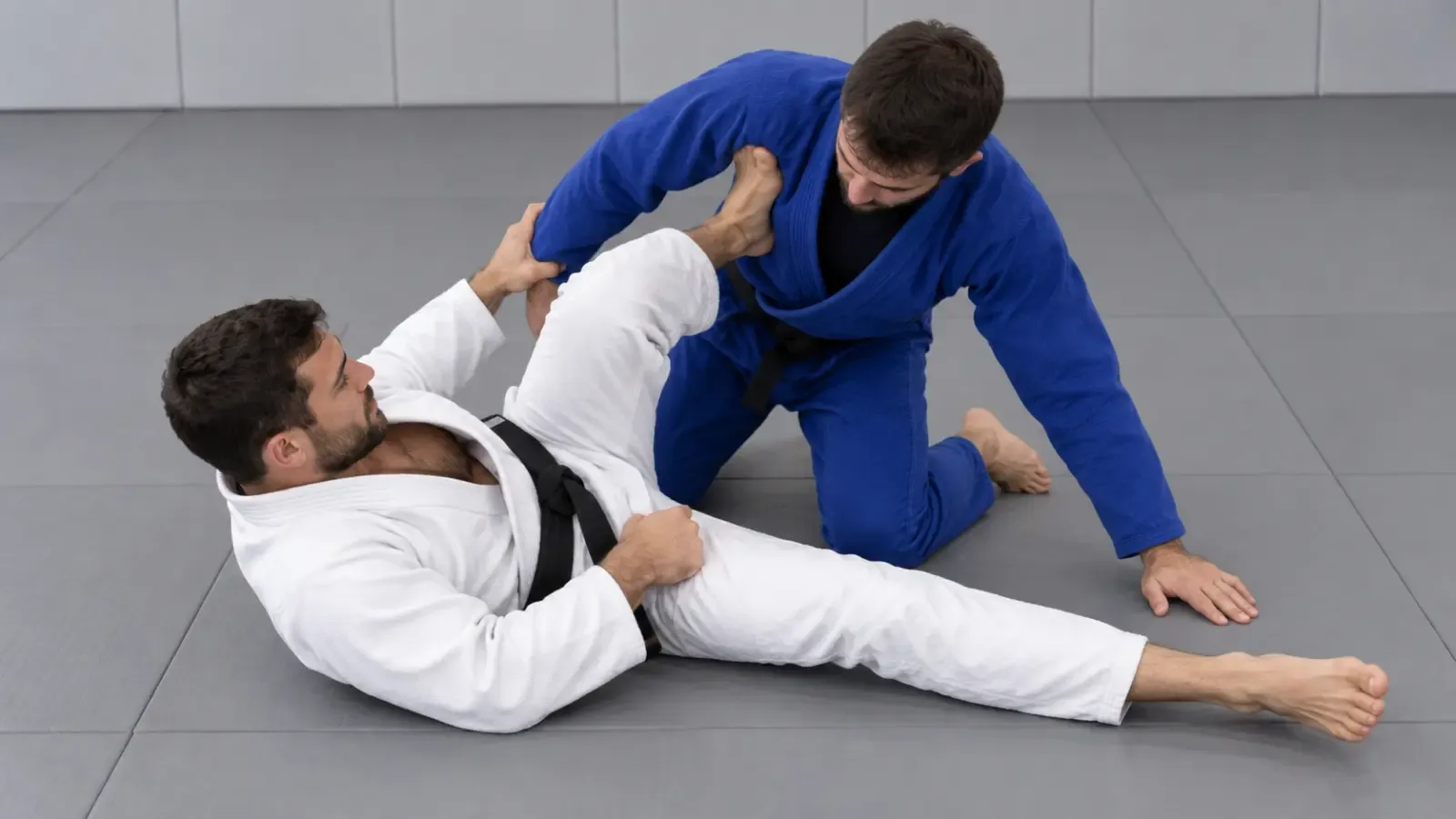
The momentum comes from the legs, not from lifting with the arms. This is the thing people get wrong: they hold the arm, then try to haul the opponent over with their upper body while the legs do very little. The legs are the engine; the arms only remove the post and steer.
A useful check while drilling: if the sweep feels heavy, you are lifting. It should feel like a swing that carries them.
The sequence
- Break their posture and get their weight forward over their knees.
- Control the arm on the sweeping side and pull it across.
- Open the guard and get an angle — turn onto your hip, not flat on your back.
- Swing: top leg up past their head, bottom leg down and across.
- Follow the rotation and come up. You land in mount.
Step five matters. The sweep delivers you to mount rather than to a neutral top position, which is a better outcome than most sweeps offer — but only if you follow the momentum up rather than stopping halfway.
Why it fails
- You did not control the arm. They post, and the swing does nothing.
- You tried to lift them. Arms cannot do what the legs are for.
- You are flat on your back. No angle, no rotation available.
- Their weight is back on their heels. The sweep wants forward-loaded weight; a sitting-back opponent has a base behind them that the pendulum cannot take.
- They are standing. Wrong technique. Standing opponents are a different problem.
- You stopped at the top. The rotation has to carry you into mount or you finish in a scramble.
What they do about it
- They post the free arm. Which is why you take one of them; if they post with the other, the sweep usually still works because that post is on the wrong side.
- They widen their base and sit back. Now the pendulum has nothing to turn. This is the moment the hip bump sweep or a collar attack becomes the better option.
- They stand up. Different problem, different sweeps.
The practical lesson is the same as with the other closed guard sweeps: threatening one to get the other beats committing to a single plan.
Gi and no-gi
Both, and this model records it as GI/NO_GI.
In the gi the arm control is more secure — a sleeve grip is a real hold, and the sweep is correspondingly higher percentage.
In no-gi you are gripping the arm itself or scooping under the elbow, which slips when sweaty. The sweep still works and the leg mechanics are identical, but the arm control has to be tighter to the body and the whole thing is faster.
Leg mechanics transferring while grips do not is the usual shape of what changes between gi and no-gi.
How to drill it
Drill the swing without a partner first: lie on your back, turn onto your hip, and practise the two legs travelling in opposite directions while your hips rotate. It feels strange and it is the part that becomes automatic or does not.
Then drill it with a cooperative partner kneeling, with the arm already controlled, focusing on finishing in mount rather than merely turning them over.
Then add the arm control against resistance, because that is where the sweep is actually won.
Arm control being where the sweep is won, rather than the leg swing, is something most sweeps have in common.
Safety
A low-risk technique — nothing here loads a joint.
Two things to watch: where your partner lands, since the pendulum can turn somebody over with real speed, and your own neck, which should not be taking weight as you rotate underneath them. In a busy class, check the space beside you before swinging somebody into it.
Always ask your coach or instructor to check your technique and practise safely at your academy.
Common questions
Is the flower sweep the same as the pendulum sweep? Yes. Two names for one technique — “pendulum” describes the mechanism, “flower” is the older Brazilian name.
Why does my pendulum sweep not work? Usually because the opponent’s arm is free and they post out, or because you are trying to lift them with your arms instead of swinging with your legs.
Which arm should I control? The one on the side you are sweeping towards. That is the post that would otherwise stop the sweep.
Where do I end up? In mount, if you follow the rotation up. That is one of the technique’s main advantages.
Does it work on a standing opponent? No. It wants a kneeling opponent with their weight forward. A standing opponent needs a different sweep.
Does the pendulum sweep transfer to no-gi? Yes. The leg mechanics are identical; the arm control is harder to keep without a sleeve, so it has to be tighter and faster.