
Submissions
Triangle Choke
A strangle made with the legs that tends to appear as a mistake-punisher — it becomes available when an opponent leaves one arm in and one arm out.
A triangle choke is a strangle, not a crush. Your legs form a figure four around their neck and one of their own arms, and the pressure that closes the carotid arteries on both sides comes partly from your thigh and partly from their own shoulder being driven into their neck. Understanding that second half is what separates a triangle that finishes from one you hold for ninety seconds while your legs burn.
The judo name is sankaku-jime, and the “triangle” is the shape the legs make once the lock is closed: one leg across the back of the neck, the other hooked over that shin.
Where it comes from
The triangle is a mistake-punisher. It becomes available when an opponent leaves one arm in and one arm out — usually while passing your guard, when one hand is posted on the mat or reaching past your hip and the other is inside. That configuration is the whole precondition. If both arms are in, you have no room. If both are out, there is nothing trapping their shoulder into their own neck.
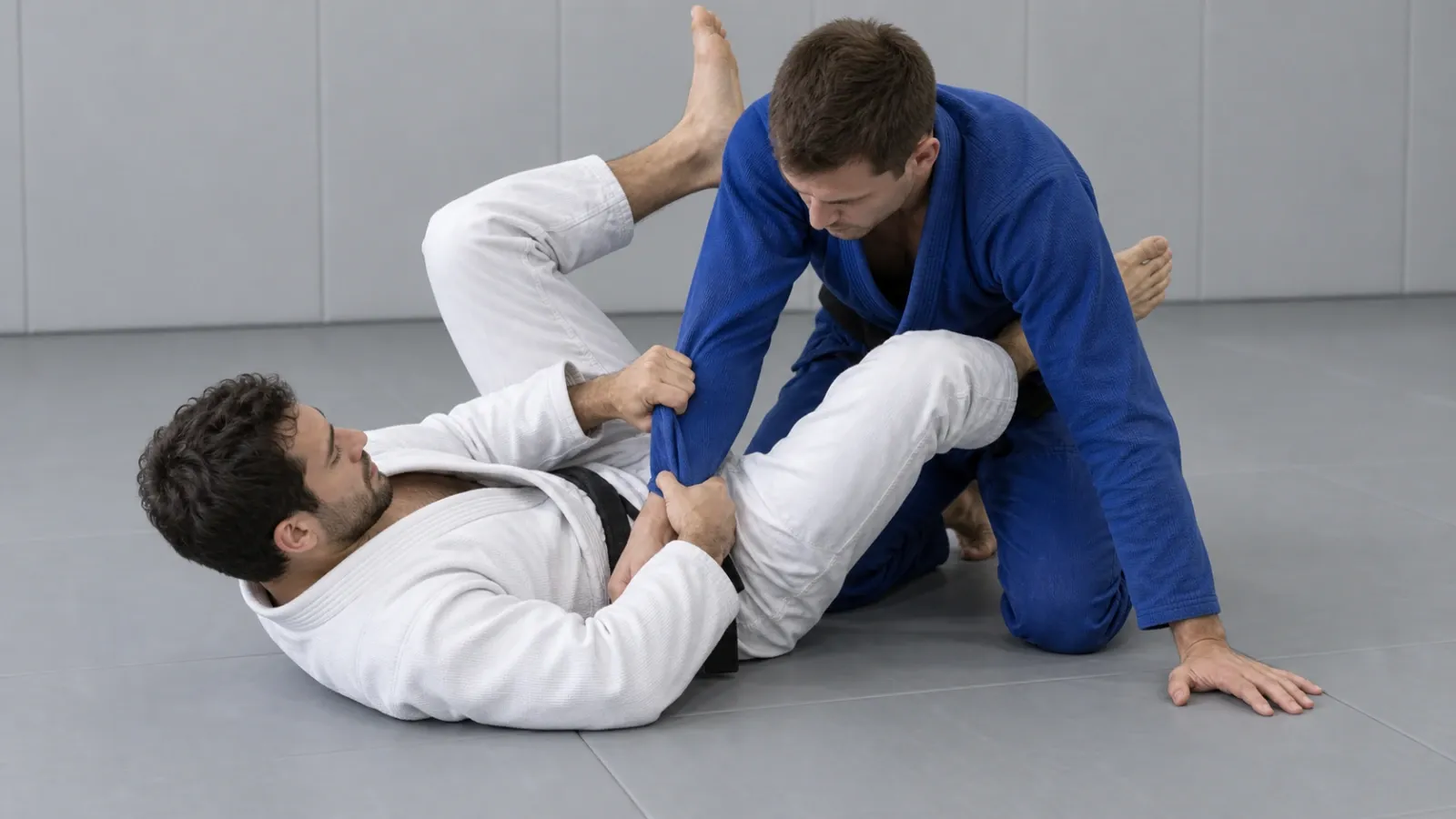
In this library’s model it is recorded from closed guard, supine open guard, and mount. Guard is where nearly everyone meets it first, because the opponent’s passing posture repeatedly offers the one-in-one-out shape without their meaning to. Practitioners do apply it from top positions and from the back, and there is a flying entry taken against a standing opponent, but those are separate problems of entry rather than a different choke.
Guard is where nearly every triangle begins, and guards and what each one offers covers which ones make it available.
Why angle beats squeezing
The single most common thing a beginner does wrong is to lock the legs square, straight down the middle of the opponent, and then squeeze as hard as possible. Squared up, your thigh presses the back of their neck and the trapped arm sits flat against the front — and there is enough room for them to breathe, posture and eventually stand.
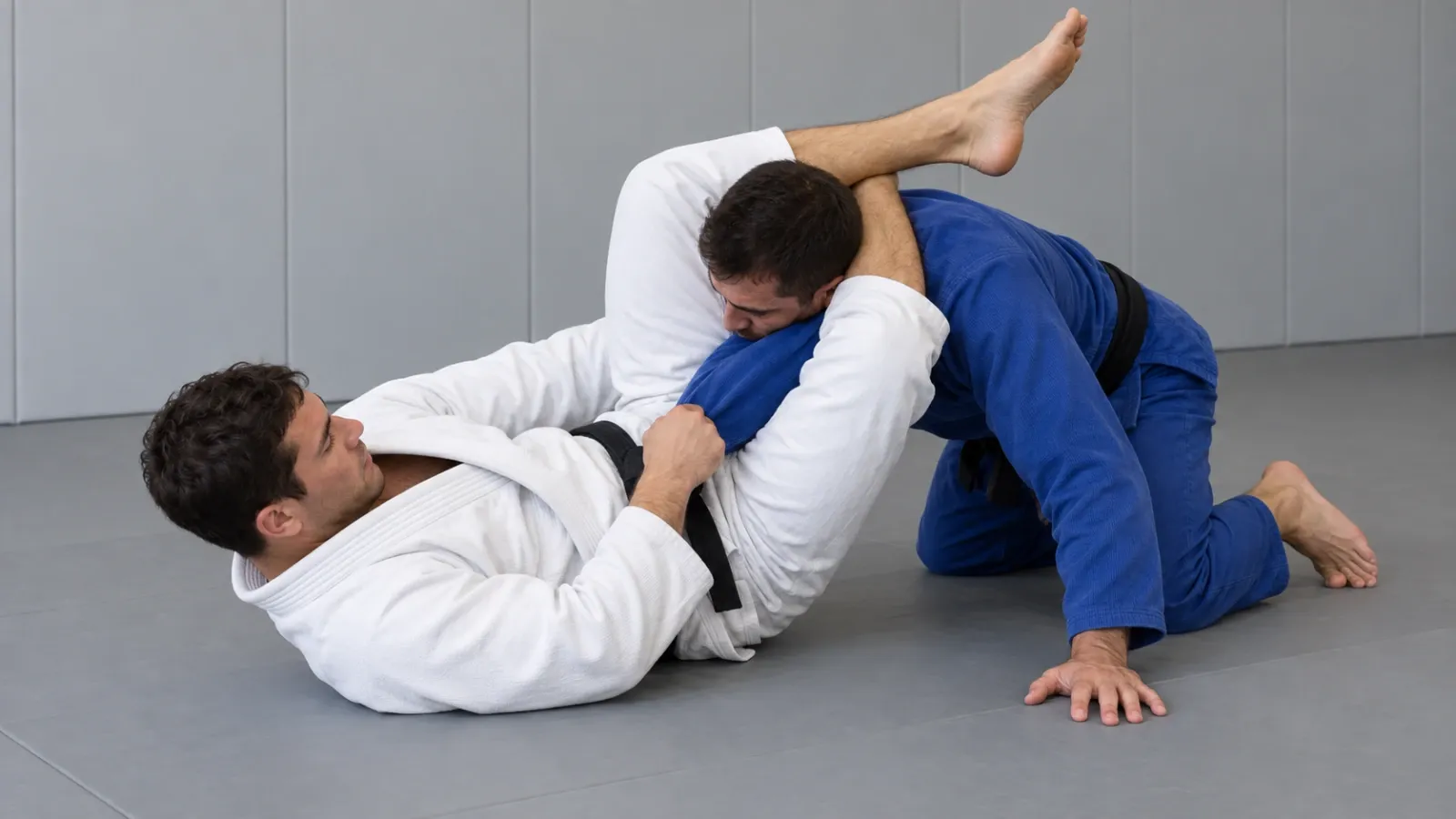
Turning your hips perpendicular is what makes it tight. Pivot so your body is at roughly a right angle to theirs, which does two things at once: it shortens the distance your legs have to span, and it drives their own shoulder across their neck rather than beside it. The choke then comes from geometry rather than from leg strength, which is why small people finish triangles on large people.
A useful check while training: if you are straining and nothing is happening, stop squeezing and create the angle first. It is almost always the missing ingredient.
Closing the lock
The sequence most people are taught, and the reasons behind each part:
- Get the arm across. Their trapped arm has to be pulled across your centre line, so their shoulder ends up in front of their own throat. A triangle with the arm still beside the neck is a headlock with your legs.
- Cut the angle. Pivot on your shoulder, walk your hips out, bring your knee across. Do this before you lock, not after — pivoting inside a closed lock is much harder.
- Lock the figure four. Knee pit over the shin, not over the foot. Locking on the foot lets them break the lock by pushing on your ankle.
- Pull the head down and finish. Breaking their posture down closes the last of the space. Lifting your hips slightly at the same time is what most people are missing.
Troubleshooting a triangle that will not finish
- It is loose and they are posturing. Almost always the angle. Re-pivot rather than squeeze harder.
- They are stacking you. Their weight is coming over your hips and your knees are being driven towards your face. Stacking is the standard defence; the usual answer is to keep working the angle and to threaten the armbar on the trapped arm, because a stacking opponent is committing their weight forwards.
- Their free hand is on your hip or your thigh. They are creating the frame that lets them posture. Deal with the hand before you commit.
- Your legs are burning. That is the sign the shape is wrong. A well-angled triangle does not require much muscular effort.
- You cannot get their arm across. Consider that you may not have a triangle at all. The omoplata and the armbar attack the same arm from the same configuration, and switching is usually faster than forcing.
How it is defended and escaped
The full version is its own subject — see triangle defence for the sequence from the other side.
The defence recorded against it in this model is the triangle defence, and its whole content is posture. Get your head and spine upright, drive the trapped arm’s elbow towards their far hip, and put your shoulder into the crook of their knee so the legs cannot lock. A bent spine hands them the angle they need.
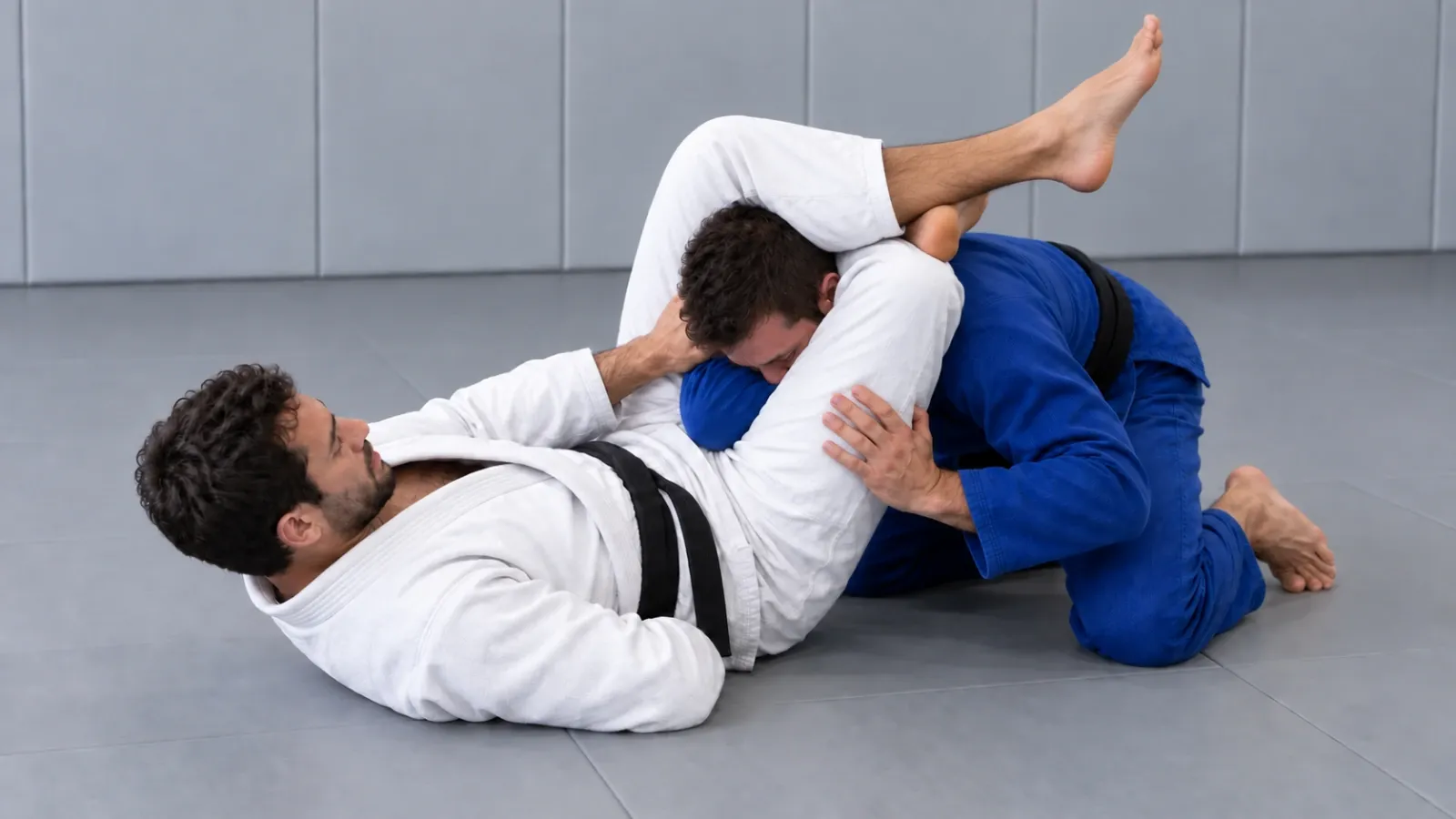
Once it is locked the priorities change. Now it is about stacking, walking towards the trapped side, and getting your posture back from a much worse starting point. The most common mistake — and it finishes the choke for them more often than anything else — is trying to rip your head out backwards, which drags your neck straight into the lock.
Safety
This is a blood choke. Applied correctly it works quickly, and an opponent can lose consciousness in a handful of seconds without the gradual warning a joint lock gives.
Apply it at a controlled tempo in training, release the instant your partner taps, and do not hold it “just to be sure” once they have. If your partner goes quiet or stops responding, let go immediately. Tap early yourself: there is no advantage in riding out a choke to prove a point, and the difference between uncomfortable and unconscious is small.
A partner going quiet instead of tapping is this problem from the other side; when to tap, and why waiting costs more covers it from yours.
Gi and no-gi
The choke itself does not care about the jacket — it is a leg-and-shoulder strangle. What changes is the fight to get there. In the gi you have grips that let you break posture and control the trapped sleeve, so entries are more controlled. In no-gi a posturing opponent is harder to hold down and the whole exchange is faster, which pushes people towards taking the angle earlier rather than tidying up the lock first.
The entry changing while the finish does not is one of the clearer illustrations of what the jacket actually affects.
Common questions
Why will my triangle choke not finish? Angle, in the great majority of cases. Squared up, there is room for them to breathe and posture. If you are squeezing hard and nothing is changing, pivot rather than squeeze.
What does “one arm in, one arm out” mean? It describes the configuration the choke needs: one of their arms inside your legs and the other outside. The inside arm is what gets trapped against their own neck and supplies half the pressure.
What angle should I be at? Roughly perpendicular to them, rather than square on. The exact number matters less than the direction of the correction — off the centre line, hips out.
Should I lock on my foot or my shin? Behind the knee, over the shin. A lock on the foot is easy for them to break by pushing your ankle.
How do you escape a triangle choke? Before it closes: posture up, elbow of the trapped arm to their far hip, shoulder into the crook of their knee. Once it is locked: stack and walk towards the trapped side. Never pull your head straight back.
Can you get a triangle from the top? Yes — from mount, side control and the back, and there is a flying entry from standing. Guard is simply where the one-arm-in configuration appears most often.