
Control and transitions
Knee on Belly
A shin across their midsection and your posture up. Less control than side control, far more pressure and mobility, and a position that makes people move.
Knee on belly is a deliberate trade: you give up some control to buy pressure and mobility. Your shin goes across the opponent’s midsection, your posture stays tall, and your weight concentrates into a very small area. It is not as secure as side control and it is not supposed to be. What it does is make somebody move, and a person who is moving has told you what they are going to do next.
The position
The near shin crosses their stomach or the base of their ribcage, the knee pointing towards their far hip. Your other leg is out wide, foot posted on the mat, giving you a base you can move around. Your posture is upright — head up, back straight, hands free.
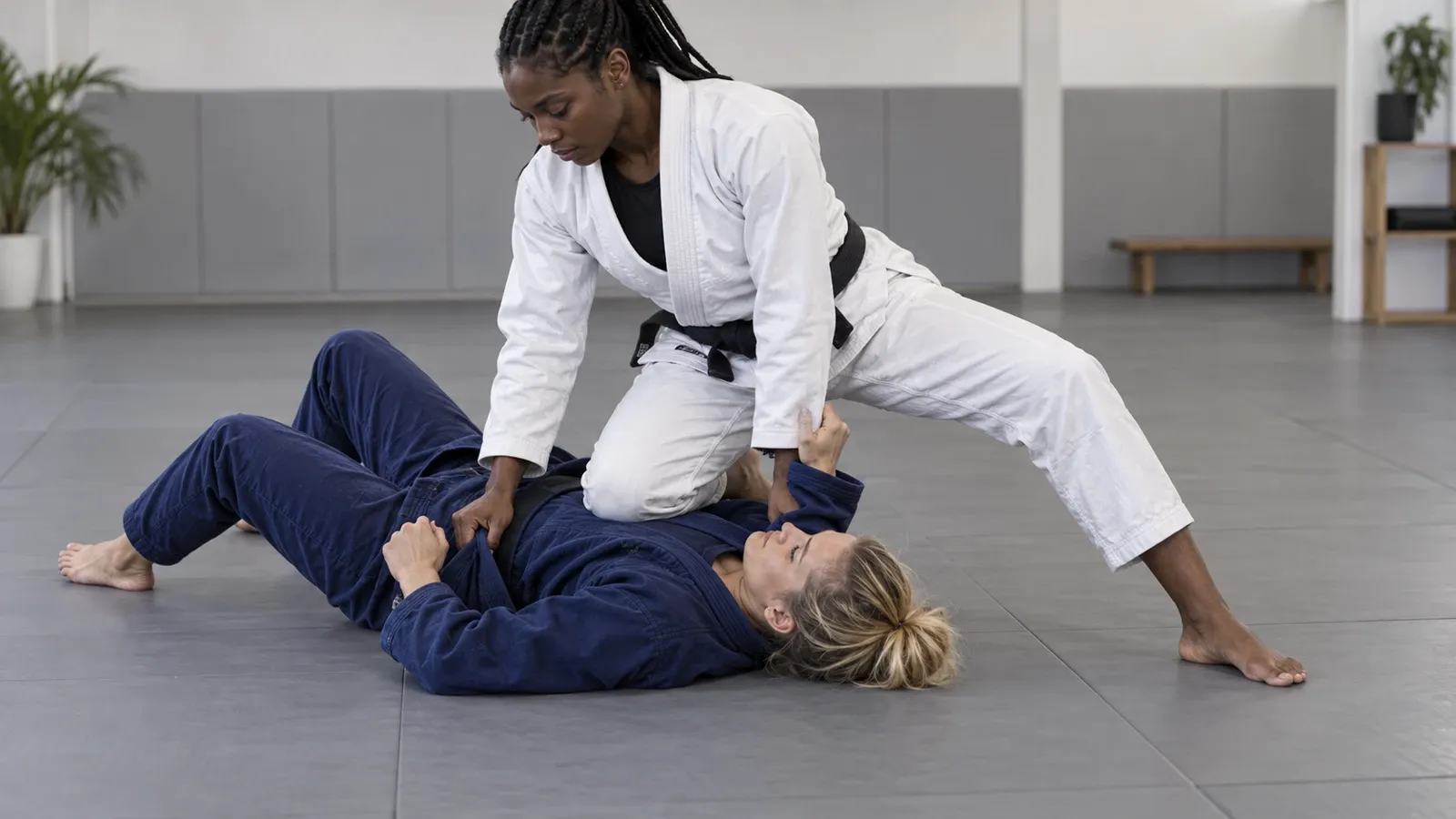
That tall posture is the part that feels wrong to beginners, who instinctively hunch forward to feel more secure. Sitting up is what makes the position work: it puts your weight over the knee instead of spreading it out, and it lets you move the instant they do.
What you are trading, and what you get
You give up: chest-to-chest connection, the pin quality of side control, and some of your ability to stop a determined escape.
You get:
- Pressure that forces a reaction. A shin on the diaphragm is genuinely unpleasant and it is difficult to breathe under. People do not lie still for it.
- Mobility. From here you can move to the other side, to mount, back to side control, or towards the head almost freely, because you are not committed with your weight.
- Free hands. Both hands are available for grips and attacks, which is not true in a heavy pin.
- Height to see and choose. You can watch what they do instead of feeling for it.
It is a bridge position in both senses: it connects side control to mount, and it is a place you pass through rather than a place you live.
The reaction it forces, and what to do with it
Most people under knee-on-belly do one of three things, and all three are useful:
They push the knee. Two hands go to your shin. That is two arms committed to a leg, and it is where armbars and collar chokes come from — the cross collar choke in the gi is the classic, because the hands leaving the collar is exactly what it needs.
They turn to their side, away from you. This is the most common, and it opens the road to the back or to mount as the near side clears.
They bridge and shrimp underneath. The correct escape, and the one that tells you to move rather than to hold — step over to mount or switch to the far side as the space appears.
Holding the position and waiting for something to happen is the mistake. You are there to make somebody choose.
Keeping it
- Stay tall. The moment you hunch, your weight redistributes and the pressure that was doing the work disappears.
- Keep the posted foot wide. A narrow base is what gets rolled.
- Do not let the shin slide to the hip. On the hip it is a hold; on the soft part of the midsection it is pressure.
- Move with them, not against them. If they turn, take what the turn offers rather than fighting to restore the exact position.
- Grips in the gi, collar and belt, make it much easier to hold; in no-gi it is a more transient position and is normally used as a stepping stone.
Where it commonly goes wrong
- Sitting on them rather than posting the far leg, which removes the mobility that is the whole point.
- Driving the knee into the ribs or the sternum instead of the soft midsection — see safety.
- Hunching forward to feel secure. Understandable and self-defeating.
- Treating it as a resting position. It is the opposite; it is a place you are choosing from.
- Staying when the escape has already started. Knee on belly rewards leaving early.
Drilling it
Transitions, not holds. Side control to knee on belly to mount to knee on belly to the other side. Twenty repetitions with a passive partner until moving between them is one continuous thing.
Then hold it against escapes for time, with no submissions allowed, so you learn which reaction comes from which escape.
Then attack the reactions: partner pushes the knee, you take the arm or the collar; partner turns away, you take mount or the back. Choosing rather than forcing is what makes the position pay, and it is the same habit that turns a collection of techniques into a game.
Safety
This is a position where the pressure is the technique, and that deserves a clear head.
Where the knee lands matters. The soft area below the ribs and above the hip is the target. A knee driven onto the sternum, onto floating ribs, or into the bladder is a genuine way to injure a training partner and it is not more effective. Drop your weight progressively rather than jumping onto somebody, and never land on a person who is not expecting it.
Breathing is restricted under a good knee on belly, so if a partner taps to the pressure alone, that is a real tap — release immediately and do not treat it as a lesser signal. With a large weight difference this scales badly in one direction, and the considerations in training with bigger, stronger partners apply to whoever is heavier.
Always ask your coach or instructor to check your technique and practise safely at your academy.
Common questions
What is knee on belly in Brazilian Jiu Jitsu? A top position where one shin crosses the opponent’s midsection while your posture stays upright and your other leg is posted wide, trading some control for pressure and mobility.
Why should my posture stay tall? Because upright posture concentrates your weight through the knee and lets you move as they move. Hunching forward spreads the weight and removes both advantages.
Where exactly should the knee go? Across the soft midsection below the ribs. On the hip it becomes a hold rather than pressure, and on the ribs or sternum it becomes an injury risk.
Is knee on belly worth points in competition? It is a scoring position in many rulesets, though the requirements and the points vary by organisation, belt level and age division — check the rules you are competing under.
What should I attack from here? Whatever their reaction gives you: the arm or a collar choke when they push the knee, mount or the back when they turn away.
Is it useful in no-gi? Yes, but it is harder to hold without grips, so it functions more as a transition between positions than as a place to settle.