
Submissions
Bow and Arrow Choke
The best gi finish from back control, and one of the few chokes that is genuinely difficult to defend once it is set.
Take away the leg and this is just a collar choke. The leg is the technique. Pulling the opponent’s far leg while holding their collar bends their body into an arc — the bow — and that arc is what makes the choke almost impossible to posture out of. Everything else about the finish is ordinary; the leg is what makes it exceptional.
Where it comes from
Back control, attacking. One position in this model, and rightly so: the choke needs to be behind them with a collar available and a leg reachable.
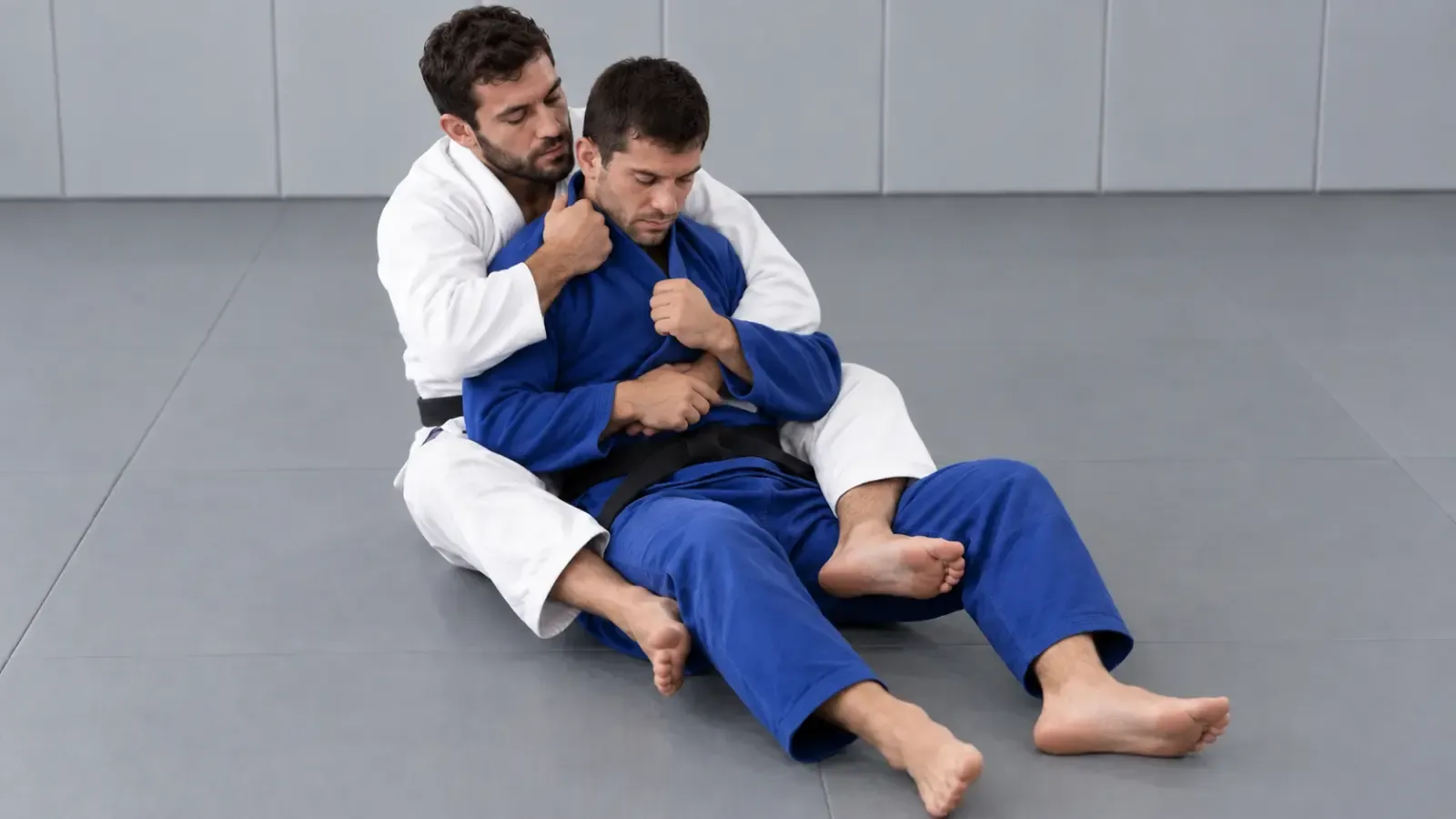
It belongs to the same family as the other gi collar chokes — the cross collar, the sliding collar, the clock choke — and it reuses the same first skill: taking a deep grip on the collar. If you can do that, this choke is largely already available.
How it works
Three elements, and they have to arrive in a sensible order.
The collar grip. Deep, across the neck, taken with the hand on the same side as the arm that is over their shoulder. Depth matters here for the same reason it matters in the cross collar choke: a shallow grip puts your forearm on the jaw and cannot be rescued later.
The leg. Your free hand reaches down and grips their far leg — the trouser cuff, or under the knee. This is the part that most people are missing when their bow and arrow feels loose.
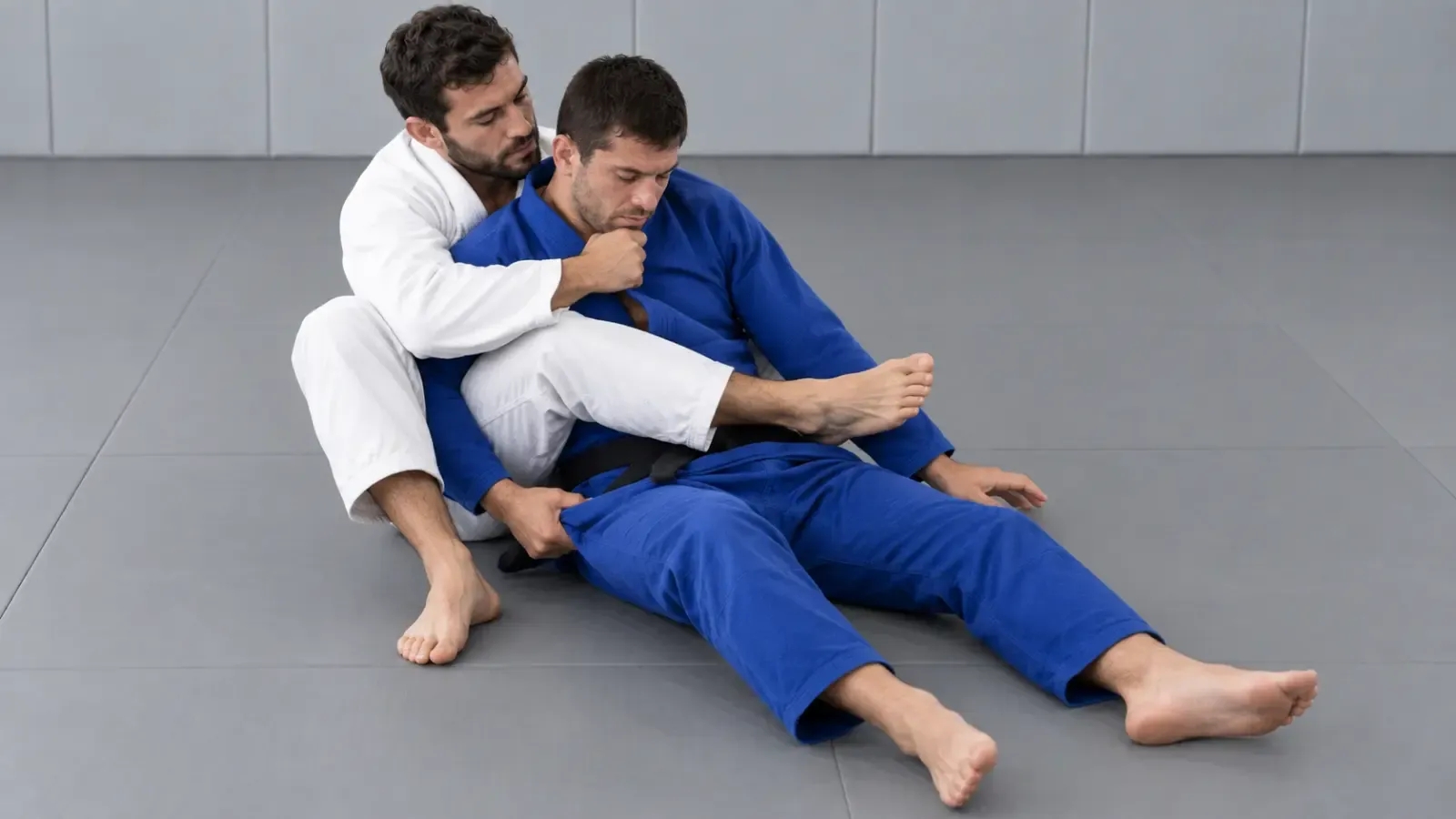
The angle. You fall to the side and rotate, so you end up perpendicular to them rather than directly behind. Your chest comes off their back and your hip drives into their shoulder blade.
The finish
Pull the collar one way and the leg the other, and let your bodyweight fall.
That opposition is the whole mechanism. Their body is bent backwards over your hip, their spine cannot straighten, and the collar tightens against their neck without you having to squeeze anything. The taxonomy’s own note is the useful one: your bodyweight does the work rather than your arms.
A common beginner error is to keep the chest glued to their back and try to finish from directly behind, which is a standard collar choke and much easier to defend. The rotation off to the side is what converts it.
Why it fails
- No leg grip. You have a collar choke, and they can defend it like one.
- The collar grip is shallow. Forearm on the jaw, not the neck.
- You stayed square behind them. No arc, no bow.
- You lost the hooks or the harness before rotating. Rotating is the moment the position is loosest; if their hips are free at that point, they turn in.
- You reached for the leg too early. Reaching down with the second hand before the collar is secure gives them a free moment to strip the grip and turn.
- Their chin is tucked and you have not dealt with it. Depth answers this — a grip behind the chin is not blocked by tucking.
How it is defended
Mostly by getting the collar grip off before it is deep, which is why the choke feels binary: very hard to defend once set, entirely preventable beforehand.
Once it is on, the defender’s options are to protect the neck with two hands on the choking arm, to fight to get their back to the mat, and to try to turn in before the rotation completes. Those are the same priorities as the back escape generally — survive first, escape second — and they get harder the moment the leg is captured.
Where it fits
The bow and arrow is one of the reasons back control is the top of the positional hierarchy in gi Brazilian Jiu Jitsu. It gives the attacker a second high-percentage finish alongside the rear naked choke, and the two cover each other:
- If they defend the naked choke by fighting the arm across the throat, the collar is often free.
- If they strip your collar grip, their hands are away from the choking arm.
Competitors frequently alternate between the two rather than committing to either.
Gi and no-gi
Gi only. The choke is made of the collar, and this model records it as GI. There is no no-gi version — the nearest relative is the rear naked choke, which is a different technique with different mechanics.
There is no way to carry this one across, which is the sort of thing worth knowing when you read what changes between gi and no-gi.
How to drill it
Drill the rotation, not the squeeze. From back control with a collar grip and a leg grip already established, practise falling to the side and finding the angle, with a partner who is simply holding position. The finish arrives on its own once the angle is right, which is the lesson.
Then drill the grip sequence against resistance: collar first, then leg, without losing the harness in between. That transition is where the technique is lost in a live roll.
A grip sequence is exactly the kind of detail that survives a drill and disappears in a round, which is why both are on the timetable.
Safety
A blood choke, and a strong one. Applied correctly it is fast and gives little warning.
Build the pressure gradually rather than dropping your weight all at once, release immediately on the tap, and stop if a partner goes quiet. Tap early when you are on the receiving end — a bow and arrow that is properly set is not something to test your resolve against.
Always ask your coach or instructor to check your technique and practise safely at your academy.
It closes quickly, from a position the other person cannot see, so tap early.
Common questions
What makes the bow and arrow choke so strong? The leg. Pulling the far leg while holding the collar bends the opponent’s body into an arc they cannot straighten, so they cannot posture out of the choke.
Where do I grip the leg? The far leg — the trouser cuff or under the knee. The far one, not the near one, because the arc depends on opposition.
Why is my bow and arrow loose? Usually because you are still square behind them. Rotate off to the side so your hip drives into their shoulder blade.
Collar grip or leg grip first? Collar. Reaching for the leg before the collar is secure gives them a free moment to strip the grip.
Is the bow and arrow available in no-gi? No. It is a collar choke and needs the jacket.
How do you defend the bow and arrow? Prevent the deep collar grip. Once it is set with the leg captured, the realistic answer is to protect the neck and try to turn before the rotation finishes — and to tap if it closes.