
Grips and control
Seatbelt Control
One arm over the shoulder, one under the far armpit, hands joined. The upper-body half of back control, and the half that keeps you attached when the legs come off.
Back control is two grips, not one, and the seatbelt is the half that decides whether you keep the position. One arm goes over the shoulder, the other under the opposite armpit, and your hands join in front of their chest. The legs can be hooks or a body triangle or, briefly, nothing at all — but if the harness is intact, you are still on their back.
The shape of it
The over arm crosses their collarbone from behind. The under arm comes through their armpit on the other side. Your hands meet in front of their sternum, usually with a palm-to-palm or gable grip, and your chest stays glued to their upper back.
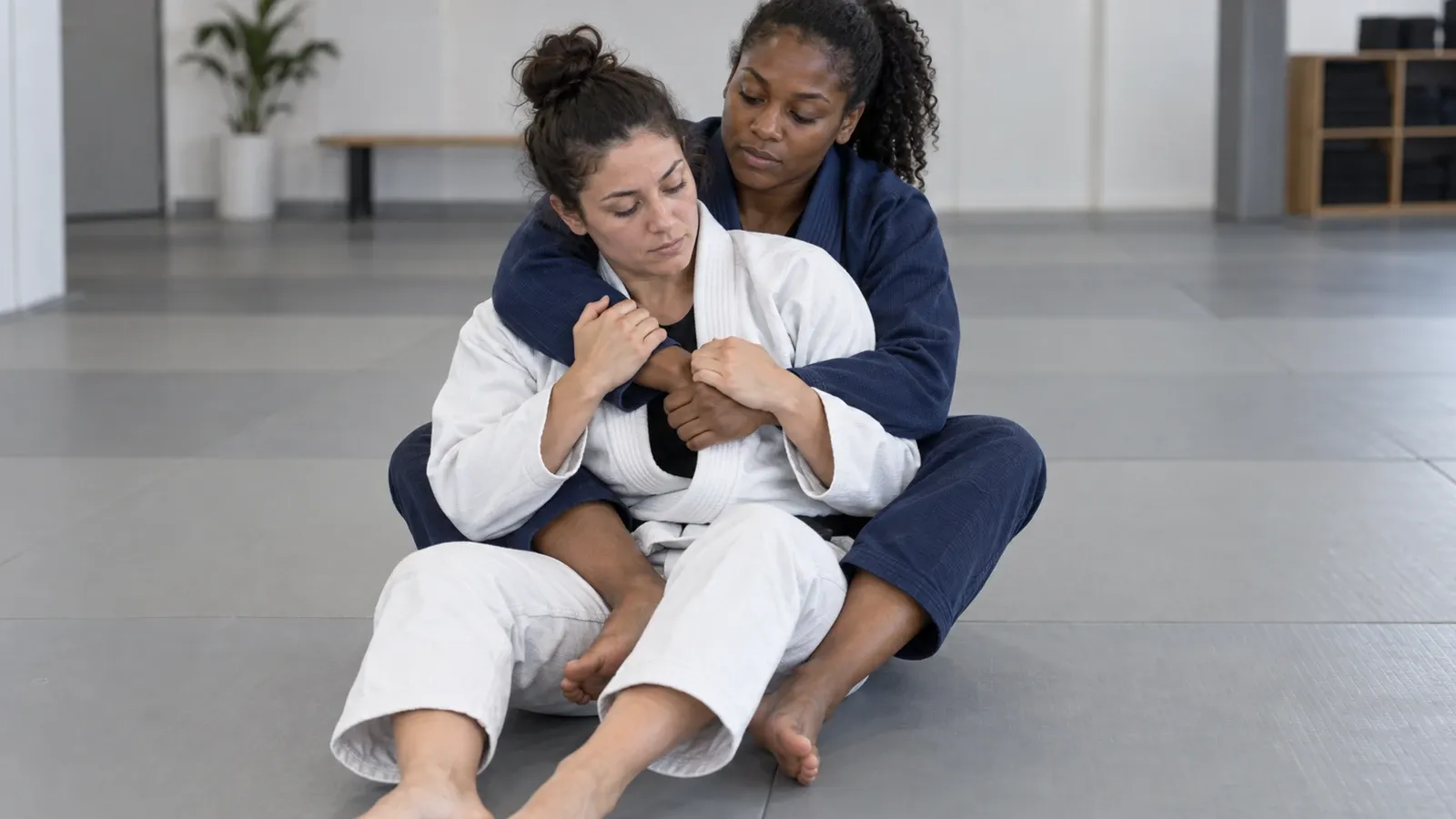
The name is literal. It sits across the torso the way a car seatbelt does, and it does the same job: it keeps a body attached to the thing behind it during movement that would otherwise separate them.
Why it matters more than the hooks
New back-takers hold on with their legs and treat the arms as a formality. That is backwards.
Hooks are easy to strip. A defender peels one, drops the shoulder to the mat, and the legs are suddenly out of the argument. What stops them completing the escape is the harness — as long as your hands are joined and your chest is on their back, they have moved but they have not escaped, and you can re-insert a hook or convert to a body triangle while they are busy congratulating themselves.
The reverse is not true. Hooks with no harness is a position a competent defender spins out of almost immediately.
The choking-arm convention
There is a convention worth adopting early: keep your choking arm over the shoulder.
The arm over the shoulder is the one that can slide under the chin. If it is already there, the rear naked choke finish is one movement away at any moment — you are never setting up, you are only ever finishing. If your choking arm is the under arm, every finish starts with an arm swap, and arm swaps are where back control gets lost.
It also settles a question that otherwise gets decided by accident: which side are you attacking? The over-arm side is your attacking side. Their escape side is the other one.
Which way they escape, and why you care
A defender on the back escapes towards the under-arm side — the side where your arm is beneath their armpit rather than across their chest. That is where the space is.
Knowing this in advance is most of back retention. You are not reacting to a mystery; you are watching one specific direction and putting your weight there before they commit. Staying on your side rather than flat on your back is the other half, because a defender who gets their shoulders to the mat has taken the position back whatever your arms are doing. That race is exactly what the back escape is about from the other end.
What it connects to
The harness is a hub rather than a destination:
- The rear naked choke, directly, from the over-arm side.
- The bow and arrow choke in the gi, where the collar grip usually replaces the over-arm’s hand.
- Arm attacks, when they defend the neck by fighting one hand and expose the arm.
- The body triangle, which is a legs decision rather than an arms decision and can be made while the harness holds everything together.
Getting to the back first and attacking second is the clearest example of why the order is position then submission the sport has: from here, the finish is close to automatic, and from anywhere else it does not exist.
Common faults
- Hands joined but elbows wide. The grip is intact and the control is not. Elbows squeeze in towards their ribs.
- Sitting flat behind them. You want to be on a hip, slightly behind their shoulder. Flat on your back means their shoulders can reach the mat.
- Crossing your feet in front. An old habit that invites a footlock and gives them a handle; hooks or a triangle, not a cross.
- Letting the over arm drift down. If it slides towards their chest it stops threatening the neck and starts being a thing to grab.
- Squeezing the harness as a substitute for position. Effort is not the same as control, and it is tiring in a way that is its own problem — why beginners get so tired is largely this habit applied everywhere.
Drilling it
Hold it against escape attempts, with no submissions allowed. Three minutes of only keeping the harness teaches more about back control than three minutes of chasing chokes, because it forces you to solve the escape rather than race it.
Then drill the swap between hooks and a body triangle while the harness stays joined. That is the transition where most people lose the back, and it is entirely trainable.
Then from the defensive side. Understanding how it feels to escape a good harness is the fastest way to learn where to put your elbows.
Safety
The grip itself is benign — no joint is loaded and nothing is applied to the neck by the harness alone.
The risk sits next to it. From this position a choke is always one movement away, and a training partner who is concentrating on escaping may not notice how close it is. Apply anything from here gradually and release the moment they tap. If you are the one underneath, tap early rather than riding out a strangle you cannot see coming — when to tap is written about exactly this position.
Always ask your coach or instructor to check your technique and practise safely at your academy.
Common questions
What is the seatbelt grip in BJJ? The upper-body harness from back control: one arm over the opponent’s shoulder, one under their opposite armpit, with your hands joined in front of their chest.
Why is it called a seatbelt? Because it crosses the torso diagonally like a car seatbelt, and because it does the same job of keeping a body attached during movement.
Should my choking arm go over the shoulder or under the armpit? Over the shoulder. That keeps the finish one movement away and makes the over-arm side your attacking side rather than something you have to rearrange.
Can I keep back control without hooks? For a while, yes — that is the point of the harness. Hooks make it comfortable; the seatbelt is what actually keeps you attached while you rebuild them.
Which way will they try to escape? Towards the under-arm side, where there is space. Watching that direction rather than reacting to whatever happens is most of keeping the back.
Is the seatbelt the same as a body triangle? No. They do the same job with different limbs — the seatbelt is the arms, the body triangle is the legs — and they are usually used together.