
Submissions
Ezekiel Choke
A sleeve-assisted strangle that works in the tightest positions in the sport — including from underneath, which almost no other choke manages.
Most chokes need room to set up. This one needs almost none. That is the Ezekiel’s whole argument: it can be built inside a position so tight that nothing else is available, including from underneath somebody, which is rare enough to be worth stating twice.
The Japanese name is sode guruma jime — sleeve wheel choke. It reached Brazilian Jiu Jitsu through judo and is named after Ezequiel Paraguassú, a judoka who used it on the mats at Carlson Gracie’s gym.
Where it comes from
Three positions in this model: mount top, technical mount, and — unusually — closed guard bottom.
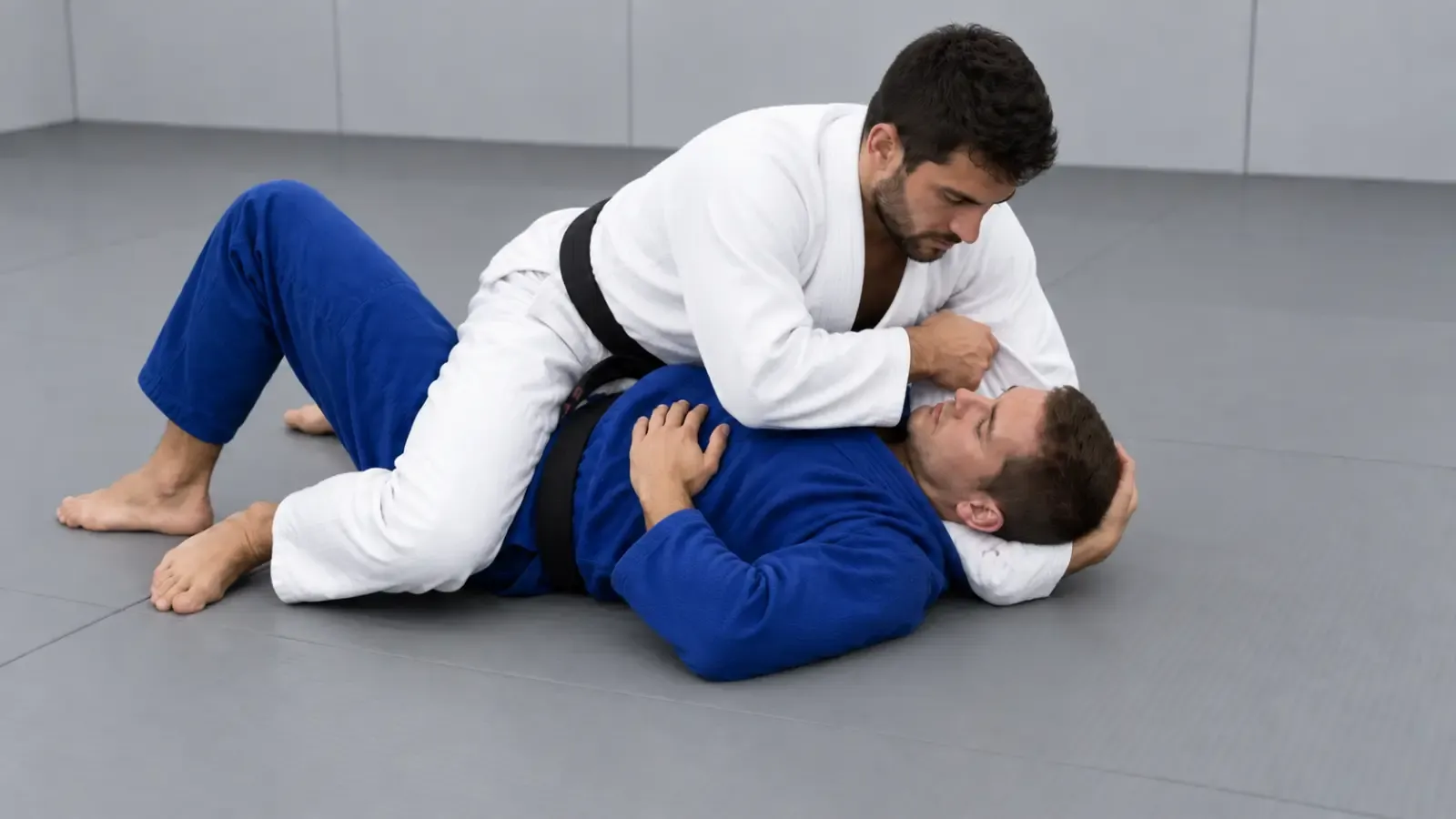
Mount is where it belongs first. An opponent defending well in mount, elbows tight, chin down, arms busy, is exactly the situation in which most attacks are unavailable and this one is not.
The guard-bottom version is the curiosity. Very few strangles can be finished by the person underneath, and the Ezekiel can, because it needs no room to build.
How it works
The mechanism is simpler than the setup suggests, and getting it the right way round matters:
The forearm chokes. The sleeve only locks the structure.
One arm goes behind their neck. That hand grips the inside of your own opposite sleeve. Your second forearm then comes across the front of their throat, and because your first hand is anchored to your own sleeve, the two arms form a closed loop that cannot be pulled apart.
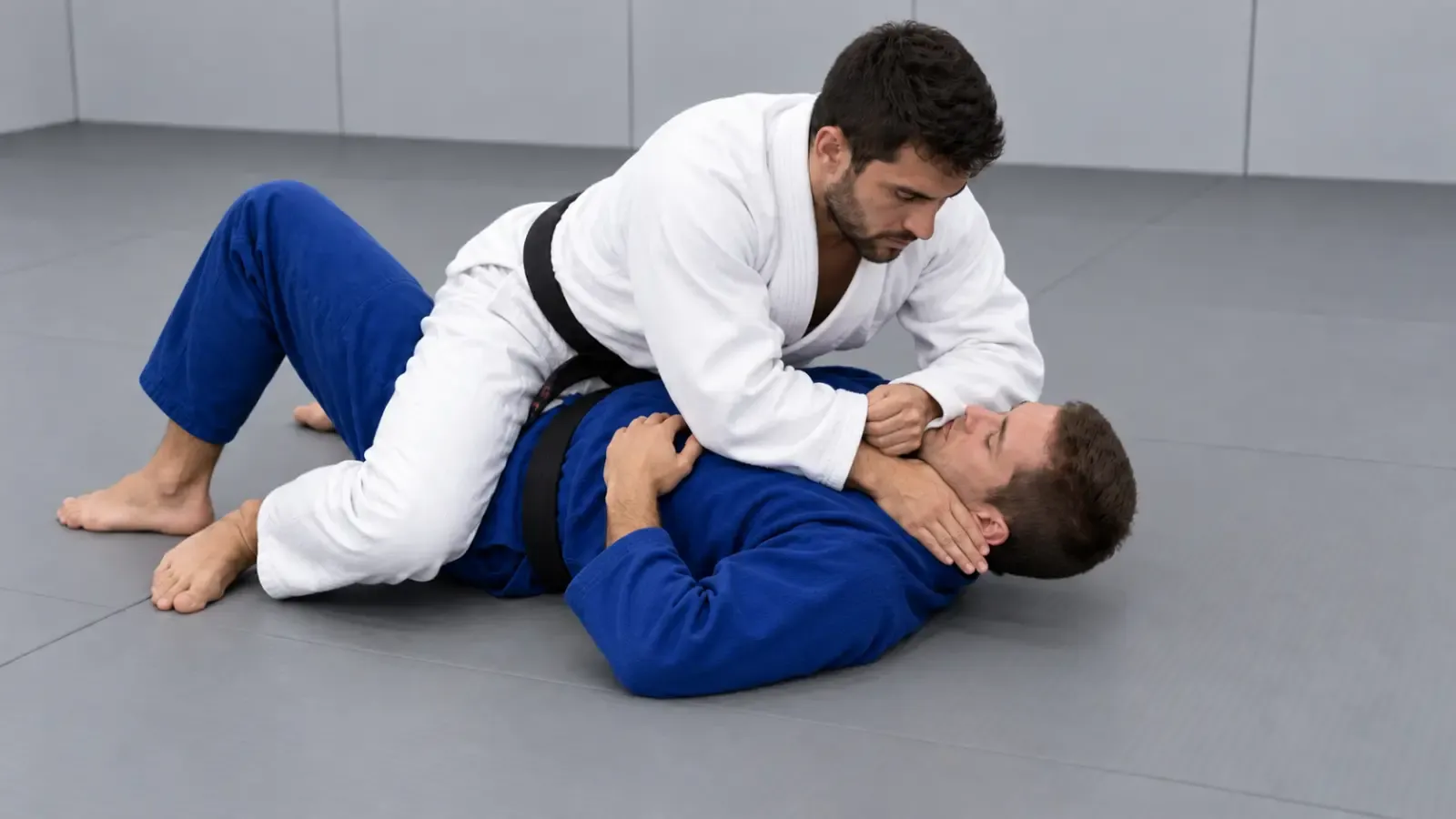
Then you draw your elbows together and expand your chest. The forearm across the neck does the work — the sleeve grip is structure, not pressure. People who try to finish by pulling harder on the sleeve are pulling on the wrong thing.
Where the forearm sits
This decides whether it is a strangle or a face crank.
The blade of the forearm should be against the side of the neck, not across the jaw or the mouth. On the neck it closes the carotid and works quickly and without much discomfort. On the jaw it is unpleasant, much less effective, and people sometimes tap to it — which teaches you a bad habit that will not work on somebody tougher.
Why it fails
- The forearm is on the jaw. The most common fault by a distance.
- The first arm is not deep enough behind the neck. The loop cannot close.
- You are pulling the sleeve instead of drawing the elbows in. Wrong motor.
- Your weight came off them to set it up. From mount, sitting up to thread the arm is how people get bridged and rolled. The threading should happen with your chest still heavy.
- You tried it from a loose mount. The Ezekiel rewards tight positions; a mount you are barely holding is not one.
How it is defended
Chin down, hands fighting the first arm before it threads behind the neck. Once the loop is closed the choke is very hard to strip, because neither of your hands is grippable in the usual way — one is holding your own sleeve and the other is behind their neck.
From underneath, the realistic defence is positional: escape the mount before the arm threads, using the bridge and roll or the elbow-knee escape. Waiting until the Ezekiel is being built is waiting too long.
Where it fits in a gi game
The Ezekiel is a specialist rather than a staple, and it earns its place by covering a gap:
- From mount, it answers the opponent who has defended everything else. When the collar is protected, the arms are tight and the americana and armbar are gone, this is often what is left.
- From technical mount, it works while you are already transitioning towards the back.
- From closed guard bottom, it is a genuine surprise, and worth knowing for that reason alone — although as a primary guard attack there are better options.
It pairs naturally with the cross collar choke from mount: the defences are different, so an opponent tucking their chin against one is often opening the other.
A specialist that covers a gap is worth adding deliberately rather than collecting, which is the difference having a game makes.
Gi and no-gi
Gi, in this model, and that is the honest answer for the classical version — the technique is built on gripping your own sleeve.
A no-gi variant exists, using the wrist or a gable grip in place of the sleeve, and it is a real technique. It is meaningfully less secure, because the sleeve is what makes the loop uncloseable, and it is better treated as a related no-gi choke rather than as the same technique without a jacket.
A technique with a weaker no-gi cousin rather than a no-gi version is a common pattern, and gi and no-gi compared has the rest of it.
How to drill it
Drill threading the arm with your chest staying heavy. From mount, practise getting the first arm behind the neck without posting up, against a partner who is defending. That is the hard part.
Then drill the forearm placement slowly, with a cooperative partner telling you whether they feel it on the neck or the jaw. It is the difference between the technique working and not, and it is almost impossible to judge from your own side.
Safety
A blood choke, and one that closes quickly once the loop is set.
Apply it gradually, release immediately on the tap, and stop if a partner stops responding. Be especially careful about the jaw version — grinding a forearm across somebody’s face is not a technique and is a good way to hurt a training partner for no benefit. Tap early when caught.
Always ask your coach or instructor to check your technique and practise safely at your academy.
Chokes that close this quickly are the reason tapping early is a habit worth building before you need it.
Common questions
What is an Ezekiel choke? A sleeve-assisted strangle: one arm threads behind the neck and grips your own opposite sleeve, while the other forearm comes across the throat to form a closed loop.
Can you really finish it from the bottom? Yes — from closed guard, which is unusual for a strangle. It works because the choke needs almost no space to build.
Why does my Ezekiel not work? Usually the forearm is across the jaw rather than the side of the neck, or the first arm is not deep enough behind the neck for the loop to close.
Should I pull the sleeve harder? No. The sleeve is structure. Draw your elbows together and expand your chest; the forearm on the neck is what chokes.
Can you do an Ezekiel without a gi? A variant using a wrist or gable grip exists and is a real technique, but it is less secure. The classical version needs the sleeve.
When should I go for it? When an opponent in mount has defended everything else — tight elbows, chin down, collar protected. It is the attack that fits where nothing else does.