
Grips and control
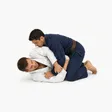
Underhook
One arm under the opponent's armpit, and with it most of the say in where the exchange goes next. The connection that half guard, the clinch and the scramble are all arguments about.
An underhook is one arm threaded under the opponent’s armpit, and it is worth more than that description makes it sound. Whoever has it decides the direction of the exchange — who turns, who gets turned, and which way the position opens. That is why it is fought over continuously rather than taken once, and why losing it usually costs you the position it was holding up.
What it is, and what it is not
Your arm goes under their arm, and your hand arrives on their back, their shoulder blade or the far side of their ribs. The elbow stays tight to their body. That last part is the whole thing: an arm under the armpit with the elbow flared is a passenger, and they can circle away from it as if it were not there.
It is not the same as an overhook, which goes over the top of their arm. The two do opposite jobs. An overhook controls their posture and their arm; an underhook controls their hips and their direction of travel. The whizzer is an overhook doing defensive work against a leg attack, and it is a useful contrast — a whizzer stops you from being moved, an underhook moves somebody.
Why it decides so much
Three reasons, and they compound.
It attaches you to their hips. Because your arm runs under their arm and around their body, your chest and their chest are connected through a rigid line. Where your shoulder goes, their torso follows.
It takes away one of their frames. An arm that is over the top of yours can push. An arm that is lifted by your underhook cannot get between you.
It opens their back. Every underhook is halfway to being behind somebody. Turn the corner with it and you are on their side; turn a little further and you are on their back.
Where the fight actually happens
Half guard, bottom. This is the underhook’s home, and the reason half guard is a real guard rather than a failed one. With it, the bottom player can come up to their side, into the dogfight, and take the top position — the half guard underhook sweep is that sequence written out. Without it, the top player flattens them and starts passing.
Half guard, top. The mirror image. The top player’s job is to deny the underhook or to answer it with a cross face, which is the standard trade: they get the underhook, you take their head, and the position turns on whose control is better.
Standing. In the clinch, the underhook is the entry to body locks, to turning the corner, and to the back. It is also how you stop somebody else from doing those things to you, which is why so much of wrestling practice is two people pummelling for it.
Scrambles. Whoever comes out of a scramble with the underhook usually comes out on top. That is not a coincidence; it is the same rule applied at speed.
Winning it and keeping it
Pummelling is the basic exchange: your arm goes under, theirs goes under, both of you repeat, and the position rotates. Done well it is not a wrestle — it is a rhythm, and the person who is relaxed about it wins because the person who is straining runs out of arms first. That is the same argument why straining loses to relaxing makes about the sport generally, and the underhook battle is where beginners feel it first.
Two details separate an underhook that holds from one that slips:
- Get your head on the same side. Head outside their shoulder on the underhook side. A head on the wrong side lets them cross-face you and the underhook stops mattering.
- Take the back, not just the arm. A hand that reaches all the way to the far shoulder blade controls them. A hand resting on their side does not.
What beats it
The cross face. The standard answer, and the reason a good half guard top player is not frightened of giving up the underhook. Their head goes across yours, and now your underhook is carrying a head instead of moving hips.
The whizzer. They overhook your underhooking arm and drive their hip down into your shoulder. This is the direct counter standing and in the dogfight.
Getting flat. If they can put your shoulders on the mat, the underhook loses most of its value. Almost everything you do from underneath — including this — starts with getting onto your side, and that starts with the hip escape.
Drilling it
Pummel with a partner, slowly, for time. Not to win, but to keep swapping. The goal is to make the movement thoughtless, because in a round you will not have time to think about it.
Then pummel with one person trying to keep it. This is where you learn the difference between an underhook and a deep underhook.
Then from half guard bottom, with the top player instructed to cross face. That single exchange is most of what half guard is, from either side, and it repays more attention than almost any individual sweep. If your rounds feel like they are all spent flattened underneath somebody, this drill and losing the guard, diagnosed are the two places to start.
Safety
Low risk in itself — nothing here is a joint lock and nothing closes on a neck.
Two practical things. Pummelling with a much larger partner can put real weight through your shoulder when they drive in, so build up the intensity rather than starting there. And an underhook fought for with a straight, locked-out arm is how shoulders get tweaked in a scramble; keep the elbow bent and tight to them.
Always ask your coach or instructor to check your technique and practise safely at your academy.
Common questions
What is an underhook in Brazilian Jiu Jitsu? An arm threaded under the opponent’s armpit with your hand on their back or shoulder, connecting your torso to theirs and giving you control of which way the exchange turns.
Why is the underhook so important in half guard? Because it is what lets the bottom player come up onto their side. With it, half guard is an attacking position. Without it, the bottom player gets flattened and passed.
What is the difference between an underhook and an overhook? The underhook goes under their arm and controls their hips and direction. The overhook goes over their arm and controls their posture. They are used for different jobs, not as alternatives.
How do I stop somebody getting an underhook on me? Pummel your own arm back inside before theirs is deep, or answer it with a cross face so their underhook has to carry your head. Letting it settle and then fighting it is much harder.
Does the underhook work the same in no-gi? Yes, and if anything it matters more. Without sleeve and collar grips to substitute for it, the underhook is the main upper-body connection available.
Is the underhook only useful on the ground? No. It is just as central standing, where it feeds body locks, the back and most of the clinch game.