
Guard passes
Knee Cut Pass
The pass most modern passing games are built around, and the one where the arms matter more than the leg the technique is named after.
The knee is what the pass is named after and the least important part of it. A knee cut with a good underhook and a dead far arm works even when the knee mechanics are mediocre. A knee cut with perfect knee position and no upper-body control gets swept, back-taken or re-guarded almost every time.
The pass slices through the guard on a diagonal rather than going around it. Your lead knee cuts across the opponent’s thigh towards the mat while your upper body already owns the side you are cutting to.
Where it comes from
This model records four sources: standing passing, kneeling passing, half guard top, and headquarters. That breadth is why it is the backbone of so many passing games — it is reachable from the neutral standing-over position, from inside half guard, and from the headquarters position that so much modern guard passing runs through.
Half guard is where most people meet it. You are on top with one of your legs trapped between theirs, and the knee cut is the answer to “how do I get this leg out”.
The three things that decide it
The underhook
Your arm under their far armpit, on the side you are cutting towards. This is the single most important element.
It does two jobs at once: it stops them from turning into you and coming up, which is the main counter, and it flattens their shoulders to the mat, which takes away the base they would use to re-guard. A knee cut without it is a race you will sometimes win; with it, most of their options are already gone before you move.
The far-side arm
Their far arm — the one on the side you are passing to — has to be controlled or trapped. If it is free, they frame with it, recover their hip, and the knee cut stops halfway.
In the gi this is often a cross-collar or shoulder grip. In no-gi it is more often a head-and-arm tie or simply pinning it under your chest as you cut.
The trailing leg
The leg that is not cutting has to be dealt with, and this is where most passes stall. As you cut across, their bottom leg — usually a knee shield or a hook on your trailing leg — wants to follow you and re-establish the guard.
The standard answers are to staple that leg to the mat with your own shin or your hand before cutting, or to pull your trailing leg free first and then cut. Ignoring it gives them the half guard back at the last moment.
The sequence
- Establish the underhook and flatten their shoulders.
- Kill the far arm.
- Deal with their outside leg — staple it, or clear your trailing leg.
- Slide the lead knee across their thigh towards the mat, chest staying heavy and forward.
- Finish by bringing your hips down onto them, arriving in side control or mount.
The details worth naming: keep your chest forward, over their head-side shoulder, rather than sitting back. Sitting back as you cut is what gives them the space to turn in and take your back — the most common way a knee cut goes badly wrong.
Why it stalls
- No underhook. They turn in, come up on the elbow, and you are in a scramble at best.
- The far arm is free. They frame and recover.
- You sat back as you cut. Their hips come out, and often your back goes with them.
- You cut too early. Before the upper body is settled, the knee cut is just an invitation to re-guard.
- Their knee shield is still in place. A knee across your hip is a frame; cutting into it does not work. It has to be cleared or passed around.
- You cut too shallow. The knee has to reach the mat on the far side of their thigh; stopping on top of the leg leaves you in a half guard you have made worse for yourself.
What counters it
Three things reliably stop a knee cut, and they are worth knowing from both sides:
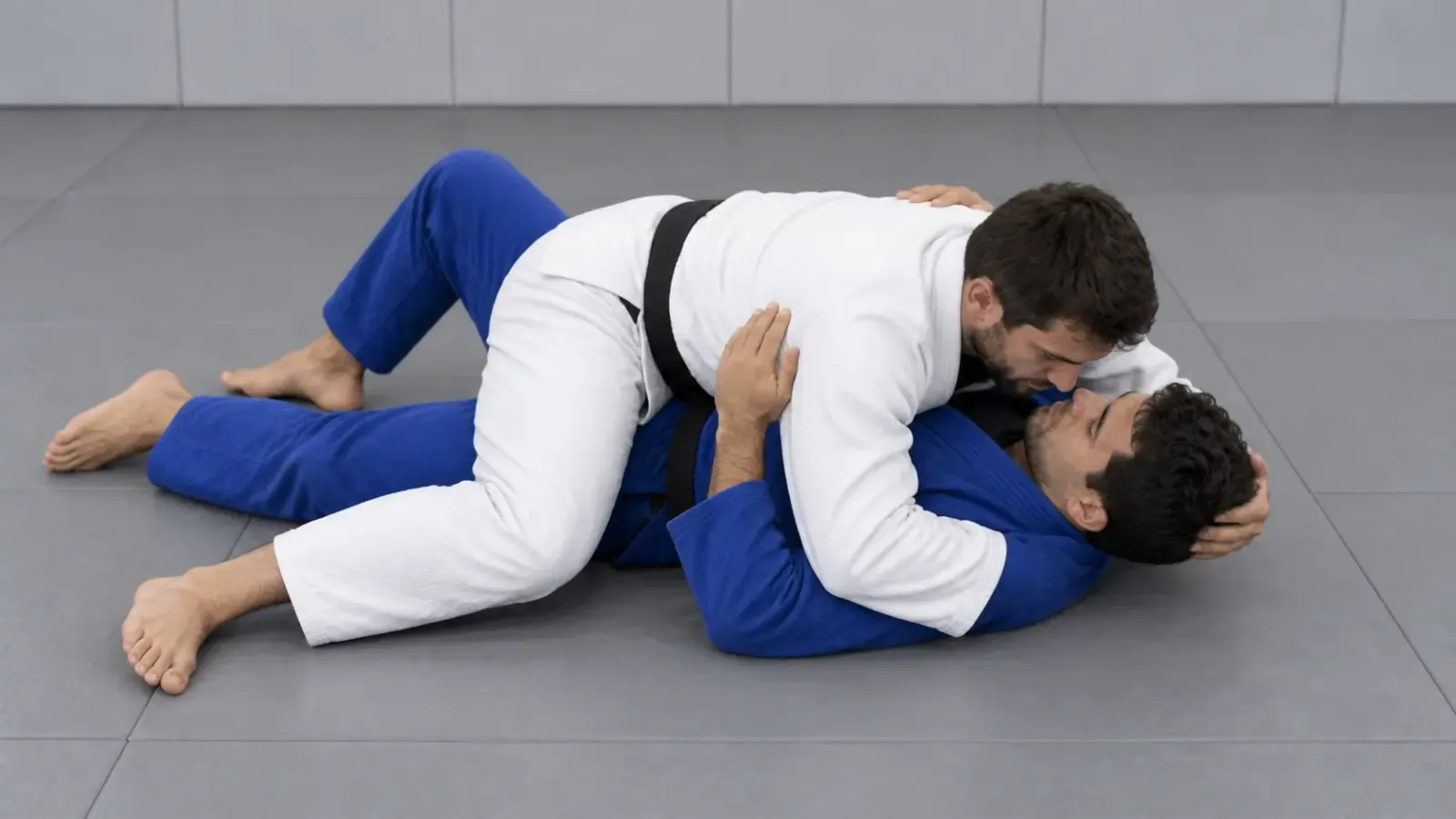
- The underhook battle. Whoever gets the underhook first usually decides the exchange. A bottom player who wins it is not defending a pass any more — they are attacking a sweep or the back.
- The knee shield. A shin across the passer’s hip denies the cutting line entirely.
- Coming up to the elbow / wrestling up. If the passer sits back or loses chest contact, the bottom player getting to their elbow and then to their knees turns the position around.
This library records the leg drag and its counter explicitly, and the same logic applies here: the pass and its defence are one exchange with a small number of decision points, not two unrelated techniques.
From underneath, the counters are much easier to find when you know which pass you are in; why your guard keeps getting passed is the same problem from the bottom.
Gi and no-gi
The mechanics are the same, and this is one of the passes that transfers most cleanly — which is part of why it became so dominant across both rulesets.
In the gi, grips make the upper-body control easier and more durable: a cross-collar grip holds the far side dead, and friction slows their hip recovery. Passes are slower and more grinding.
In no-gi, everything is faster and the underhook matters even more because there is no grip to substitute for it. Head position becomes a bigger part of the control, and the whole exchange resembles wrestling more closely.
An exchange that comes to resemble wrestling once the grips are gone is a recurring theme in gi and no-gi compared.
Drilling it
Drill the underhook fight on its own, from half guard, with neither person allowed to pass or sweep — just a two-minute round over who gets and keeps the underhook. That single drill improves the knee cut more than repetition of the pass itself.
Then drill the cut from a settled position — underhook in, far arm controlled, outside leg stapled — so that the movement is learned as the last step rather than the first.
Finally, drill the failure: what you do when they get the underhook back or turn in. A knee cut without a plan for that becomes a back-take for the other person.
Drilling the failure rather than only the success is one of the things drilling is genuinely good for.
Safety
A low-risk technique for both people, with one thing to watch. Driving your shin across somebody’s thigh with your full weight can put a lot of pressure on their knee if their foot is trapped and their hip cannot follow. Cut on a diagonal rather than grinding straight down, and ease off if your partner’s leg is stuck.
Technique varies with your body and your training partner. Ask your coach or instructor to check your chest position — sitting back is hard to feel and easy to see.
Common questions
How does the knee cut pass work? You cut a knee diagonally across the opponent’s thigh to the mat while controlling their upper body, so the pass goes through the guard rather than around it.
Where should the underhook be? Under their far armpit, on the side you are cutting towards. It stops them turning in and flattens their shoulders, which removes most of their defensive options.
What stops a knee cut? Winning the underhook, a knee shield across your hip, or the bottom player coming up to their elbow when you lose chest contact.
Why do I keep getting my back taken during this pass? Almost certainly because you are sitting back as you cut. Keep your chest forward and heavy over their shoulder.
Is it different in gi and no-gi? The mechanics are identical. The gi gives you grips that make the upper-body control easier and the pass slower; no-gi is faster and depends more heavily on the underhook and head position.
What do I do about their knee shield? It has to be cleared before you cut — a shin across your hip is a frame, and cutting into a frame does not work.