
Guard passes
Body Lock Pass
Lock your hands around their hips and take the space away. A guard needs a gap to function, and this pass is built on there not being one.
Every guard needs space to work in, and the body lock pass wins by refusing to provide any. You close your hands around the opponent’s hips, glue your chest to them, and pass with the connection never breaking. There are no grips to strip because you are not holding cloth, and there is no distance to manage because there is no distance. It is one of the few passes that is equally strong with a jacket and without one, for exactly that reason.
The connection
Your arms go around their waist or hips — under the arms, around the back, below the belt line — and your hands join behind them or on the far hip. Your head is up, your chest is on them, and your hips are low and heavy.
Low hips are the whole game. The most common failure is a body lock applied with the hips high, which turns the pass into a hug and gives the guard player room to insert a knee underneath. Hips down, connected to theirs, and the lock becomes something they cannot get anything between.
From there you do not lunge past. You walk — small steps, pressure maintained, working towards one side until their legs are no longer in front of your hips.
Where it is applied from
Most often from standing or kneeling in front of an open guard, closing the distance and locking before their feet or knees can find your hips.
It also appears once you are already past the legs, as a way of holding somebody who is trying to recompose, and from behind when an opponent turns away and gives up their hips — a rear body lock is the same connection doing a different job.
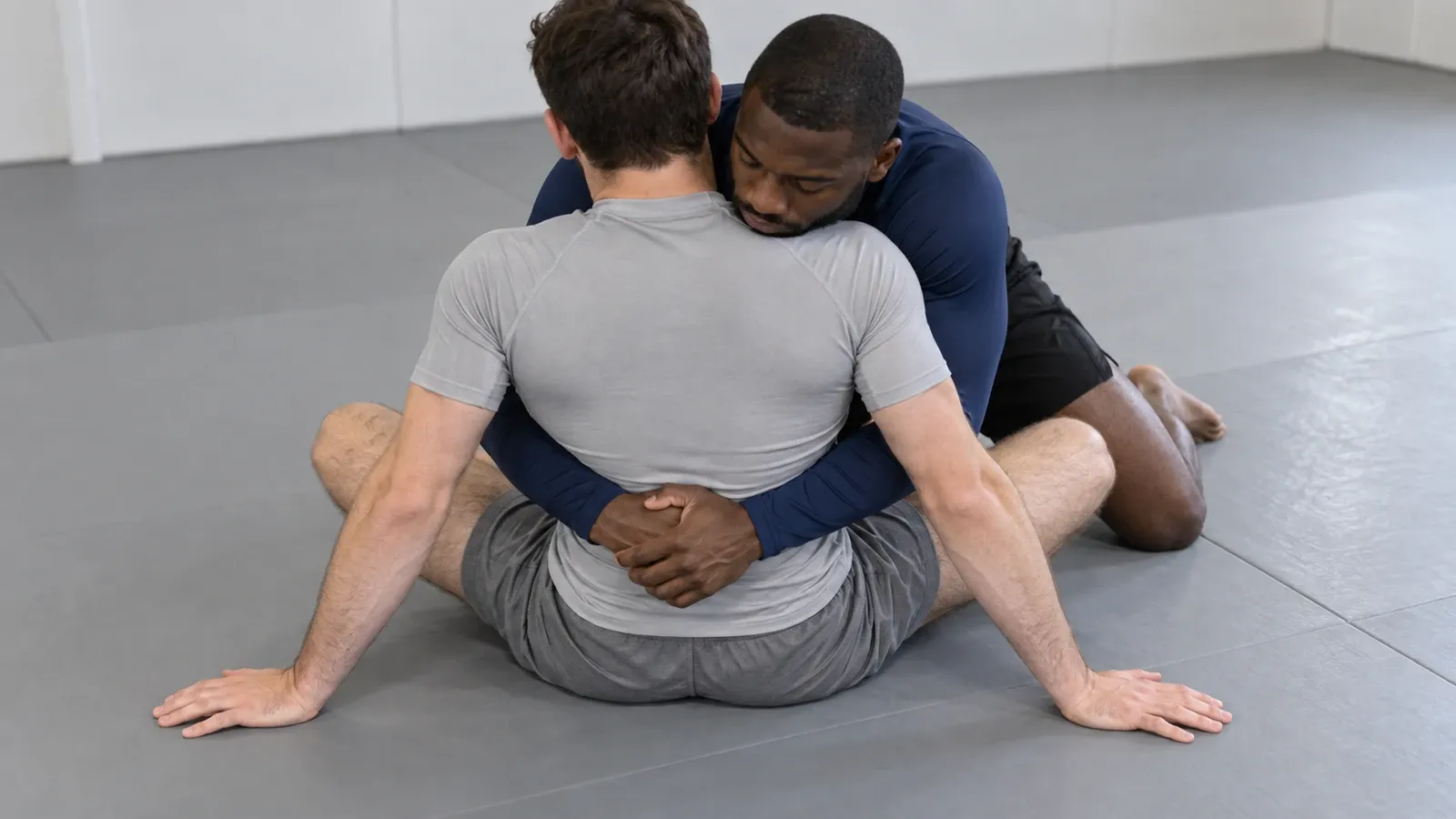
That variant is worth knowing because it is what a body lock often becomes when somebody turns to escape rather than defending in front of you. The lock does not change; the destination does, and it frequently ends at the back rather than in side control.
Why it works in both rulesets
Most passes shift considerably between gi and no-gi. This one barely moves.
A knee cut leans on grips; a torreando leans on being able to hold and steer legs, and both change character when the fabric disappears. The body lock holds a body. Sweat makes it slightly harder to keep, and that is the entire difference.
That property makes it a sensible investment for anybody splitting their week between the two, which is the practical version of the argument in gi and no-gi compared — techniques that survive the change are worth more per hour than techniques that have to be learned twice.
What beats it
- Frames into the hips, early. Before the lock closes, a forearm or shin between your hips is the cheapest defence. Afterwards it is much harder, which is why guard retention framing is the direct counter-skill.
- Getting the hips away. A guard player who can turn their hips out and get a knee back in front breaks the connection without ever fighting the hands.
- Making you carry them. If they can get their weight onto you rather than into the mat, the low hips you need become hard to keep.
- Attacking the neck. Your head is forward and your arms are committed, which is the same price the double under pass pays. Guillotines are the standard punishment for a body lock taken with the head down.
Common faults
- High hips. The defining error. It converts a pass into a hold.
- Locking the hands and stopping. The lock is a connection, not a pass. You still have to walk.
- Head down. Posture up, or you are offering a guillotine while both your arms are busy.
- Locking too high, around the ribs. Above the hips there is room for a knee. Below the belt line there is not.
- Squeezing instead of moving. A very strong squeeze that does not travel is a stalemate that tires you out faster than it tires them.
- Ignoring the exit. Know where you are going — side control on the near side, mount over the top, or the back if they turn — before you start walking.
Drilling it
Closing the lock against a seated guard player, ten times each side, with the partner only trying to frame. The skill being trained is arriving with your hips already low.
Then holding it for time while they try to insert a knee or turn out. No passing allowed. This is where you find out whether your connection is a lock or a hug.
Then the walk, with the constraint that if your chest leaves their body you restart. That constraint fixes most of what goes wrong.
And from underneath, defending it — which teaches the timing of the frames better than being told where to put them, and is the same diagnosis why a guard keeps disappearing works through.
Safety
A comparatively low-risk pass, with two things worth naming.
Squeezing a body lock hard around somebody’s ribs or lower back, especially with a size difference, is uncomfortable in a way that has little to do with passing and can bruise ribs over time. Use the lock to connect and the legs to travel, rather than clamping as hard as you can.
The other is your own neck. Both arms are committed and your head is forward, so a guillotine is available if your posture drops. Do not fight through a locked guillotine to complete a pass — let go and restart.
Always ask your coach or instructor to check your technique and practise safely at your academy.
Common questions
What is the body lock pass? A guard pass in which you lock your hands around the opponent’s hips and pass with the connection intact, removing the space a guard needs rather than fighting the guard directly.
Why are low hips so important? Because a body lock with high hips leaves a gap under your waist, and a gap is exactly what a guard player needs to insert a knee and rebuild the guard.
Does the body lock pass work the same in the gi? Almost exactly. It holds a body rather than fabric, which is why it is one of the few passes that transfers between gi and no-gi with very little change.
How do I defend a body lock pass? Frame into the hips before the hands join, and get your own hips out and a knee back in front. Once the lock is closed and their hips are low, it is a much harder problem.
Should the lock go around the waist or the hips? On or below the hip line. Locked higher, around the ribs, there is room for a knee to come through underneath.
What is the main risk when passing this way? Your neck. Both arms are committed and your head is forward, so dropping your posture makes the guillotine available.