
Guide
How to build your own Brazilian Jiu Jitsu game
At some point technique collecting stops working and you need a game — a small connected set of things that reliably lead into each other. How that actually gets built.
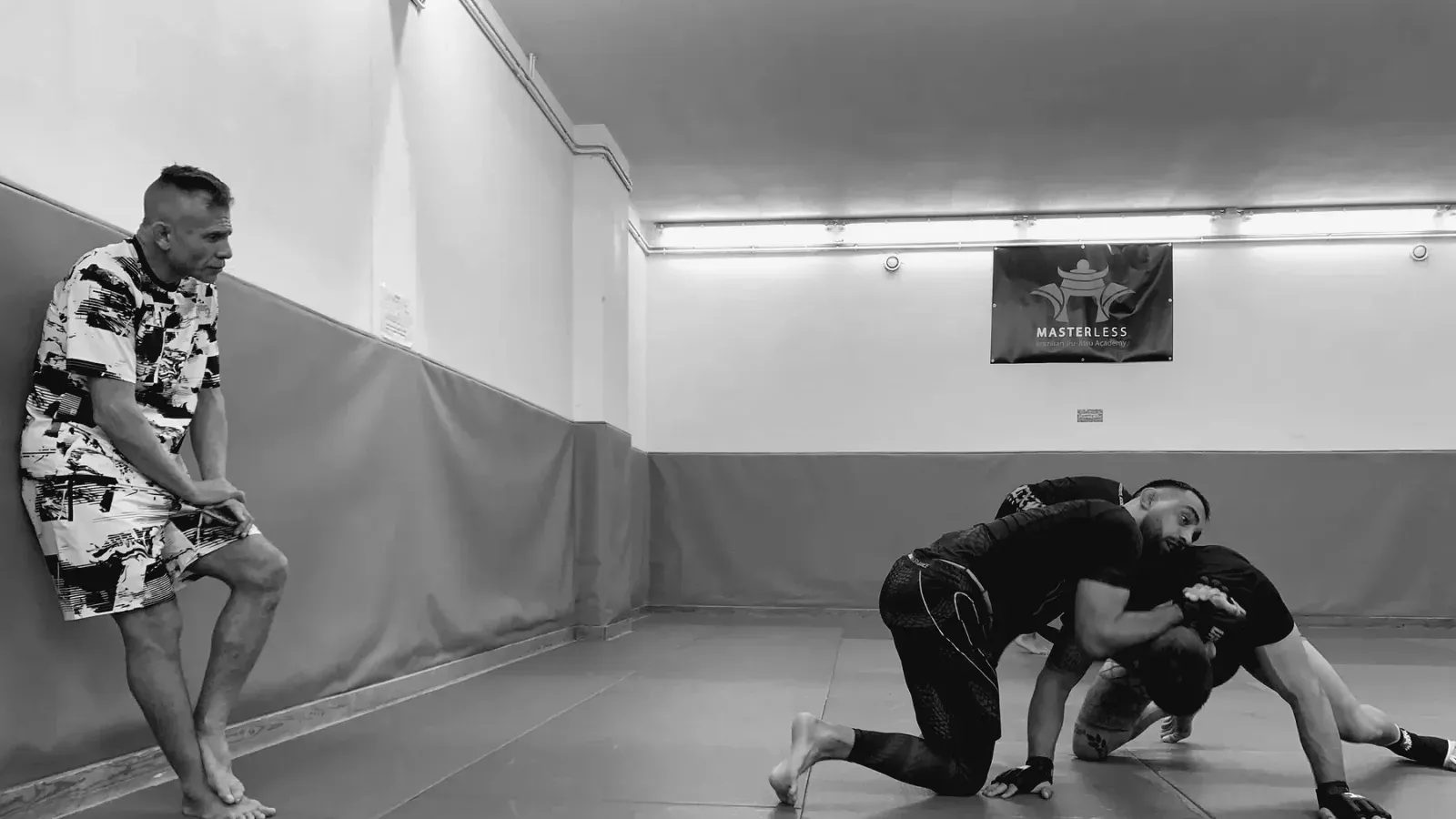
A game is a small set of positions and techniques that connect to each other, that you steer toward on purpose, and that you know well enough to use under pressure. Building one means finding the positions you already end up in, learning what comes next from them — including what happens when it fails — and resisting the urge to add a second chain before the first one holds.
For the first year or so, getting better means learning more techniques. Then, for most people, that stops working. You know a great many things, can reliably do very few of them, and rolling feels like a scramble to remember something applicable.
What a game is
The critical word is connect. A game is not a list of favourite moves; it is a set of things where each one leads somewhere you have already thought about. When the sweep works you know what you are doing from the top. When it fails you know where you have ended up and what is available there.
That is the difference between having twenty techniques and having a game. Twenty disconnected techniques give you twenty starting points and no second move — and under resistance, the second move is the whole thing, because the first one usually gets stopped.
Why collecting stops working
Every technique you learn carries a cost you do not see at first: it needs maintenance, and it competes for attention in the moment.
Under real resistance you have perhaps a second to decide. A person with four options they know cold will beat a person with thirty they half-know, every time. The thirty-option player spends that second choosing; the four-option player spends it moving.
This is also why rolling teaches badly and drilling teaches well — a game is built out of repetitions, and rolling does not supply enough of them per position to make anything automatic.
Games are found, not chosen
The most common mistake is picking a game from a video: deciding you will be a de la Riva player because somebody impressive is one.
That rarely holds, because a game has to fit your body, your build, your flexibility, your temperament and how often you train. A game that suits a flexible 60 kg person who trains six times a week will not suit a stiff 100 kg person who trains twice. Long limbs favour some things and punish others. Being older changes what you can recover from. None of that is visible in a highlight reel.
The better approach is to notice what is already working. Somewhere in your rolling there are two or three positions you keep ending up in and doing reasonably well from — usually not the ones you think, which is a problem worth taking seriously.
How one actually gets built
Roughly, and slowly:
- Find your starting position. One place you already end up often and do not hate. Not the most impressive one — the most frequent one. Frequency is what makes the investment pay.
- Learn what comes next from there. Two or three things, and specifically what happens when each fails. The failures are where the connections come from, and they are the part people skip.
- Work backwards. How do you get to that position on purpose, rather than by accident? A position you only reach by luck is not yet part of a game.
- Work forwards. When the technique works, where are you, and what do you do from there? A sweep that lands you somewhere you do not understand has half-solved your problem. The ranking underneath all four steps is position before submission — a game is a route through that hierarchy rather than a list of finishes.
- Repeat, once the first chain holds. Not before. A second chain built on an unfinished first one is technique collecting with extra steps.
This takes months per chain. That is the normal rate, and being impatient with it is how people end up back where they started.
A concrete example
Suppose you notice you spend a lot of time in closed guard on the bottom — not because you chose it, but because that is where you end up when somebody takes you down.
A first chain might be: one sweep, one submission that threatens from the same grip, and one answer for when they stand up. Three things, all from one position, each connected to the others: they defend the sweep and the submission opens, they defend both and they have to stand, and now you are in the third scenario, which you have also thought about.
That is a game — a small one, but a real one. Compare it with knowing nine techniques from closed guard, none of which you have connected, all of which you attempt in isolation and abandon when the first defence appears.
The specific techniques matter far less than the structure. Almost any three that genuinely connect will beat any nine that do not.
A short chain of that kind might be an arm drag to the back, or taking the back from mount when they turn away, with the strangle from the back waiting at the end of both.
Common mistakes
- Building from a position you rarely reach. Flashy, and it will not come up.
- Adding a second chain too early. The most common one. It feels like progress and is not.
- Ignoring the top game entirely. Guard players who never develop passing spend years being swept and having no idea what to do next.
- Copying a body type you do not have.
- Never revising it. Games change with injuries, age, training partners and what stops working. A game you built at blue belt will not all survive to purple.
The part that is hard to do honestly
Every step above depends on knowing what actually happens in your rolling, and that is exactly what memory is worst at.
Ask most people which position they end up in most often and they will name the one they like. Ask which submission they attempt most and they will name the one they finished most recently. The gap between those answers and the truth is where a game gets built or does not.
Closing it needs something better than recall — which is the argument for writing it down, and the reason measuring progress properly is a prerequisite rather than a nice-to-have. You cannot build a game around your most frequent position if you do not know which one that is.
What a game is not
It is not a rigid script — good grapplers have a game and improvise constantly around it. It is not permanent. And it is not narrow in a limiting way: having a game makes you more able to handle the unexpected, because you always have somewhere to steer back toward.
The people who look like they have no game usually have a very good one that has stopped being visible, because what works has become invisible to them and reads as instinct from the outside.