
Sweeps
Half Guard Underhook Sweep
Use the underhook from half guard bottom to come up into the dogfight, and take the top position from there. The position comes first; the sweep is what follows.
This is the sweep that made half guard an attacking position rather than a place people ended up. You take the underhook from the bottom, come up onto your side into the dogfight, and from there the top position is available several different ways. What makes it reliable is the order: the position comes first and the sweep is a consequence, which is the opposite of how most people try to do it.
Where it starts
Half guard, bottom, with an underhook on the far side.
Half guard is one of the guards worth learning as a system rather than a fallback, and the main types of guard sets out where it sits.
Getting that underhook is the whole precondition, and if you are flat on your back you are not going to get it. The sequence before this sequence is usually a knee shield to buy distance, then turning onto your side and pummelling the arm through. People who cannot make this sweep work are usually failing one step earlier than they think.
The real work: getting to your side and freeing your head
Two things have to happen before anything resembling a sweep.
Get onto your side. Flat, your underhook is an arm you are holding up. On your side, it is connected to their hips and you can drive off your bottom leg.
Free your head. This is the step people skip and it is the one that decides the exchange. If your head is trapped under their chest or turned by a cross face, you cannot come up regardless of how good the underhook is. Your head has to come up and to the outside of their shoulder, on the same side as the underhook.
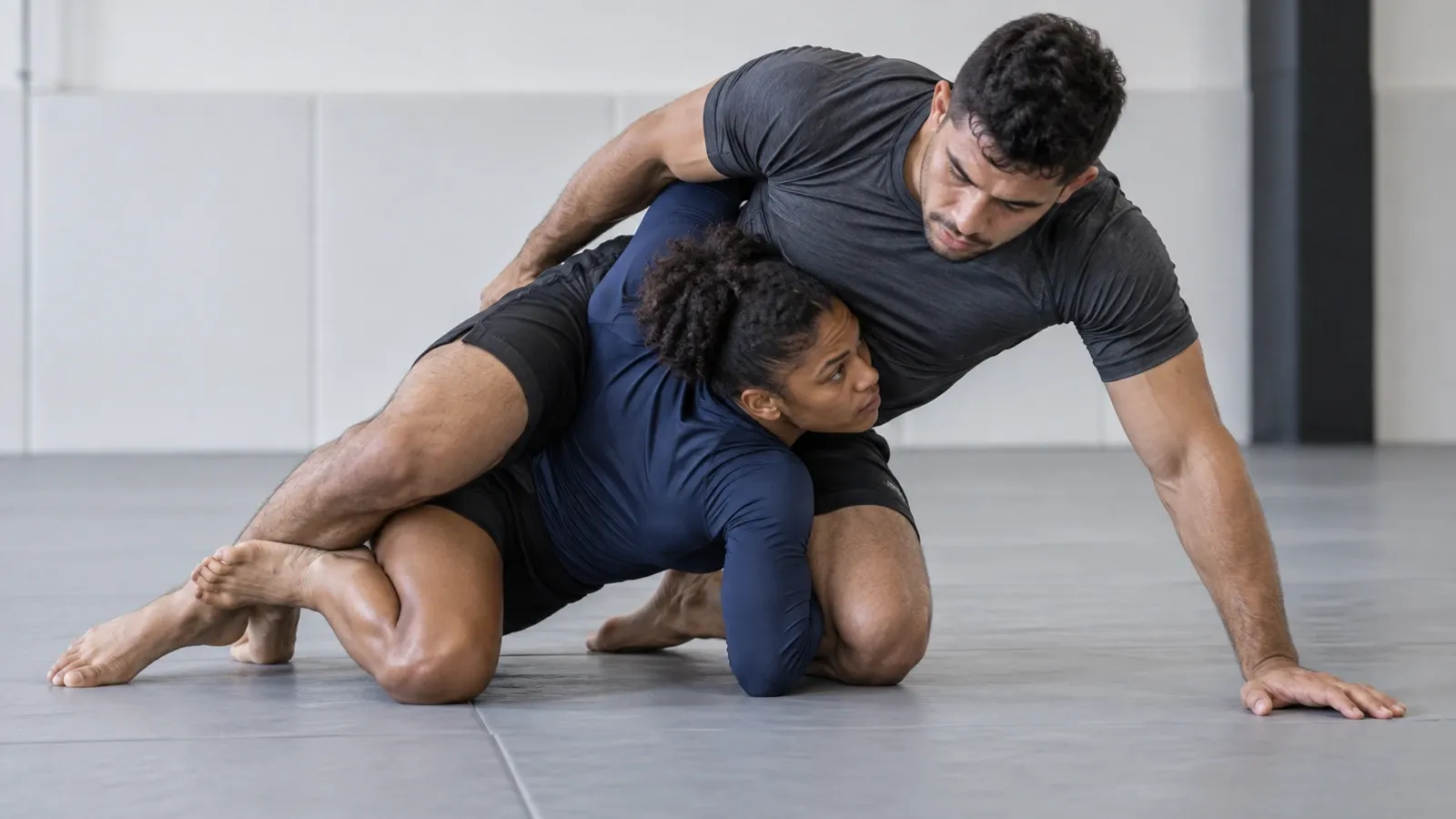
Head free plus underhook plus being on your side is the dogfight, and arriving there is roughly ninety per cent of the job.
The dogfight, and the finishes it offers
From the dogfight — both of you on your knees and hips, chest to chest, you with the underhook — the sweep is not one technique. It is a small menu, chosen by what they do:
- They post the far hand and lean away: take the near leg or run the corner and come up on top.
- They drive into you: use their pressure, sit through to the side and come up behind their shoulder.
- They whizzer your underhooking arm: expect this, it is the standard answer. Switch direction, take the back or attack the far leg rather than fighting the whizzer head on.
- They defend everything and stall: come up to a single leg, which is often there and almost always ignored.
Having several answers rather than one is what makes the position hold up against resistance, and it is the same structural point that runs through what every sweep needs — sweeps that depend on one reaction fail against anybody who gives a different one.
Why it fails
- No underhook, or a shallow one. A hand resting on their side is not an underhook. It reaches their back.
- Still flat. Everything after this step assumes you are on a hip.
- Head trapped. The single most common reason a technically correct underhook produces nothing.
- Coming up without the bottom leg. Your trapped leg is the thing you push off; people forget it is doing anything.
- Fighting the whizzer. Muscling against an overhook is a losing exchange. Change direction instead.
- Stopping at the top of the dogfight. Arriving on your knees and stalling there gives them time to re-flatten you. The dogfight is a transition, not a destination.
How the top player stops it
Worth knowing, because it tells you what you are racing:
- Cross face first. Kill the head and the underhook stops mattering.
- Whizzer the arm and drive the hip down into your shoulder.
- Flatten the shoulders. A bottom player on their back is not sweeping anybody.
- Back-step or switch sides, so the underhook is pointing at nothing.
The exchange is genuinely even, which is why half guard is one of the more interesting positions in the sport rather than a bad place to be.
Drilling it
Get to the dogfight, ten times a side, and stop there. No finish. The drill is the entry, because the entry is the part that fails.
Then add the finishes, one reaction at a time. Partner posts, you take the corner. Partner drives, you sit through. Partner whizzers, you switch. Building the menu deliberately is better than hoping to find it live.
Then live half guard rounds from the bottom, with the top player’s only job being to flatten you. Both people learn the position faster this way than in open rolling, where half guard tends to be something that happens rather than something you practise.
Safety
A comparatively safe technique, with two practical notes.
Coming up into the dogfight puts your head and neck against somebody’s chest and hip while they may be driving down. Do not force your head through a gap that is closing — that is how necks get compressed in half guard scrambles — and if their weight settles, reset rather than grinding through.
The other is the landing. When the sweep works, somebody goes over, and you are frequently coming up on top of a knee or an ankle that is still trapped. Come up cleanly rather than twisting through a leg that has not been released, for their sake and for your own knee.
Always ask your coach or instructor to check your technique and practise safely at your academy.
Common questions
What is the half guard underhook sweep? A sweep from half guard bottom that uses an underhook to come up onto your side into the dogfight, from which the top position is taken in one of several ways.
Why can I not come up even with the underhook? Almost always because your head is still trapped, or because you are on your back rather than on your side. The underhook alone does not lift anybody.
What is the dogfight? The position you arrive in partway through: both players up on knees and hips, chest to chest, with the bottom player holding the underhook. It is a transition, not a place to settle.
What do I do if they whizzer my arm? Change direction rather than fighting it — take the back, attack the far leg, or come up to a single leg. Muscling through a whizzer is the losing option.
Is half guard a defensive position? Not with the underhook. Flattened and without it, it is defensive; on your side with the underhook it is one of the better attacking guards.
Does this sweep work without a gi? Yes. It depends on an underhook and body position rather than grips, so it transfers almost unchanged, and it is a staple of no-gi half guard.