
Escapes
Technical Stand Up
The safe way back to the feet, and one of the first things taught in any academy — because standing up badly hands the position straight back.
Anybody can stand up. The problem is standing up in front of somebody who wants you back down. The technical stand up solves that by keeping a hand and a leg posted between you and the opponent the whole way, so that at no point in the movement are you upright, square and undefended.
It is taught in the first weeks of training, alongside the hip escape and the bridge, and it stays in use forever — it is how experienced players disengage, reset, and get back to their feet in competition.
Where it comes from
Three positions in this model: turtle bottom, front headlock (defending), and knee shield half guard. What they share is being on the ground, in front of somebody, needing to be on your feet.
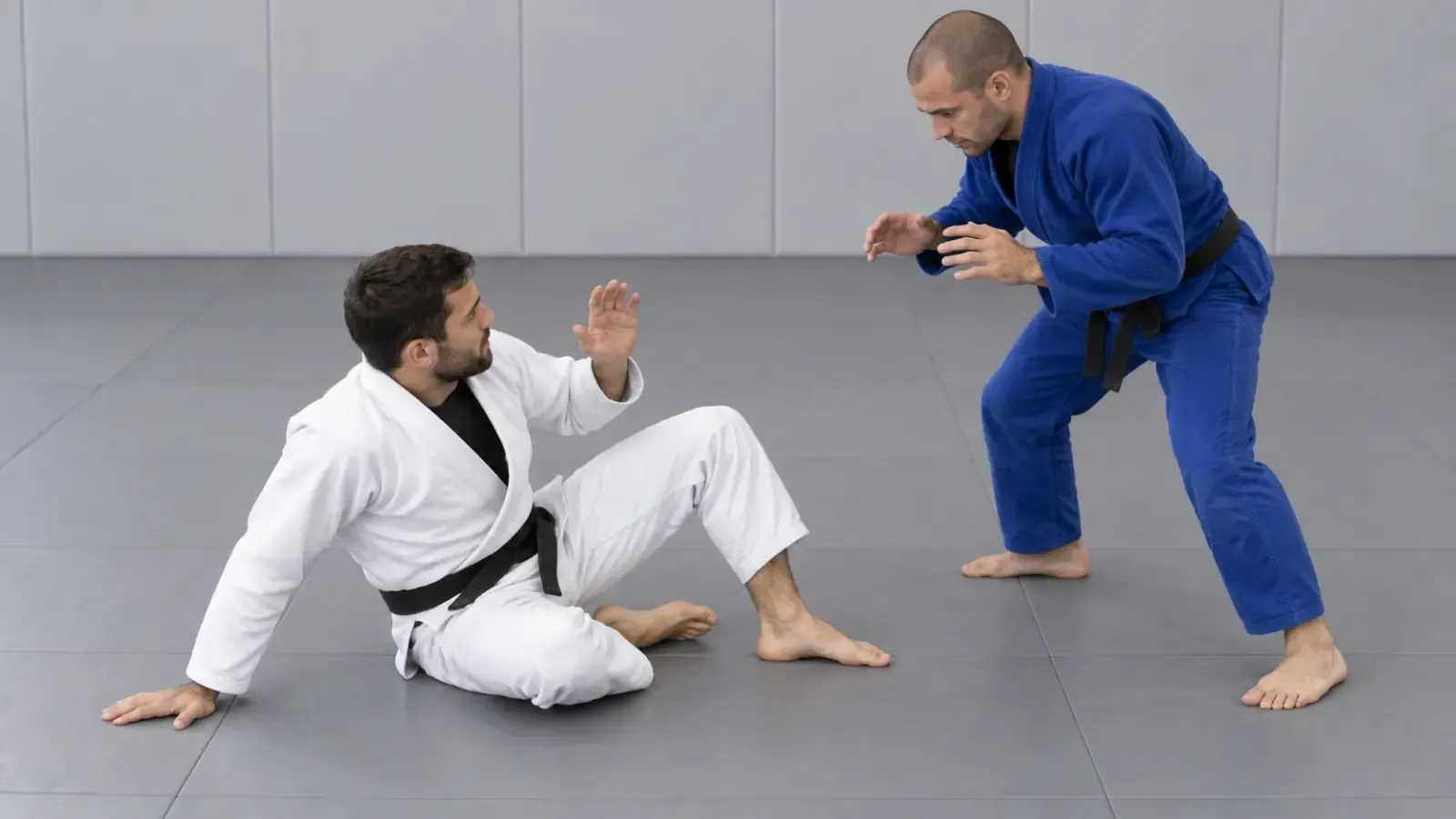
The most common situation of all is simpler than any of those: you are sitting on the mat in an open guard and you have decided to stand.
It is usually taught in the first weeks, alongside the other things worth prioritising early; what to focus on as a white belt covers the rest of that list.
The structure
The whole technique is one rule, and the taxonomy states it precisely: the posting hand and the rear leg never cross.
Concretely, from seated:
- Post one hand behind you, flat on the mat, on the same side as the leg you are going to keep underneath.
- Plant the opposite foot flat in front of you, knee up, between you and the opponent.
- Lift your hips off the mat, supported by the posted hand and the planted foot.
- Swing the rear leg through the gap — behind the posted hand and under your own body — and bring it back to stand.
- Come up facing them, with your free hand up and in front.
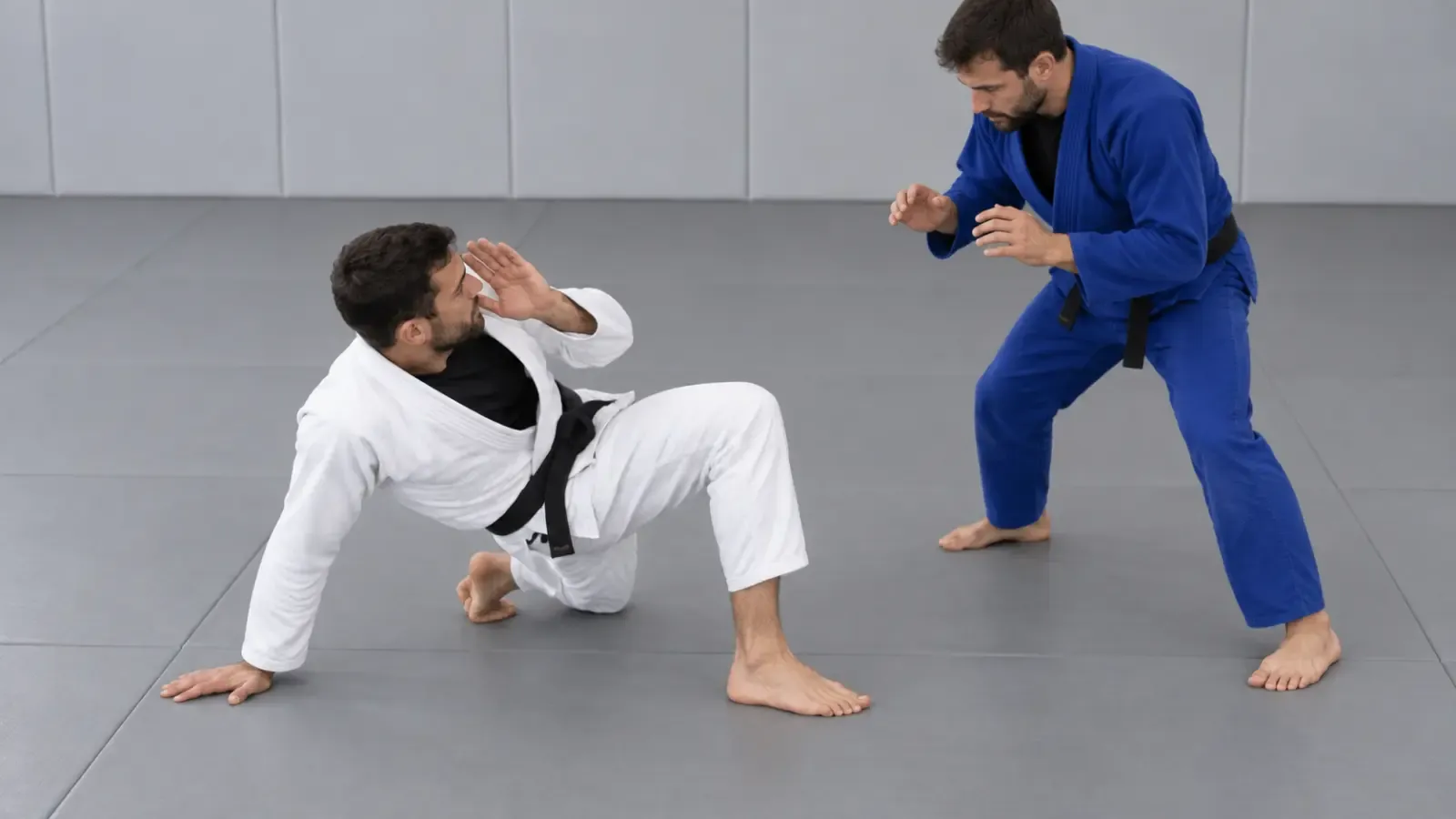
At every point in that movement there is a limb between you and them. That is the difference between this and simply standing up.
Why standing up square is punished
If you get to your feet facing them with both feet level and your weight even, you have offered a neutral stance to somebody who is already closer than you are and who has just had time to prepare. The taxonomy’s own note is the short version: standing up square invites an immediate takedown.
Two things go wrong specifically:
- Your legs are reachable. Both of them, at the same distance, with your weight settled.
- Your posture arrives late. You are still finding your balance when they are already moving.
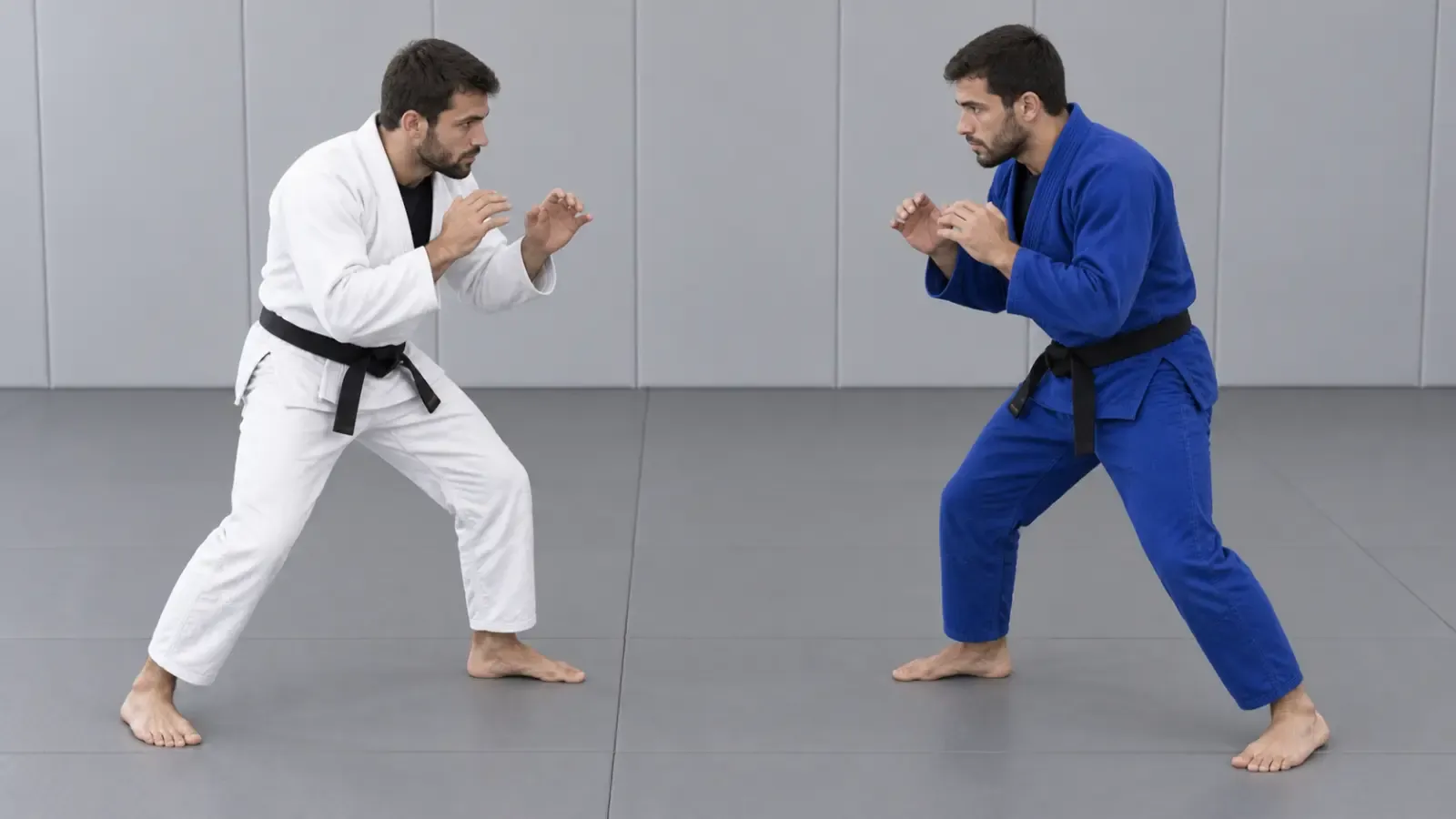
The technical stand up avoids both because you arrive staggered, with one leg already back and one hand already up.
Common mistakes
- The posting hand crosses the body. Now your shoulder is turned, your structure is gone, and the arm is available to them.
- Looking at the mat. Eyes on the opponent throughout. People look at their own hands.
- Standing up too slowly in stages. The lift and the leg swing are one movement, not two.
- Getting up too close. The stand up should create distance as well as height; drifting upright within their reach gives away the benefit.
- Dropping the free hand. It is the frame that keeps them from closing as you arrive.
- Practising on one side only. Very common, and it shows up immediately in a live scramble.
Where it fits in a game
More places than its simplicity suggests:
- Disengaging from bottom guard. The standard way to reset to standing rather than playing a guard you do not want.
- From turtle. One of the ways out that does not involve giving up the back, which is the usual price of the alternatives.
- After a failed takedown or in a scramble, when you need to be on your feet before they settle.
- Under a front headlock, where getting your hips up and your head out is the priority and this movement supplies both.
In competition it is also how players reset the position deliberately — standing up is a legitimate strategic choice, not only an escape.
Standing up as a deliberate choice rather than an escape is the sort of decision that belongs to a game you have actually planned.
Gi and no-gi
Both, and essentially unchanged, which is unusual. Nothing in it grips anything.
The one practical difference is friction: in the gi, the fabric on the mat slows you slightly and a grip on your jacket gives them more ability to drag you back down as you rise. In no-gi you move faster but so do they, and the free hand matters more because there is less to hold onto on either side.
A movement that changes only in friction is about as close to unchanged as anything gets between gi and no-gi.
How to drill it
Solo, both sides, repeatedly. This is a movement drill and belongs in a warm-up. Sit, post, lift, swing, stand, sit back down, repeat. Alternate sides deliberately — almost everybody has a strong side and a side they have never trained.
Then with a partner applying pressure, standing in front of you and trying to close the distance as you rise. That is the version that teaches you to create distance rather than just height.
Then from turtle and from a front headlock, where the movement is the same but the starting structure is worse.
It is one of the few techniques that genuinely improves without a partner, which is most of what solo training is good for.
Safety
The lowest-risk technique in this library: no joint is loaded and nothing is applied to anybody.
The only things worth mentioning are your own wrist — the posting hand takes real weight, so post on a flat hand rather than a bent one — and your surroundings, since standing up quickly in a crowded class is a good way to collide with somebody.
Always ask your coach or instructor to check your technique and practise safely at your academy.
Common questions
What is a technical stand up in BJJ? A way of standing up from the ground while keeping a hand and a leg posted between you and the opponent, so you are never square and undefended during the movement.
Why not just stand up normally? Because standing up square in front of somebody who is already close hands them an easy takedown. The technical version arrives staggered, with a frame up and a leg already back.
Which hand should I post? The one on the same side as the leg that stays underneath. The posting hand and the rear leg never cross — that rule is the technique.
Where should I be looking? At the opponent, throughout. Looking at the mat or at your own hands is the usual beginner error.
Is the technical stand up the same in no-gi? Yes, essentially unchanged. Nothing in it depends on grips.
Is it only for beginners? No. It is taught early because it is fundamental, and it stays in use at every level — including as a deliberate way to reset the position in competition.