
Escapes
Sprawl
The answer to a leg attack: hips thrown down and back so your weight lands on their shoulders and the shot collapses. The first line of takedown defence, before hands are involved.
A shot is stopped by weight arriving in the right place, not by hands pushing somebody away. The sprawl throws your hips down and back so that your bodyweight lands on the shoulders of the person shooting, and their entry folds underneath it. It is the first and most important layer of takedown defence, and it is almost always the answer before grips become relevant.
The movement
As they change levels and step in, your legs kick back and your hips drop. Your chest comes down onto their upper back or the back of their shoulders. Your head goes to one side of their body rather than straight over the top.
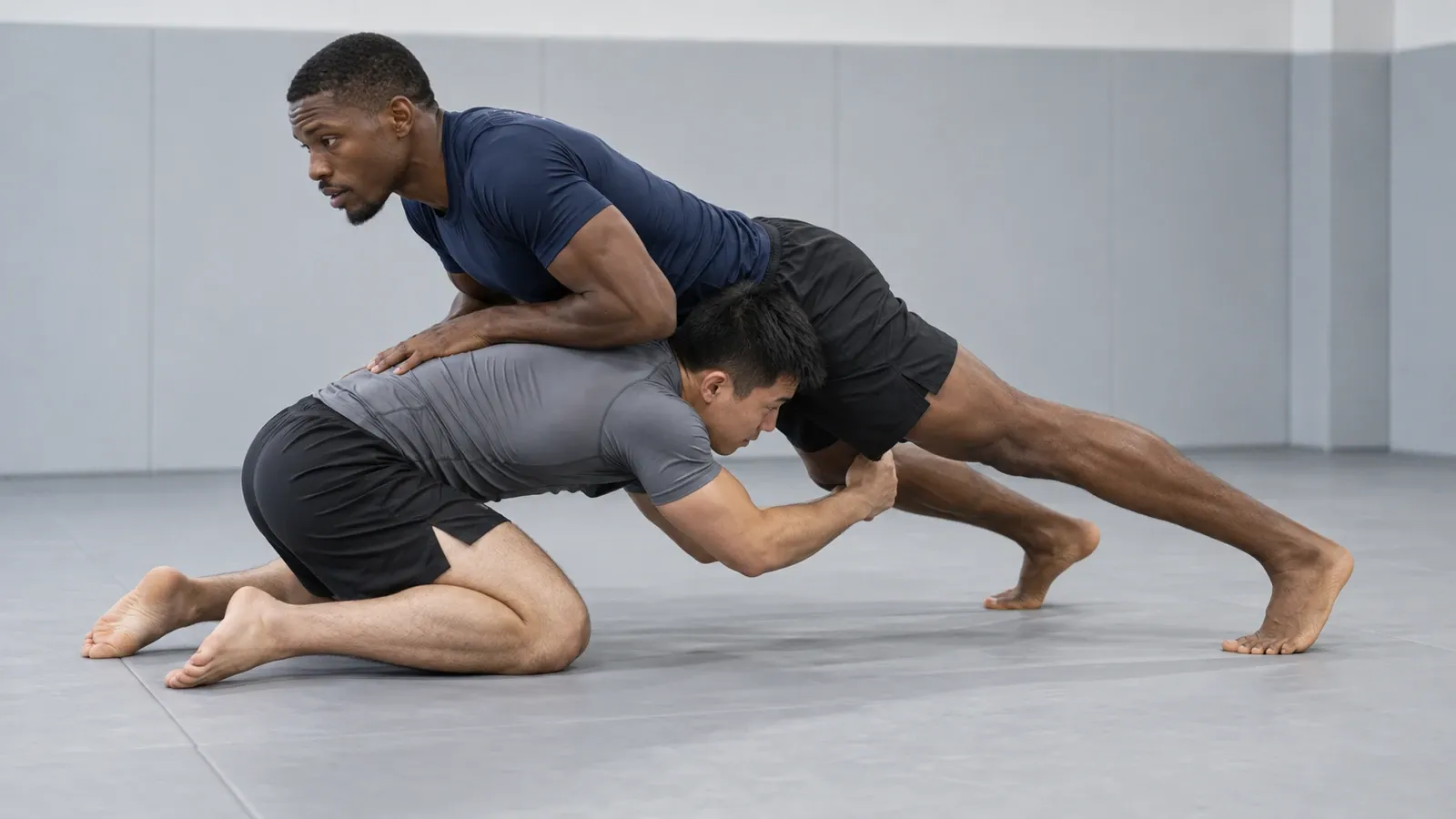
The legs go back, not just down. This is the detail that separates a sprawl that stops a shot from one that merely slows it. Dropping your hips straight down puts your weight beside their drive rather than on top of it, and a committed attacker simply keeps going. Kicking the legs backwards is what gets your hips over them, and hips over the attacker is what makes the position collapse.
Two supporting details:
- Weight goes through the chest, not through the arms. Arms pushing on a head are a lever somebody drives under.
- Hips stay heavy and low for a beat after the sprawl lands. People bounce straight back up and hand the position back.
Why it comes first
Takedown defence has layers: distance and stance, hand fighting, the sprawl, and then the specific answers to a leg already held. Most beginners try to skip to the last one, which is why they spend so much time defending single legs.
The sprawl sits early in that order because it deals with the attack while it is still an attempt. Once somebody has your leg, you are into the whizzer and a much harder problem. The same argument runs through the standing game and how to build it: the shot is easier to stop than the finish is.
What it leads to
A sprawl is not only defensive, and this is the part people underuse. If it lands well, the person who shot is bent over in front of you with their head down and their hips back — which is a gift.
- The front headlock. The standard follow-on, and the hub that everything else runs through.
- The guillotine. Available immediately, because a head-down shot is precisely the position the choke was built for. Both the double leg and the single leg articles name this as the price of shooting badly.
- The go-behind. Often the best option: circle to their back while they are still low.
- Their turtle, if they survive the first two, which leaves you on top and attacking.
So the sprawl is where defence turns into offence in the standing game, and treating it as purely defensive costs you most of its value.
Why it fails
- Hips dropped without the legs going back. The most common version. Your weight is next to the drive rather than on it.
- Sprawling too early. A fake draws it, and a sprawl on nothing leaves you low with your hips back — which is a reasonable thing for them to attack.
- Sprawling too late. Once their head and shoulder are past your hip, the sprawl has nothing to land on.
- Coming back up immediately. The position is won in the seconds after the sprawl, not in the sprawl itself.
- Head straight over the top. It should be off to one side, or you are offering your own neck.
- Trying to sprawl with the arms. Pushing a head down while your hips stay forward is not a sprawl; it is an invitation.
Drilling it
Solo, on a whistle or a call. Stance, level change, sprawl, back to stance. It is one of the few takedown-related things that trains well without a partner, and it needs to be a reflex rather than a decision.
Then reactive, with a partner shooting at fifty per cent, unannounced. The skill being trained is timing, and timing cannot be drilled against a shot you knew was coming.
Then sprawl-to-position, chaining into the front headlock and the go-behind rather than stopping when the shot is stopped. This is the half most gyms skip.
And from the other side. Taking shots on somebody who sprawls well is the fastest way to understand what a good entry has to do — which is the argument for drilling and rolling doing different jobs rather than one covering for the other.
Safety
Lower risk than the takedowns it defends, but two things deserve care.
Your bodyweight lands on somebody’s neck and upper back. Dropping onto a partner’s cervical spine from height, or driving the chest down onto the back of a bent neck, is a real way to hurt somebody who is doing you the favour of shooting. Land on the shoulders and the upper back, and control the descent rather than collapsing.
The other is your own knees: sprawling hard onto a mat with the knees taking the impact, repeatedly, adds up. Land on the balls of the feet and the chest, not on kneecaps.
Always ask your coach or instructor to check your technique and practise safely at your academy.
Common questions
What is a sprawl in Brazilian Jiu Jitsu? A takedown defence in which you throw your hips down and your legs back so your weight lands on the shoulders of somebody shooting for your legs, collapsing their entry.
Why do my legs need to go back rather than just down? Because hips have to end up over the attacker. Dropping straight down puts your weight beside their drive instead of on top of it, and a committed shot goes through that.
What should I do after a successful sprawl? Stay heavy for a beat, then take the front headlock or circle behind. Standing straight back up gives away the position the sprawl just earned.
Is the sprawl the answer to both the double leg and the single leg? It is the first answer to both. Once a single leg is already held, the whizzer becomes the more relevant tool.
Can I practise sprawling on my own? Yes — it is one of the best solo drills in grappling. What you cannot train alone is the timing, which needs somebody actually shooting.
Why do I keep getting taken down even though I sprawl? Usually timing: too early against a fake, or too late once their shoulder is past your hip. Both are fixed by reactive drilling rather than by sprawling harder.