
Escapes
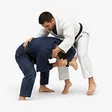
Whizzer
The overhook that answers a single leg: hip driven down into their shoulder until their level rises and the leg comes free. The sprawl's standing partner.
The sprawl answers a shot; the whizzer answers a leg somebody already has. You overhook their near arm, drive your hip down into their shoulder, and keep driving until their posture rises and the leg they were holding is no longer worth holding. It is one of the few grappling techniques where the name — a wrestling word for the overhook used this way — is more obscure than the mechanic.
The position
Their arm is around your leg. Your arm on that side comes over the top of their near arm, wrapping it at the shoulder or upper arm. From there:
- Your hip drops onto their shoulder, driving down and slightly across.
- Your chest stays over them, not upright.
- The trapped leg stops fighting to get out and instead becomes something you are standing on while you work.
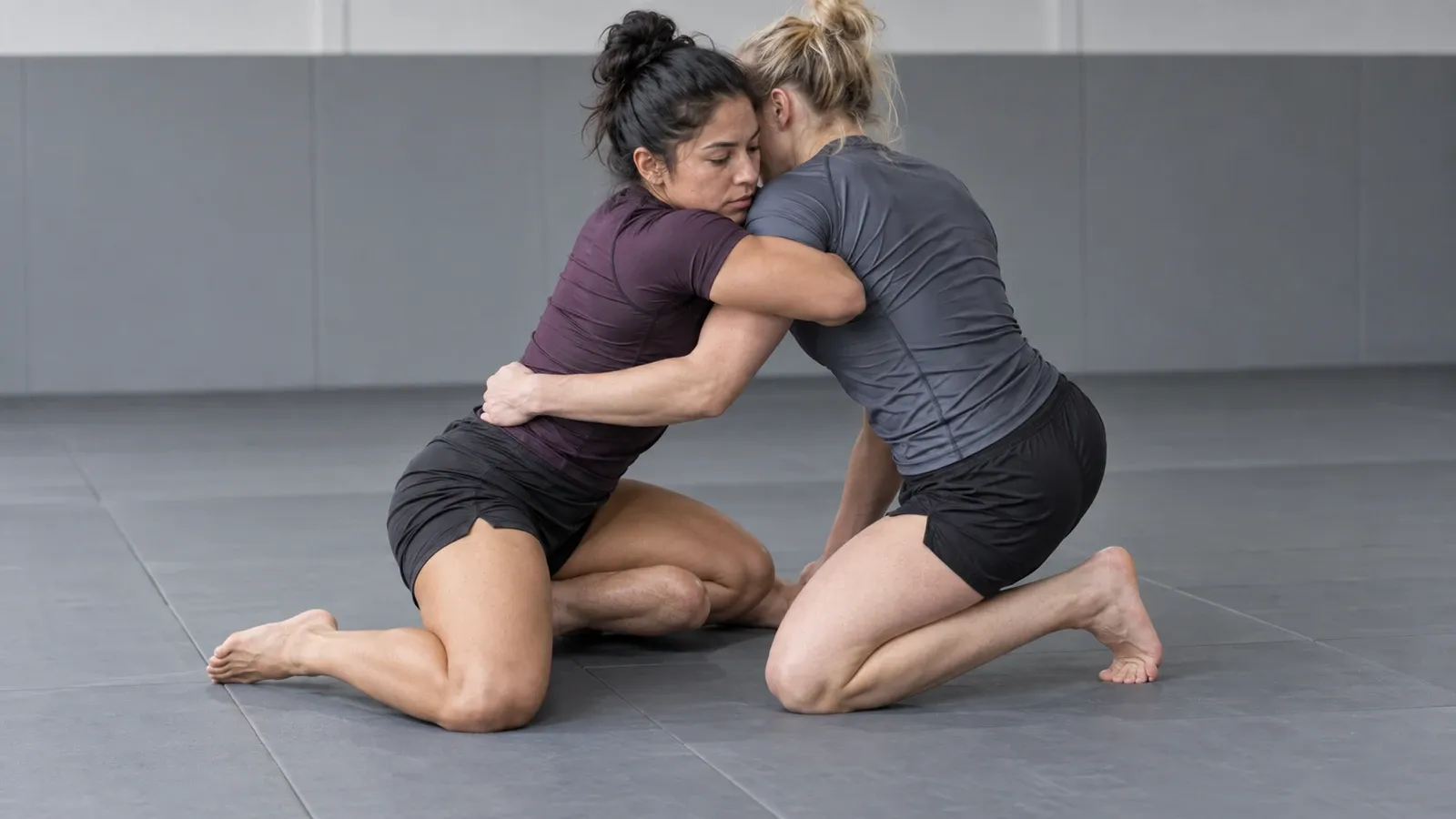
The picture people carry is of somebody squeezing an arm very hard. That is not it.
The hip does the work
A whizzer without hip pressure just gets run through.
Squeezing the overhook is the instinct and it produces almost nothing, because their arm is stronger in that direction than yours is and because arm pressure does not change their level. What changes their level is weight arriving on the shoulder: as your hip drives down, their shoulder is pushed towards the mat, their head comes up, and a person whose head has come up cannot finish a single leg.
Once their level rises, the leg comes free almost on its own. That is the whole mechanism, and it is why the technique works for people who are not strong.
Where it fits against the single leg
The single leg article names the whizzer as the counter you will meet constantly, and it is worth understanding from both sides.
From the attacker’s point of view, a whizzer is a problem with a time limit — they have to change direction or finish before your hip settles, which is why that article insists a single leg is dynamic and stalls quickly. From the defender’s point of view, the whizzer is what buys you the time to get the leg back or to start your own attack.
It sits in the same family as the sprawl without being interchangeable with it. Sprawl for the shot, whizzer for the leg. Trying to sprawl on a leg that is already held mostly means hopping backwards.
What it turns into
A whizzer is not only defensive, and the offensive exits are the reason good wrestlers like the position:
- Recovering the leg, which is the simplest and often the right answer.
- The go-behind, by circling towards their back as their posture rises.
- A front headlock, if their head drops as they try to re-shoot — the front headlock is a short step from here.
- A throw over the whizzer in gi and judo contexts, using the overhook as the connection.
It is also, in half guard on the ground, the answer to somebody’s underhook — the same overhook doing the same job at a different altitude. Worth knowing that the word covers both.
Where it goes wrong
- Squeezing instead of driving. The defining error. Arms are not what moves somebody.
- Standing upright. A tall whizzer has no weight in it. Your chest has to be over their shoulder.
- Hopping. Hopping away on the free leg while holding an overhook is the most common thing beginners do, and it postpones the problem without solving it.
- Whizzering with the wrong arm. It has to be the arm on the side of the trapped leg.
- Forgetting the second hand. Your free hand should be doing something — on their hip, on their head, on the mat — rather than hanging.
- Holding it forever. A whizzer is a transition. If their level has not changed after a few seconds, you are in a stalemate that favours whoever is fresher.
An honest note on the name
Outside wrestling rooms, “whizzer” and “overhook” get used loosely and sometimes interchangeably. They are the same limb doing different jobs: a guard overhook controls posture, and a whizzer defends a takedown by driving into a shoulder. If somebody in your gym uses one word for both, they are not wrong, and the distinction is worth keeping in your own head anyway because the two are trained completely differently.
Drilling it
Start with the leg already taken. There is no point drilling the whizzer from neutral — the position it answers is a single leg in progress, so that is where the repetition starts.
Whizzer and drive, with a partner giving graded resistance. The measure of success is their level rising, not the leg coming out. If you are watching for the leg you will squeeze; if you are watching for their head you will drive.
This is also one of the clearest reasons to spend time on the standing game rather than postponing it, which is the argument spending real time on the feet makes at length.
Then the exits: recover the leg, go behind, re-attack. A whizzer drilled with no exit becomes a habit of stalling in the position.
And from the attacking side, learning to change direction the moment the overhook lands. The counter and the counter-counter are the same drill from two ends, and rotating between them is exactly the kind of work drilling does better than a free round.
Safety
The shoulder being driven into is the joint to think about.
Hip pressure onto a shoulder that is already loaded by holding a leg can put real force through it, especially if you drop suddenly rather than settle. Build the pressure rather than throwing your weight, and stop if a partner signals — a shoulder complaining under a whizzer is a legitimate stop, not a soft one. Your own knee is the other consideration: the trapped leg is planted and twisted under load, so do not fight to keep it if a scramble is turning it.
Always ask your coach or instructor to check your technique and practise safely at your academy.
Common questions
What is a whizzer in grappling? An overhook on the opponent’s near arm, combined with hip pressure down into their shoulder, used to defend a single leg by forcing their level up until the leg comes free.
Is a whizzer just an overhook? The grip is an overhook. The whizzer is that grip used with hip pressure to defend a leg attack, which is a different job from a guard overhook that controls posture.
Why is my whizzer not working? Almost always because you are squeezing the arm rather than driving your hip into their shoulder. The arm holds the connection; the hip creates the effect.
Should I whizzer or sprawl? Sprawl if the shot has not landed. Whizzer if they already have the leg. Trying to sprawl on a leg they are holding rarely works.
What can I attack from a whizzer? Going behind them as their posture rises is the usual one, with a front headlock available if their head drops again.
Does the whizzer work on the ground as well? Yes — the same overhook is used from half guard top against the bottom player’s underhook, doing the same job of stopping them coming up.