
Movement
Breakfall
Landing without damage: the arm slaps, the chin tucks, and the impact spreads across your back instead of arriving on a wrist. The first thing taught and the last thing to neglect.
No breakfall has ever won an exchange, and it is still the most valuable thing in a beginner’s first month. Landing properly is what makes it possible to train throws and takedowns at realistic speed, and it is the difference between a long training career and one interrupted by a wrist you landed on in your third week. The Japanese name, carried into jiu jitsu through judo, is ukemi.
What a good landing looks like
Three things happen at once:
The arm slaps. Your arm comes down flat, palm down, at roughly forty-five degrees from your body, hitting the mat at the same moment your back does. It is not there to hold you up — it spreads the impact and, just as importantly, it stops you instinctively reaching backwards with a straight arm, which is how wrists and elbows get hurt.
The chin tucks. Look at your own belt. A tucked chin keeps the back of your head off the mat, and the head is the one part of this that does not heal quickly.
The impact spreads. You land across the broad flat of your back or along the side of your body, never on a single point — not an elbow, not a hip bone, not the base of the spine.
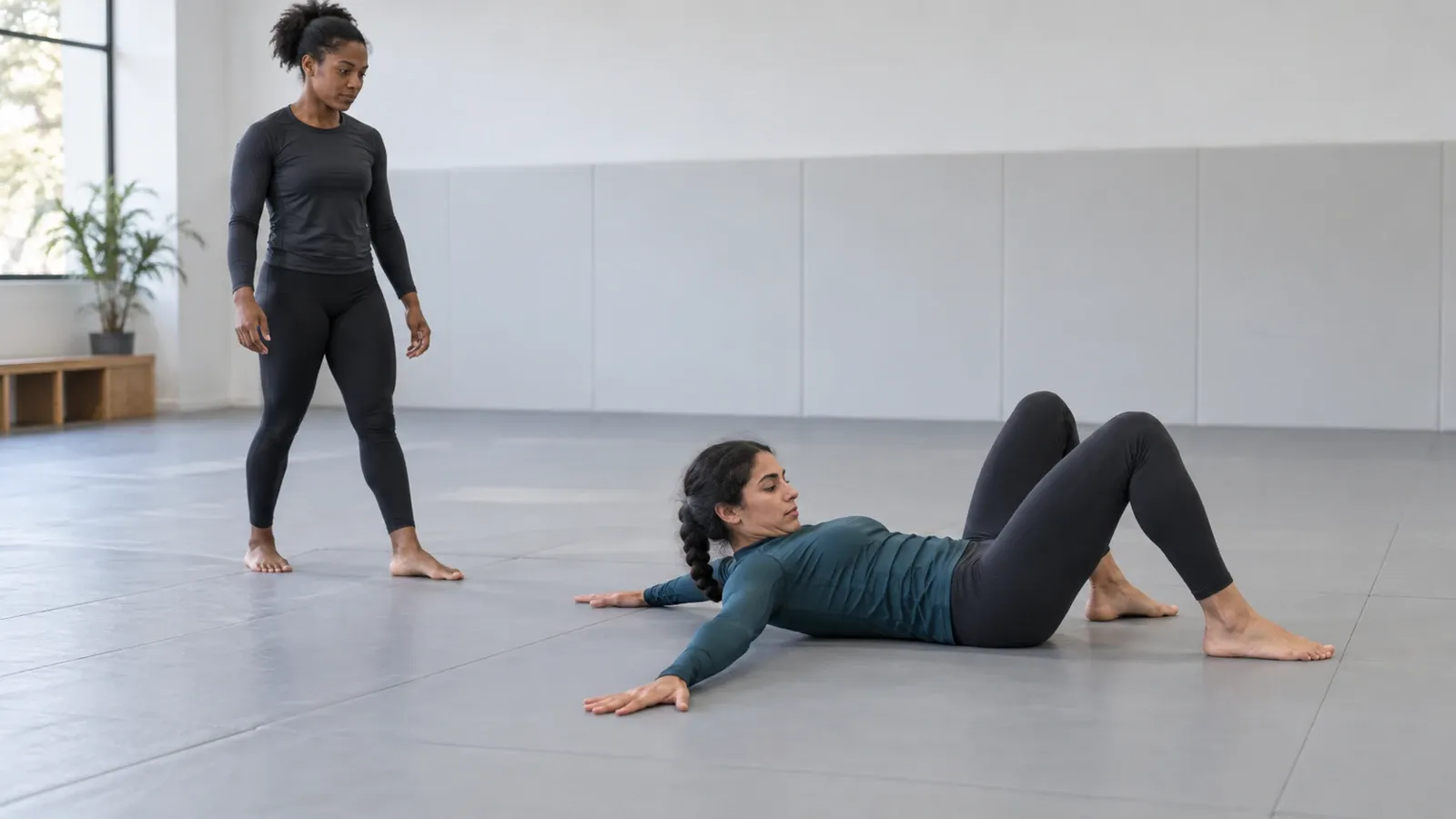
Exhaling on impact is a fourth habit worth building early. It keeps you from being winded and it stops the whole-body tension that turns a fall into a jolt.
The versions worth knowing
Back breakfall. Sit, roll back, slap with both arms, chin tucked. The foundation, and the one that turns up when somebody sweeps you.
Side breakfall. Land along one side, slapping with the arm on that side. The most common landing in actual grappling, because very few falls are perfectly square.
Forward roll. Not strictly a breakfall but taught alongside it: a shoulder roll that converts forward momentum into a rotation rather than a collision. It is what saves you when somebody turns the corner on a takedown.
Most classes drill these as part of the warm-up. That is not filler, and the reason people stop paying attention to them is that they are boring rather than that they are finished.
Why it decides how the rest of your training goes
Takedowns are the part of jiu jitsu that most people postpone, and the honest reason is usually that falling is unpleasant rather than that the entries are difficult. A partner who cannot land safely puts a hard limit on how realistically anybody can practise throws with them — you either slow everything down or you stop drilling the finish.
That is why the double leg and single leg articles both say the same thing about learning to fall before learning to throw, and why the standing game stays underdeveloped in gyms where nobody drills ukemi. If you want the takedown half of your game to grow, this is the prerequisite, not an optional extra — and it is a sensible early priority alongside the other things in what to focus on as a white belt.
Common mistakes
- Reaching back with a straight arm. The instinct everybody arrives with, and the main cause of wrist and elbow injuries in beginners. The slap replaces it.
- Lifting the head. Usually from trying to watch what is happening. The chin stays down.
- Slapping too early or too late. The slap and the landing are simultaneous. Early and it does nothing; late and you have already landed on something.
- Landing on the elbow. Flat forearm and palm, not the point of the elbow.
- Holding onto the person throwing you. Understandable and counterproductive: it pulls your body into a shape you cannot land in.
- Tensing everything. A rigid body transmits impact. Relaxed and spread absorbs it.
How to practise
From the ground up, always. Sitting, then squatting, then standing. There is no reason to begin a new breakfall from standing height, and every reason not to.
In the warm-up, every session, without treating it as a chore. It is one of the few things that genuinely improves through repetition alone and needs no partner, which puts it alongside the other movements in training on your own.
Then being thrown, slowly, by a cooperative partner, before anything resembling resistance. The person doing the throwing should be controlling the landing, not testing it.
Then at realistic speed, only once the previous three are automatic.
Safety
This is the safety technique, and it still has its own risks when trained badly.
Learn it on a proper mat, not on a hard floor, and never start from standing. Do not practise breakfalls when you are tired enough that your chin stops tucking — that is the point at which the drill starts causing the thing it prevents. If you have an existing neck, shoulder or wrist problem, say so before somebody throws you, and build up over weeks rather than sessions.
And on the other side of it: if you are the one throwing, put your partner down rather than dropping them. Controlling somebody’s landing is part of the technique, not a courtesy.
Always ask your coach or instructor to check your technique and practise safely at your academy.
Common questions
What is a breakfall in Brazilian Jiu Jitsu? A way of landing that spreads the impact across your back or side, with the arm slapping the mat and the chin tucked, so that a fall does not arrive on a single joint or on your head.
Why do we slap the mat? It spreads the impact and, more importantly, it replaces the instinct to catch yourself on a straight arm — which is what actually injures wrists and elbows.
Is a breakfall the same as ukemi? Yes. Ukemi is the judo term that came into jiu jitsu with the sport, and it is used interchangeably in most gyms.
How long does it take to learn? The basic shape takes a session. Making it automatic under surprise takes months of warm-ups, which is the part that actually matters.
Do I need breakfalls if I only train ground jiu jitsu? You will still be swept, and sweeps land people. The back and side falls turn up constantly even in gyms that never drill takedowns.
What should I do if I am being thrown and it feels wrong? Tuck your chin and go with the direction rather than posting a hand to stop it. Posting is what converts an awkward landing into an injured one.