
Guard recovery
Knee Shield Recovery
A shin across the opponent's hips, inserted from underneath, that converts a flattened half guard into one with distance, frames and something to attack from.
Flattened half guard and knee shield half guard are two different positions that happen to share a name. In the first you are underneath somebody with a leg trapped and nothing else; in the second you have a shin across their hips, distance, and a route back to attacking. The knee shield is how you get from one to the other, and it is the single most useful thing to know from half guard bottom.
What the shield is
Your top leg bends and the shin crosses the opponent’s hips or lower abdomen, knee pointing at their far shoulder. Your bottom leg still has one of their legs trapped. Your top arm frames on their shoulder or biceps, and you are on your side rather than flat.
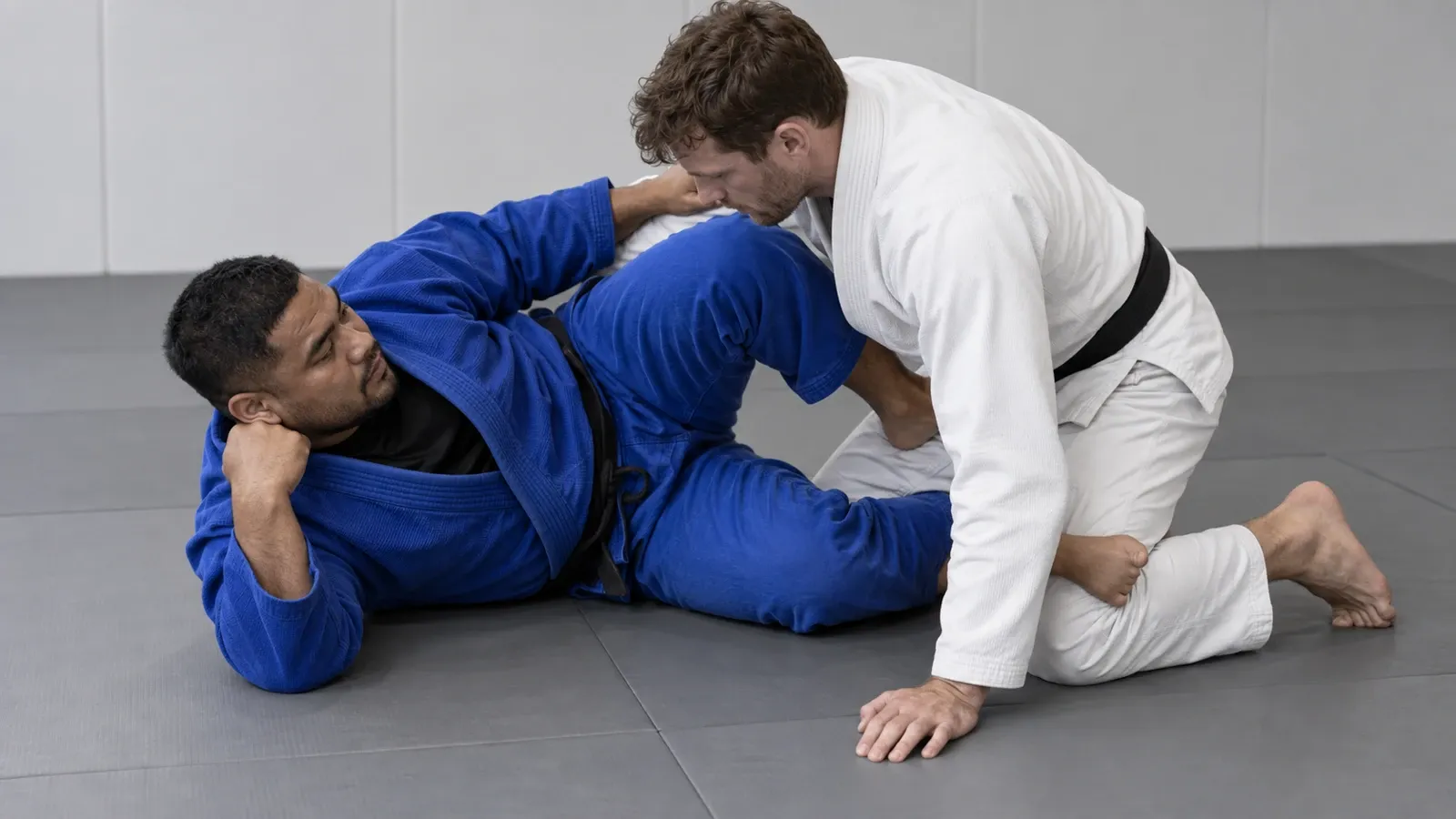
That shin is doing the same job as a forearm frame, with a much stronger limb. It is why half guard with a knee shield is comfortable to hold and half guard without one is a grind.
The detail that decides it
The bottom knee stays connected to their hip.
Everything else can be right and the position will still collapse if the bottom leg loses its connection. The top shin holds them off; the bottom knee stops them re-flattening you by circling towards your back or driving their hips down into you. People who complain that their knee shield “gets smashed” have almost always lost the bottom knee first, and only noticed when the top shin folded.
Two more things matter and are less obvious:
- Stay on your side, not your back. Flat, the shield becomes a leg you are holding up rather than a structure.
- Frame with the arm on the same side as the shield. Shin and forearm working on the same line is a wall. Working on different lines, they are two things to beat separately.
Getting it back when you are already flat
This is the recovery part, and it is a sequence rather than a single movement.
- Turn onto your side, towards them. Nothing works from flat. This is the same precondition every escape from underneath has.
- Frame into their shoulder or hip, straight arm, elbow connected to your body.
- Bridge or hip escape to make an inch. A small bridge is usually enough — you are not trying to reverse them, only to unstick their hips.
- Slide the top knee in, across their body, before they resettle.
- Re-connect the bottom knee to their hip.
Step four is what people rush. The knee has to go in front of their hip, not under their chest; a knee that arrives in the wrong place becomes a leg they are already past.
What it gives you
The shield is not the end of the sequence. It is the point at which half guard becomes a guard again:
- The underhook, which is the main attacking road out of half guard and leads directly to the half guard underhook sweep.
- Distance to recover full guard, by using the shield to hold them off while the bottom leg comes free.
- Sweeps that use the shield itself, pushing off their hip to elevate them.
- Simply resting. This is a legitimate use. A knee shield is one of the few bottom positions you can hold without burning energy, which matters more than it sounds in a long round.
Half guard sits inside a wider family of guards worth understanding together, and where half guard sits among the guards covers where it fits against the others.
How the top player answers it
Knowing this tells you what to protect:
- Kill the shin. Push the knee across your body and pin it to the mat, then start passing where the shield used to be.
- Cross face. As everywhere, a cross face turns the head and takes away the bottom player’s ability to follow their own frames.
- Back-step or go to the other side, so the shield is pointing at nothing.
- Flatten first, pass second. Patient top players do not attack the shield. They attack the bottom knee and the shoulder, and the shield falls over on its own.
Drilling it
Start flattened, recover the shield, reset. Ten repetitions each side with a cooperative partner, then with light resistance. The recovery is the skill; holding the finished position is the easy part.
Then hold it against a passer for time. One rule: you are not allowed to attack, only to keep the shield. It teaches the bottom knee lesson faster than being told it.
If half guard is where your rounds keep ending up rather than where you choose to be, retaining guard is the wider version of this problem.
Then from the top, learning to kill the shin. Understanding what beats your own position is the quickest way to stop giving it away.
Safety
The shield is a frame rather than a lock, so the risk is low, but it puts a knee joint between two bodies.
Two things. A passer who drops their full weight onto a shin that is in a bad position can load the knee sideways, so as the bottom player give up the shield rather than defending it to the last moment against somebody much heavier. And as the top player, do not staple a knee shield to the mat by falling onto it — pass the leg, do not crush the joint.
Always ask your coach or instructor to check your technique and practise safely at your academy.
Common questions
What is a knee shield in Brazilian Jiu Jitsu? A shin placed across the opponent’s hips from half guard bottom, creating distance and acting as a frame so the position becomes workable rather than defensive.
How do I stop my knee shield getting flattened? Keep the bottom knee connected to their hip and stay on your side. The shield almost always collapses because the bottom leg was lost first, not because the shin was weak.
Is knee shield half guard a defensive position? It starts as one and does not have to stay that way. Once the shield is in, the underhook, sweeps and guard recovery are all available.
Which leg is the knee shield? The top leg — the one that is not trapping their leg. The bottom leg keeps the half guard.
Can I recover a knee shield once I am completely flat? Yes, but not by inserting the knee first. Turn to your side, frame, make an inch of space, then bring the knee in.
Does the knee shield work in no-gi? Yes. It is a structural frame rather than a grip, so it transfers almost unchanged, and it is especially valuable in no-gi where there is less to hold on to.