
Guide
Technique vs strength in Brazilian Jiu Jitsu
The slogan is repeated so often that it has stopped being examined. It is largely true, in a specific way, with real limits — and the limits are the part that helps you train better.
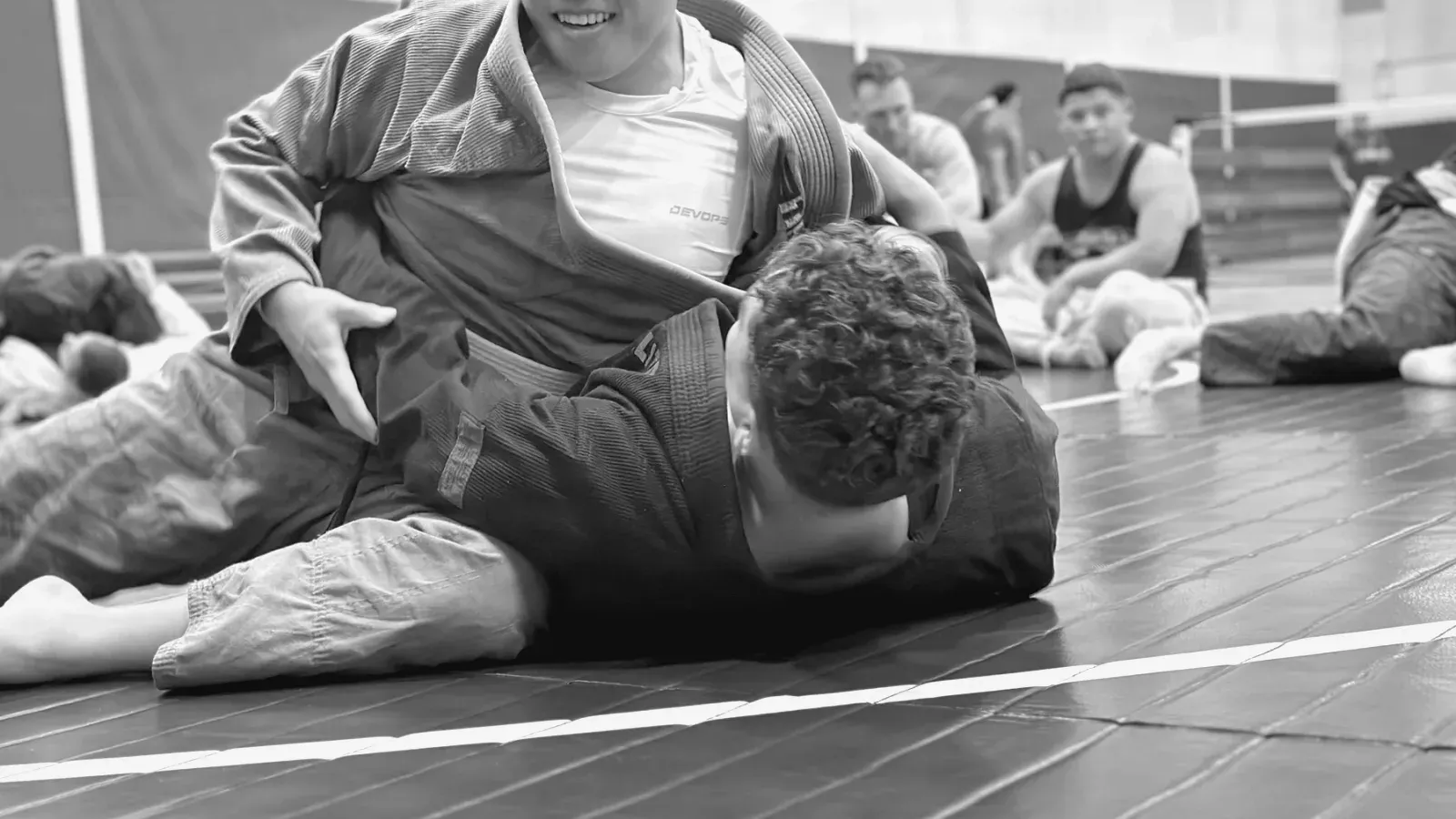
Skill sets the ceiling; attributes decide contests between people near the same ceiling. That is the accurate version of “technique beats strength”, and it explains both why the slogan feels overwhelmingly true to a beginner and why it feels increasingly qualified as you improve.
The slogan is the first thing most people hear about Brazilian Jiu Jitsu. It is mostly true. It is also repeated so automatically that it has stopped meaning anything, and the version people take away — that strength is irrelevant — is wrong in a way that makes them train worse.
What is actually true
Skill produces larger returns in grappling than in almost any other physical contest, and the gap is wide enough to be startling in person. A skilled 65 kg grappler will routinely control an untrained 95 kg one. That is not a demonstration staged for a video; it happens every day in every academy, usually to somebody who arrived confident.
The reason is structural. Technique in grappling largely means arranging things so the other person’s strength has nowhere to go: applying force against a joint’s weak direction, using your whole body against one of their limbs, or taking away the base they would need in order to push. Strength does not help much when the problem is geometry.
What is also true
Between two people of similar skill, the stronger one usually wins. Everyone who trains knows this, and it is oddly absent from the slogan.
Strength shows up as:
- A wider margin for error. A stronger person can survive a badly executed position long enough to fix it. A weaker one gets punished for the same mistake.
- Faster, more forceful transitions, which give the other person less time to react — and time to react is most of what defence is.
- Grip endurance, which decides a surprising number of exchanges in the last two minutes of a round.
- Injury resistance. Not a competitive advantage, but the thing that lets you keep training, which compounds into skill.
None of that contradicts the first section. Both are true at once: skill matters more, and strength still matters.
Why the two feel contradictory
Because most people meet them at different points.
Early on, the skill gaps around you are enormous. A white belt rolling with a purple belt is not in a contest where strength could be decisive; the gap swallows every attribute. So the slogan looks not just true but obviously true.
Later, you train mostly with people whose skill is close to yours. The gap that used to swallow everything is gone, and the remaining differences — size, strength, conditioning, age, how much you slept — start deciding rounds again. Nothing changed about the sport. You moved.
The mistake this creates
Two failure modes, and they are mirror images.
Believing strength is the answer. The beginner who muscles everything learns nothing, exhausts themselves, and injures training partners. Worse, they get away with it against other beginners for long enough to have the habit reinforced, then hit a wall against anybody skilled.
Believing strength is irrelevant. Less common but real: people who refuse any strength work, get injured more, and mistake being weak for being technical. Being small and skilled is a genuine achievement. Being weak is just a smaller margin for error.
The useful instruction sits between them: use technique first, and notice when you did not.
The diagnostic that matters
Here is the practical value hiding in this argument.
When something worked because you were stronger, you learned nothing transferable. When it worked and felt easy, you found something worth repeating. The difference between those two is information, and it disappears if you only remember the outcome.
That is a real problem for anyone who trains with people smaller or weaker than themselves, because their results stop being a signal. A larger beginner can spend a year beating people with strength and conclude they are improving, right up until they meet somebody their own size who knows what they are doing.
It is also the reason measuring progress honestly needs more than a win-loss impression of the evening.
The scissor sweep is the usual demonstration of this: done with the angle it needs, it barely feels like effort, and done without it, no amount of pulling makes it work.
So should you lift?
Yes, if you want to — and not at the cost of mat time in your first year.
For a beginner the highest-return investment is unambiguously training frequency. The skill gaps in front of you are so large that any strength gain is a rounding error against them; two extra sessions a week will do more than any programme.
Later, when your progress is being decided by narrower margins, general strength work adds real value and reduces injuries. Nothing exotic is required — the usual compound movements, done consistently, at a volume that does not wreck your training.
The order matters more than the choice. Get the skill first; the strength keeps, and it is easier to add strength to skill than skill to strength.
If you are the smaller person in the room
Three things that are genuinely true and worth acting on.
- You will improve faster, because you have to. You cannot fall back on force, so every round forces you to solve the problem properly. This is an advantage disguised as a disadvantage.
- Your defence has to be better than theirs. Not a slogan: you will spend more time in bad positions, so escapes and survival are worth disproportionate attention.
- Do not measure yourself against the room’s biggest person. Measure against your own record in the same positions over time.
The other side of it — being the one giving away thirty kilos — has its own set of adjustments, and they are the fastest route to a decent defence there is.
If you are the bigger person in the room
Two, and both are about honesty.
- Turn the strength off deliberately in some rounds. Not all of them — you are allowed to train hard. But a round where you refuse to muscle anything is the round you actually learn in.
- Be careful with people much smaller than you. The margin for error is yours to manage, and a training partner you injure is a training partner you no longer have.
The slogan survives because it is a good instruction even where it is an incomplete description. Drilling and rolling do different jobs precisely because one of them lets you practise the correct answer slowly and the other tells you whether you can find it under pressure — and neither is improved by being stronger about it.