
Guard passes
Stack Pass
Fold them onto their own shoulders and travel over the top of the stacked legs. Pressure from posture rather than arms, and the standard answer to a very flexible guard.
Some guards are beaten by out-manoeuvring them and some are beaten by folding them, and the stack pass is the second kind. Instead of trying to open a guard or move around it, you drive the opponent’s hips up over their own shoulders until their legs are stacked above their head, and then you pass over the top of them. It is uncomfortable to be underneath, effective against exactly the flexible guard players who frustrate other passes, and it depends on posture far more than on strength.
The idea
You get their hips off the mat and above their shoulders. That single fact does most of the work:
- A stacked guard player cannot shrimp, because their hips are above them rather than beside them.
- Their legs stop being long levers and become a bundle you are standing over.
- Their frames run out of direction, because everything they push on is now above them.
The pass itself is then a matter of walking your hips around to one side and dropping into side control as their legs come free — which is why people describe the stack pass as folding somebody and then simply stepping past.
Where the pressure comes from
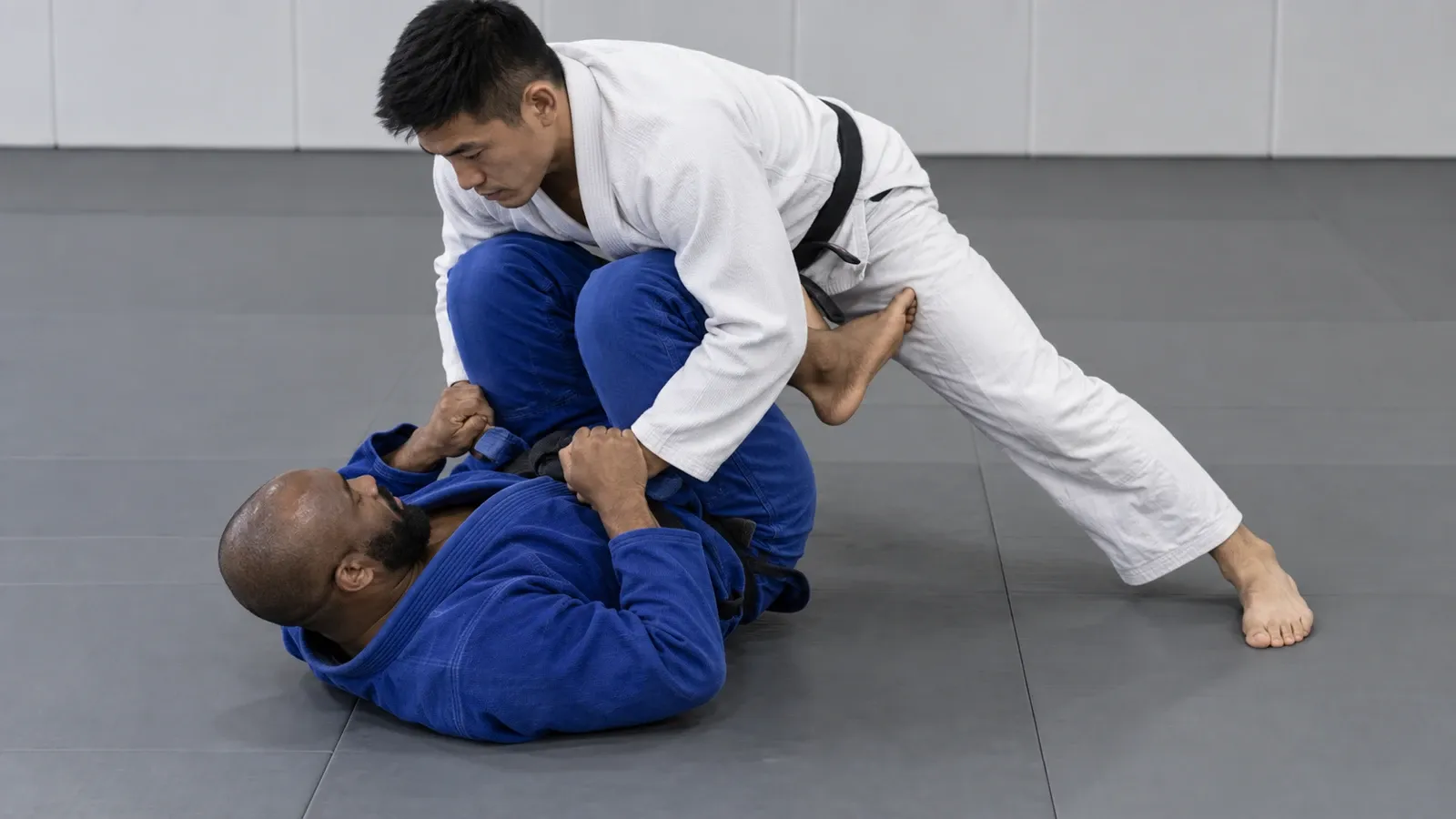
Your posture and your hips, not your arms.
The version that fails is somebody bent over, arms wrapped around two legs, trying to push a person into a ball by strength. The version that works has a straight back, the chest high, the head up, and the hips driving forward and up underneath them. You are not lifting them with your arms; you are walking your own weight into them and letting their hips rise as a consequence.
It is the same lesson the double under pass teaches, and the two passes are close relatives — the double under commits both arms under the legs, the stack does not have to. Where the double under is a specific grip, stacking is more of a position you can arrive at from several places, including from a defended triangle or armbar where the person underneath has already given you the fold.
What stops it
Knowing the counters is most of learning to hold it:
- Hips back down. The entire pass lives above the mat. If their hips return to the floor, you have a person with their knees to their chest and no pass.
- A frame into the hip. A forearm or shin between your hips and theirs restores the space the stack removed, which is why guard retention framing matters here as much as anywhere.
- Turning to a side. A stacked player who turns onto a shoulder can start to invert or to recover a knee. Good stack passers keep them square.
- Attacking the neck. As with any pass where your head goes forward, the guillotine and the triangle are available if you drop your posture. That is another reason the back stays straight.
When to choose it
Against a flexible guard player who is comfortable being folded, a stack can turn into a stalemate — they are content and you are working. Against most people it is very strong, and it is especially useful:
- when somebody’s guard is built on distance and hooks rather than on grips;
- when you have already broken their closed guard and they have kept their knees in;
- as the follow-on to a defended armbar or triangle, where the fold is already halfway done;
- when you are heavier than the person underneath and pressure is genuinely your advantage — though that comes with obligations, which the safety section covers.
If most of your rounds involve somebody’s guard reopening the moment you think you are past, the diagnosis is usually in the reasons a guard gets passed read from the other side.
Common faults
- Bending over. Round back, head down, and you are supplying a neck rather than a pass.
- Letting their hips touch the mat. The one thing the pass cannot survive.
- Lifting with the arms. Tiring, slow and easy to frame against.
- Stacking straight down onto the neck rather than folding them at the hips — see safety, this is the serious one.
- Going around too early. Walk when their hips are high and their frames are gone, not before.
- Holding it too long. A stall in the stack favours whoever is more comfortable, and a flexible guard player is often more comfortable than you are.
Drilling it
Get the fold without passing. Partner in closed or open guard, and your only job is to bring their hips off the mat and hold them there for ten seconds with a straight back. Most people discover their stack is arm-driven the first time they try this.
Then add the walk, moving to one side while the stack survives the movement. Releasing the pressure to travel is the fault that costs most stack passes.
Then from the defensive side, so you learn where the frames go and how quickly the hips have to come down. Rotating who passes and who retains is the version of this drill worth the time — it is exactly the kind of positional work drilling versus rolling argues for over free rounds.
Safety
This is the pass in this batch that most deserves a careful read, because it loads somebody’s neck and spine with your bodyweight.
Fold at the hips, not at the neck. Their chin should not be driven into their chest by your weight. The stack should feel like their hips coming up, not like their head being compressed. Build the pressure progressively, and come off immediately at any tap — a stacked partner may not be able to reach you or make a sound, so watch for a hand slapping the mat and stop at any signal.
Be especially careful with partners who are smaller, less flexible, or new. The same technique that is uncomfortable for a training partner your size can genuinely hurt somebody half your weight, and the considerations in training with bigger, stronger partners apply to you as the bigger one here.
Always ask your coach or instructor to check your technique and practise safely at your academy.
Common questions
What is a stack pass in Brazilian Jiu Jitsu? A guard pass in which you fold the opponent onto their own shoulders, lifting their hips above their head, and then travel over the top of their stacked legs into side control.
What creates the pressure in a stack pass? Your posture and hips. A straight back with the chest high and the hips driving forward does the work; arms trying to squeeze somebody into a ball does not.
Why does my stack pass keep stalling? Usually their hips have come back down, or you released the pressure while walking around. The stack has to survive the movement.
Is the stack pass good against flexible guard players? It is one of the better answers to them, though a very flexible player who is comfortable folded can turn it into a stalemate. Read the reaction rather than committing indefinitely.
How is it different from the double under pass? The double under is a specific grip with both arms under the legs. Stacking is the broader position, and you can arrive at it from several places including a defended armbar or triangle.
Is stacking dangerous for my training partner? It can be. The load goes through their neck and spine, so fold at the hips rather than compressing the head, apply it gradually, and release at any signal.