
Guard recovery
Guard Retention Framing
Frames are what stop a pass from being finished before your legs can get back in. They buy the time; the hips do the recovery. Most lost guards are frames that were never built.
There is a difference between retaining your guard and losing it slowly, and frames are it. When somebody is passing, you are not trying to stop them by strength — you are trying to hold onto a small amount of space for long enough to get your legs back in front of them. Forearms, shins and knees are what hold that space. The hips do the actual recovery, but they need something to buy them the time.
What a frame is
A frame is a rigid structure between you and the person passing: bone stacked on bone, joint locked out, so that their pressure is carried by your skeleton rather than by your muscles.
That definition rules out most of what beginners do. A bent arm pushing is not a frame — it is a press, and it fails the moment somebody heavier leans on it. A straight forearm braced against a hip with the elbow connected to your own body is a frame, and it holds up under weight that no amount of pushing would survive.
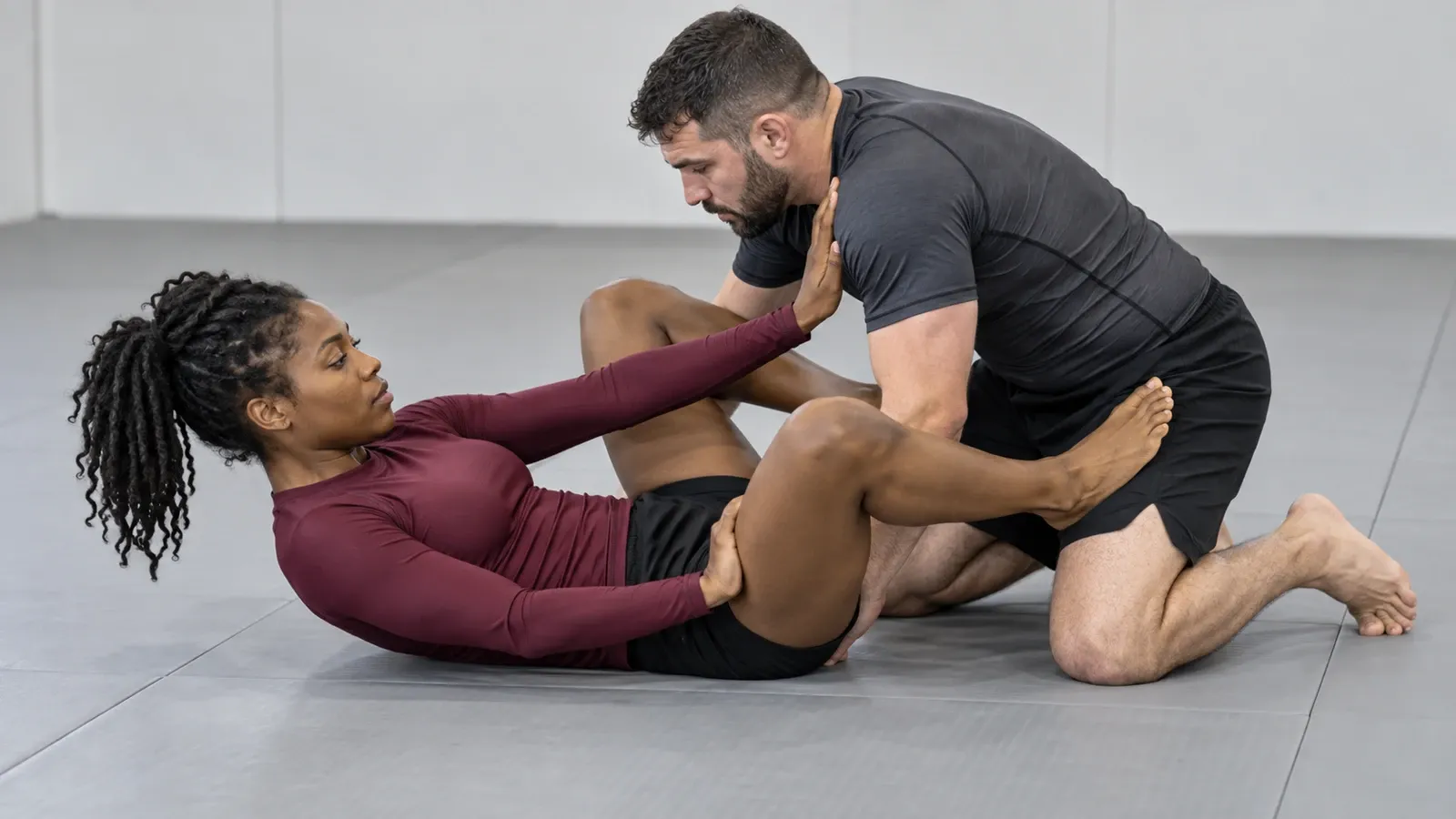
You have four to work with: two forearms, two shins. Knees count as a variant of the shin frame. In practice you will usually have two in play at once — a forearm high and a shin low is the standard pairing.
Where they go, and where they do not
Frames go into hips and shoulders.
This is the rule that decides whether retention works, and it is the one most often broken. The instinct under pressure is to push on the nearest thing — usually the head or the chest — because that is what is arriving. But the head is not what passes your guard. The hips are. A frame on somebody’s face is uncomfortable for them and irrelevant to the pass; a shin across their hip stops the pass itself.
The same goes for the shoulder on top. Framing into the shoulder that is driving your legs down does real work. Framing into a chest that is simply near you does not.
The sequence that actually recovers guard
Frames alone do not recover anything. They create a moment. What you do with the moment is the rest:
- Get on your side. Flat on your back you have no hips to use and the frames carry everything. Turning onto a hip is the precondition, not a refinement.
- Build the frames — forearm into the near shoulder or hip, shin across the far hip.
- Move your hips away, using the frames as the thing you push off. This is the hip escape, and it is the engine of the whole movement.
- Bring a knee through the gap you just made, in front of their hips rather than behind them.
- Re-establish, in whatever guard the position gives you rather than the one you wanted.
The common failure is doing step four without steps one to three, which produces a knee that gets flattened immediately.
Why it is taught on its own now
Most modern schools treat retention as its own subject, usually in the form of live retention rounds: one person starts passing, the other only retains, nobody finishes anything. That is a relatively recent change and it happened for a good reason — retention is a skill that does not get trained by accident during normal rolling, because in a normal roll the person retaining is also trying to sweep, attack and breathe, and the retention gets the leftovers.
If your guard keeps disappearing, this is the more useful diagnosis than any individual guard being wrong, and what is actually going wrong goes through the causes in order. The companion piece, how to retain guard, is the same subject from the practical side.
What beats frames
The cross face. The single best answer, which is why it is the first thing a good passer does. A cross face turns your head away, and a head that cannot face the direction of travel cannot lead the hip movement your frames were buying time for. Frames without head position are frames holding up nothing.
Getting you flat. Shoulders to the mat and the frames stop being levers.
Beating the frame’s angle. A passer who circles rather than pushes makes your straight arm irrelevant without ever fighting it. This is why retention is reactive — the frames have to move.
Weight on the framing arm. Against somebody much heavier, a frame placed a moment late gets folded. The answer is earlier, not stronger.
Drilling it
Retention rounds, with the pass restricted. Partner passes at fifty per cent, you only retain and recover, nobody submits. Three minutes. This is the drill, and there is not really a substitute.
Shrimp-and-frame down the mat, solo, so the pairing of frame and hip movement becomes one action rather than two decisions.
Then specific starts: flattened under a knee cut, stacked under a double under, chased by a torreando. Each pass takes a different frame, and learning which is most of the subject.
Safety
Low risk, with one real exception: a straight arm framing against a much heavier person is a straight arm somebody’s weight can land on.
Keep the elbow slightly soft rather than hyperextended and connected to your own torso, so that the load runs into your body rather than into the joint. Give way early against a big pressure passer instead of defending a frame to the last moment — a folded frame is a lost position, but a folded elbow is an injury. Fingers are the other one: framing with an open hand that catches a gi or a limb is a common way to jam them.
Always ask your coach or instructor to check your technique and practise safely at your academy.
Common questions
What is a frame in Brazilian Jiu Jitsu? A rigid structure between you and your opponent, made of forearm, shin or knee, that carries their pressure on your skeleton instead of your muscles and holds the space your guard needs.
Where should my frames go when somebody is passing? Into their hips and their shoulder. Framing on the head or the chest feels natural and does very little, because those are not the parts driving the pass.
Why do my frames collapse against bigger training partners? Usually because they are placed late, or because the arm is bent and pushing rather than straight and connected to your body. Earlier and more structural beats stronger.
Do frames stop a pass on their own? No. They buy time. The hips have to use that time to move and get a knee back in front, or the pass just arrives a second later.
Can I train retention on my own? Partly. Shrimping with frames down the mat builds the movement, but the timing only comes from live retention rounds with a partner.
Is retention framing different in no-gi? The principles are identical. Without grips, passes come faster and frames have to be rebuilt more often, so the movement matters more and the holding matters less.