
Guide
How to retain guard in Brazilian Jiu Jitsu
Guard retention in Brazilian Jiu Jitsu means stopping a passer from clearing your legs and establishing a dominant top position. You do it by keeping connection with frames and hooks, moving your hips, and recovering your guard as soon as your legs are displaced.
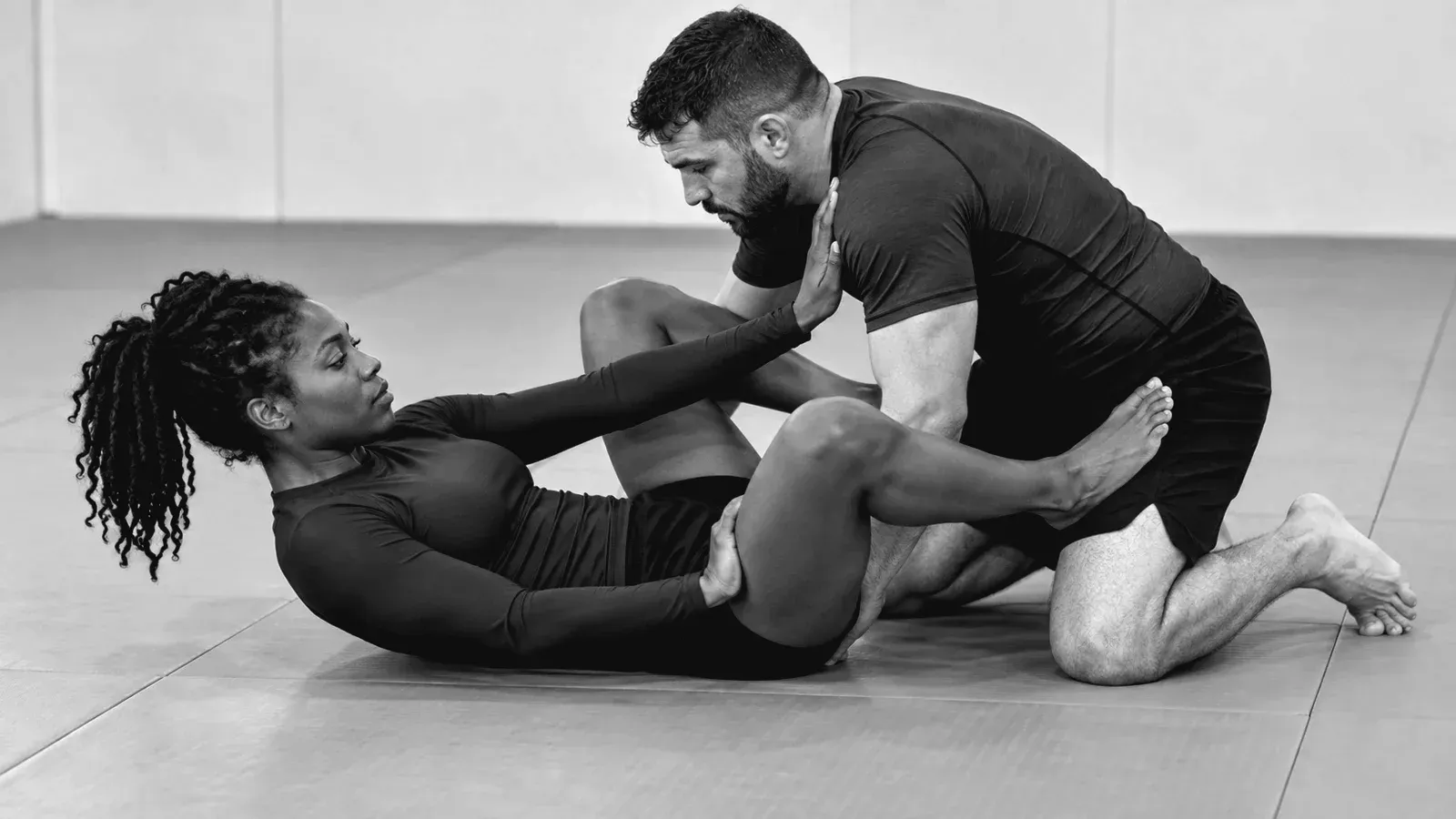
What “retain guard” means in Brazilian Jiu Jitsu
Guard retention is the skill of preventing a guard pass when you are on the bottom. “Guard” here means any bottom position where you use your legs (and often your arms) to manage distance, off-balance the top player, and stop them settling into a stable pin such as side control. Retaining guard is not the same thing as attacking from guard. Your first job is to keep your knees, shins or feet between you and the passer, keep some kind of contact, and stop them lining their chest up over your torso.
If you want a map of the positions you might be trying to retain, see The main types of guard in Brazilian Jiu Jitsu.
How to retain guard: a practical sequence you can follow
You do not retain guard with one “move”. You retain guard by solving the passer’s problems in the right order: distance, angle, and re-guard.
1) Establish frames first, before you chase with your legs
Start from any open guard where the top player is trying to come around your legs. Your priority is to build frames: straight or bent arms that stop their upper body collapsing on to you. A frame can be a hand on their shoulder line, collar line, hip line, or biceps, depending on what is available in gi or no-gi. A useful way to think about it is this: if their chest can connect to your chest and your knees are no longer inside, you are already late. Frames buy you time to move your hips and re-insert your legs.
2) Keep your knees and feet “inside” as your default
From open guard, aim to keep at least one knee and shin between you and them. If they push one leg aside, the immediate goal is not to win that exact battle; it is to put a different barrier back in place. Practically, that means you recover with your nearest knee first. Think “knee back in, then build the rest of the guard”. A single shin in front of them is often enough to stop them settling long enough for you to rebuild.
3) Move your hips before you reach with your feet
If you try to retain guard by only “reaching” with your legs while your hips stay flat, you give the passer an easy target: they can staple your legs and run around you. Instead, move your hips to keep yourself squared up. As the passer goes to your right, you turn and shift so that your belt line and knees keep facing them. Your legs follow your hips, not the other way round.
4) Win the angle battle: don’t let them get past your hip line
A clean guard pass usually happens when the top player wins an angle where their body has gone past your knees and their shoulder line is heading towards your hip line. Your retention goal is to prevent them getting their upper body past your hips. If they are already past your knees but not past your hips, you are often still in a guard-retention situation: you can pummel a knee back inside, use a frame to create space, and rebuild.
5) Reconnect: turn defence into a recognisable guard
Guard retention is “done” when you have re-established a guard you can hold, not when you merely survived the first push. Pick a simple endpoint you can reliably rebuild under pressure: closed guard, a basic open guard with both feet between you and them, or a half guard with a knee shield (if you use that in your gym). The point is to turn a scramble into structure.
Nearly all of that rests on one movement, which is worth learning on its own: the hip escape.
When guard retention applies (and when it does not)
Guard retention applies any time you are on the bottom and you still have meaningful barriers between you and the passer, or you can realistically put them back in place. This includes moments that feel “nearly passed” so long as you can frame, turn, and recover a knee or shin inside before they settle.
It stops applying once the top player has truly cleared your legs and stabilised a pinning position where you no longer have a usable guard structure. In practical gym terms, if they have beaten your legs and are chest-to-chest with control, you are now in an escape problem rather than a guard-retention problem. The boundary between “retaining guard” and “escaping” is not a moral judgement. It is simply a change of task.
Situations that change what you prioritise
If the passer is staying at long range, your retention problem is mostly distance management: keeping your legs between you and them and preventing them stepping around your feet. If the passer has already closed distance and is trying to drop their weight on you, your priority becomes frames and preventing upper-body control while you recover at least one knee inside.
If the passer is trying to pin your legs to the mat, your priority is to keep your knees mobile and your hips active so you can bring a shin back across. If the passer is trying to redirect you and win an angle, your priority is to square your hips back towards them so that they have to beat your legs again rather than simply walking past your hip line.
What people get wrong about retaining guard
They treat it as a single technique
Many people look for one guard-retention move that works against every pass. In practice, retention is a chain of small decisions: frame, square up, reinsert a knee, rebuild a guard. If you skip the early steps and jump straight to a re-guard, you usually get flattened.
They chase the passer with their legs and forget their upper body
Leg movement without frames tends to fail because the passer can drop their weight and remove your hips from the equation. Your arms are not just for grips and attacks; they are the tools that stop the passer’s torso reaching yours while you move.
They accept being flat
When your shoulders and hips are flat to the mat, your legs have less range and your frames collapse more easily. Guard retention usually gets easier when you can turn onto a side, keep your knees close to your chest, and keep your hips mobile.
They confuse “inverting” with retention
Inverting can be one way to recover your legs in some situations, but it is not the definition of guard retention. If you invert without frames or without knowing where your guard is going to reform, you may simply help the passer get around your legs.
They decide too late whether they are retaining or escaping
A common error is to stay in “half-retention”, where you keep fighting to put your legs back in place even after the passer has settled chest-to-chest control. At that point you often need to switch to an escape immediately, because the task has changed.
Knowing the passes from the passer’s side helps as much as anything — the knee cut and the torreando are the two you will meet most.
How guard retention fits into training
Guard retention is easier to improve when you train it as a specific skill, not just as something that happens accidentally during sparring. One simple method is to start rounds from an open guard where your partner’s goal is only to pass, while your goal is only to recover a stable guard. When you succeed, reset to the same start rather than immediately chasing submissions.
You can also set constraints that force good habits. For example, you can agree that you must keep at least one frame for the first few seconds of every exchange, or that you must recover a knee inside before you are allowed to stand up or disengage. The aim is to practise the sequence under pressure: build frames, square your hips, then rebuild guard.
For how to balance that kind of positional work with open sparring, see Drilling vs rolling — why you need both.
Gi and no-gi differences you should account for
Guard retention exists in both gi and no-gi, but the tools you use to create time can change. In gi, grips can help you slow the passer’s movement and keep your frames connected for longer. In no-gi, you often have to rely more on framing, head position, and immediate re-connection with your legs because the top player can disengage more easily.
If you are unsure why the same retention idea feels different when grips are removed, Gi vs no-gi — what actually changes explains the practical implications.
A useful contrast: why guard matters more in Brazilian Jiu Jitsu than in some jacket grappling sports
Guard retention is a major skill in Brazilian Jiu Jitsu because the rules and typical scoring incentives keep bottom guard in play and allow chokes. By contrast, modern sports sambo is similar to sport judo or sport Brazilian jiu-jitsu but differs in equipment (a sambovka jacket and shorts rather than a full keikogi) and places much less emphasis on guard; chokes are banned in competition, with special emphasis instead on leglocks and holds. That rules focus changes how much time athletes spend building and retaining a bottom guard.
A simple way to measure whether your guard retention is improving
If you want a clear test, measure whether you can consistently do these two things against people who are actively trying to pass:
- Recover at least one knee or shin inside after they first displace your legs.
- Reform a stable guard you recognise before they settle chest-to-chest.
If you want context for how long these skills normally take to develop across training, the mechanics will not change, but your expectations might: The Brazilian Jiu Jitsu belt system, explained is helpful for understanding how guard work fits into long-term progression.