
Grips and control
Front Headlock Control
One arm under the chin, one under the near armpit, chest driving down. The control that everything in the snap-down game runs through, and the one people ruin by squeezing too early.
Somebody bent forward in front of you with their head below their hips is in more trouble than they look. The front headlock — head and arm control, one arm under the chin and the other under the near armpit — is the position that collects them. It is not an attack in itself. It is the hub that the guillotine, the D’Arce, the anaconda and the go-behind all lead out of, which makes it one of the highest-value things to hold in grappling.
What the control is made of
Your near arm goes under their chin and across their throat line, the elbow pulled in tight beneath their jaw. Your other arm goes under their near armpit. Both elbows squeeze towards each other, and your chest drives down onto the back of their head and shoulders.
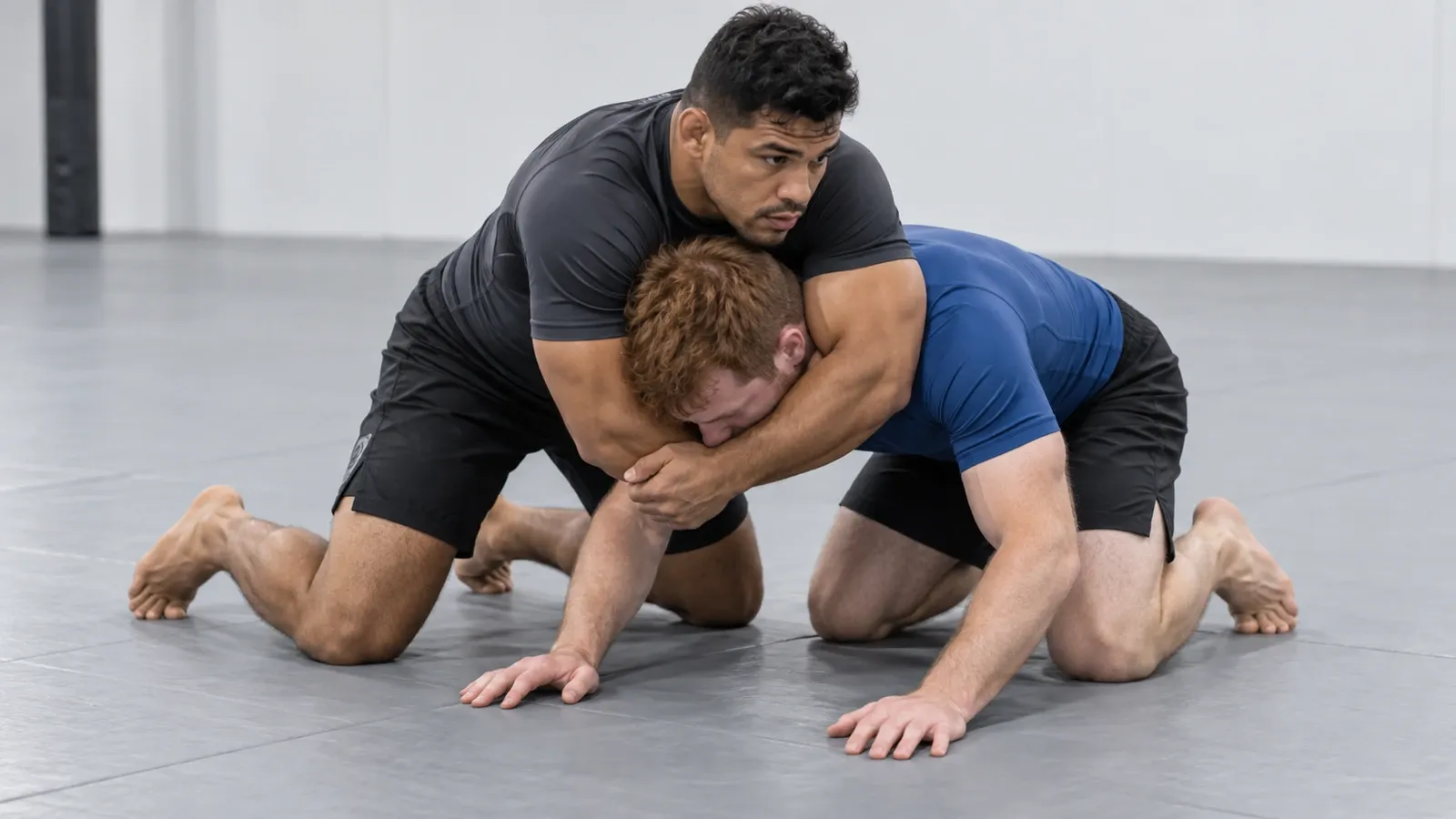
Their head is on the outside of your body, not tucked under your armpit. Their near arm is trapped. Your weight is going through them and into the mat, which is the part beginners leave out.
The rule that keeps it
Their head stays below their hips.
That is the whole maintenance problem stated in one line. A front headlock is not held with grip strength — it is held by not letting their posture come up, because posture that comes back takes the position with it. If their hips drop and their head rises, the control is already gone no matter how hard your hands are joined.
Which means the work is done by your chest and your elbows, not your forearms. Heavy elbows pin their shoulders; a chest driving down stops the posture. People who try to hold it by squeezing the neck usually lose it, because squeezing pulls your elbows apart and gives them the frame they needed.
Where it comes from
A snap down. The classic entry: you pull their head down sharply as they post or reach, and meet it with the control as it arrives.
A failed shot. This is the one that matters most in jiu jitsu. A double leg or single leg taken with the head down, or stuffed by a sprawl, ends with somebody bent over in front of you — which is the front headlock position by definition. That is why the two techniques are always taught together and why building a wrestling game for jiu jitsu means learning both the shot and what happens when it fails.
A turtle. An opponent who turtles in front of you rather than beside you is offering it.
Guard passing. A guard player who sits up and reaches without their posture can be snapped into it.
What it leads to
The value is in the number of exits, not in the hold:
- The guillotine, which is the same head position with the arm closed around the neck.
- The D’Arce and the anaconda, both of which thread the far arm through the space their trapped arm leaves.
- The go-behind. Often the best option and the least dramatic: their arm is trapped and their head is turned, so stepping around to the back is simply available.
- A return to a takedown, because a broken posture is a body you can get underneath.
Holding all four threats at once is what makes the position strong. A defender who commits to stopping the guillotine hands you the back.
How people get out of it
Posture, immediately. Hands to the mat, hips down, head up. Every second spent bent over makes it worse, so the answer is early or not at all.
Peel the chin arm. Two hands on the wrist of the arm under the chin, pulling down and away while stepping the head out to the side.
Circle to the trapped-arm side. Running away from the free side takes you into the go-behind; circling towards the trapped arm is usually the shorter route to freedom.
Do not stand up straight into it. Rising without first clearing the chin arm is how a guillotine finishes itself.
Drilling it
Hold it against a partner who is only trying to posture. No submissions. Two minutes a side. This is unglamorous and it is the drill that makes the position real, because it forces you to use your chest instead of your hands.
Then drill the branch. Partner defends one exit and you take another — they fight the neck, you go behind; they turn away, you take the neck. Choosing rather than forcing is the skill, and it is the kind of thing drilling is genuinely good for in a way live rounds are not.
Then from the losing side, posturing out early. You will understand where the elbows need to be much faster from underneath.
Safety
This is a neck position, and the person in it usually cannot see what is coming.
Keep pressure on the jaw and the side of the neck rather than crushing the windpipe, and do not use bodyweight to drive the head into their own chest — a spine loaded in flexion under somebody’s weight is not a control, it is an accident waiting to happen. Release the moment a partner taps, and remember that from here a tap can be hard to signal with a trapped arm, so watch for a foot tapping the mat or a verbal call. If you are the one bent over, tap early rather than trying to survive a choke you cannot see.
Always ask your coach or instructor to check your technique and practise safely at your academy.
Common questions
What is a front headlock in BJJ? Head and arm control applied to a bent-over opponent from the front: one arm under their chin, the other under their near armpit, with your chest driving their posture down.
Is a front headlock the same as a guillotine? No. The guillotine is one of the finishes available from it. The front headlock is the controlling position, and it also feeds the D’Arce, the anaconda and taking the back.
Why do I keep losing the front headlock? Almost always because their head has come above their hips. Holding it with the hands rather than the chest and elbows is the usual cause.
What should I do first if I am caught in one? Posture: hands down, hips down, head up, before anything else. Then clear the arm under your chin with two hands.
Is the front headlock useful in gi jiu jitsu? Yes, though it appears more in no-gi, where wrestling entries are more common and there are no collar grips to substitute for the control.
Should I squeeze the neck to hold it? No. Squeezing early spreads your elbows and loses the control. Heavy elbows and chest pressure hold it; the neck is what you attack once the position is already yours.