
Movement
Bridge (Upa)
Hips driven upward off the mat to disturb whoever is on top of you. Nearly every escape from underneath is a bridge plus one other thing.
Almost nothing works from the bottom without a bridge, which is why it is taught in the first week and still being corrected at brown belt. Driving your hips upward off the mat is how you disturb the weight of anybody on top of you — not to throw them off, usually, but to make them react so that something else becomes available. In Brazilian Jiu Jitsu it is often called the upa, which is the Portuguese name that came with the sport.
The movement itself
Feet flat, heels close to your own hips. Drive through the feet and push your hips towards the ceiling. Your weight travels up onto your upper back and shoulders — not onto your neck, which is the one detail that matters for your long-term health rather than for your jiu jitsu.
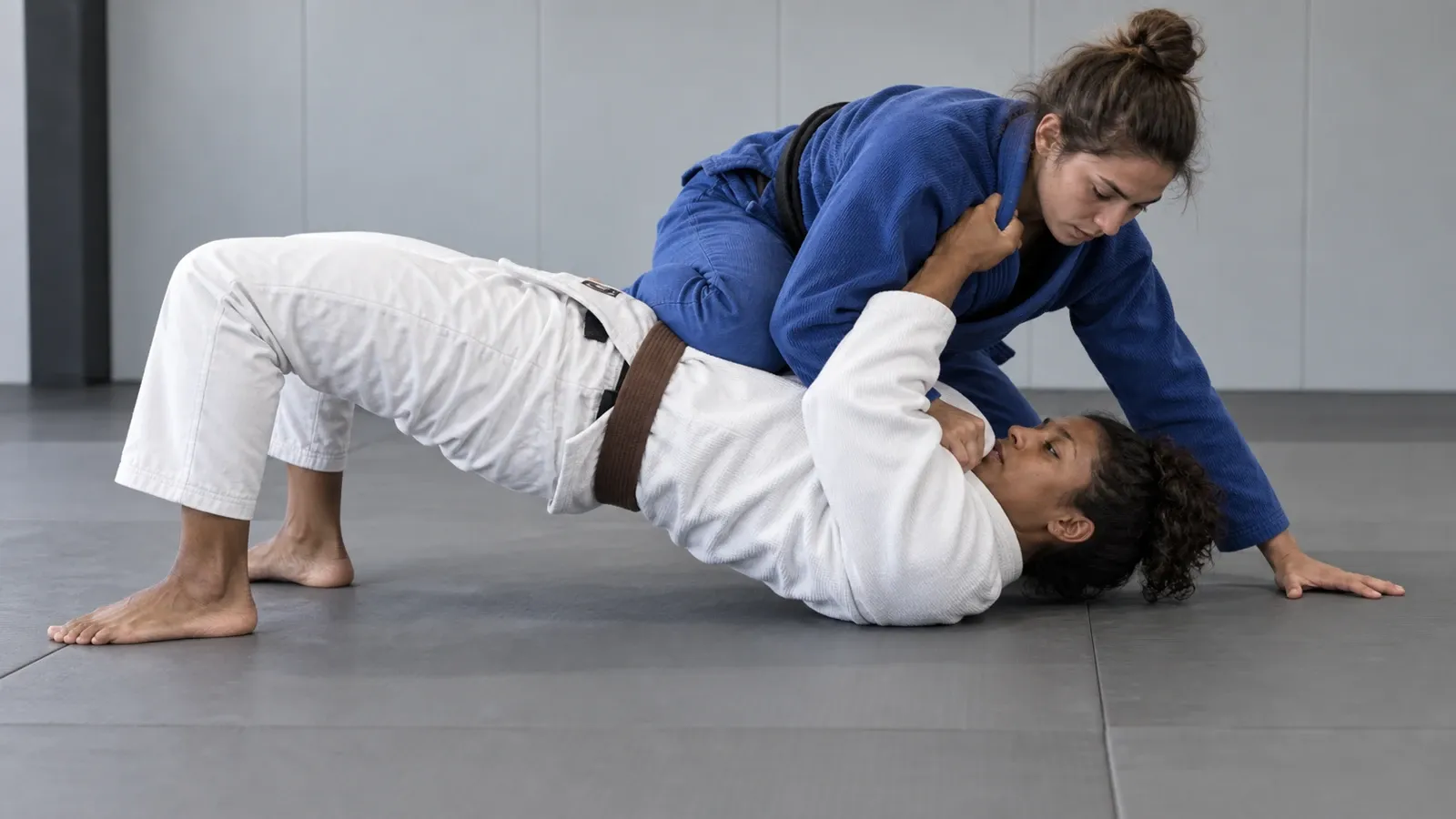
A bridge is usually finished by turning, not by going straight up. You bridge up and over one shoulder, rolling towards the side you are trying to move somebody. Vertical height on its own lifts a person and puts them back where they were; height plus direction moves them.
The single most common fault is bridging off the shoulders instead of the feet — arching the back and craning the neck, which produces a lot of effort and almost no hip movement.
What it is actually for
Three jobs, and it is worth separating them because beginners assume only the first exists.
Making space. Most of the time you are not trying to reverse anybody. You bridge, they post their weight to stop being rolled, and for a moment their weight is somewhere other than on you — which is the moment your hips, your frames or your knee get to move. This is the bridge working as part of a hip escape rather than as an escape in itself.
Reversing them. Occasionally the bridge is the technique. The bridge and roll escape from mount is exactly that: trap an arm and a leg so they cannot post, then bridge over that shoulder and arrive on top. Without the trapping it does not work, which is why “just bridge harder” is such bad advice.
Preventing the pin from settling. Constant small bridges make it very difficult for somebody on top to consolidate. This is unglamorous and it is a large part of what good defensive players do.
Where it appears
Nearly everywhere you are underneath somebody:
- Mount bottom, for the bridge and roll and to create the space the elbow-knee escape needs.
- Side control bottom, to create the gap for a frame or a knee to enter.
- Back control, where bridging into the mat is how you start getting your shoulders down.
- Guard passing exchanges, where a small bridge can disrupt somebody’s base mid-pass.
It also appears standing, in a sense: the hip drive of a takedown finish and the hip drive of a bridge are the same movement pattern in a different orientation.
Why bigger partners change the calculation
A bridge lifts somebody’s weight. Against a training partner much heavier than you, the same technique produces less displacement for more effort, and the answer is not to bridge harder.
It is to bridge earlier — before their weight is settled — and to bridge into something, so that the small amount of space you create is immediately used by a frame or a knee. Trying to out-muscle a heavier person from flat on your back is the single most reliable way to be exhausted after two rounds, which is the honest version of the problem described in training with bigger, stronger partners.
Common faults
- Pushing off the shoulders and neck instead of the feet. Uncomfortable, weak, and the version that leads to neck problems over years.
- Heels too far from the hips. With the feet out in front, the hips cannot rise. This is the most common thing a coach fixes in a beginner’s bridge.
- Going straight up. Height without direction achieves nothing. Bridge over a shoulder.
- Bridging with nothing trapped. They post a hand and you have simply lifted somebody.
- Holding the bridge. It is a moment, not a position. Bridge, use the space, come back down.
- Forgetting to breathe out. People hold their breath under pressure and then wonder why the third round feels different from the first.
How to practise it
Solo, as a warm-up, in both directions. Feet flat, hips up, turn onto a shoulder, come back. It is one of the few genuinely useful things you can drill without a partner, which is why it appears in almost every class and in training on your own.
With a partner in mount, no escape attempt. Just bridge and feel where their weight goes. Then try it with them posting, so you learn what a reaction looks like.
Then chained. Bridge, they post, you hip escape into the space. Bridge into frame, bridge into knee. The bridge is rarely the whole answer and drilling it as a standalone move teaches the wrong lesson.
Safety
The bridge itself is one of the safest things in the sport, with a single important exception: your neck.
Weight belongs on the shoulders and upper back. A bridge performed on the crown of the head — common in people who are straining for height with their feet too far away — loads the cervical spine under bodyweight plus somebody else’s, and it is a genuine injury mechanism rather than a theoretical one. If you feel the pressure in your neck rather than your upper back, stop and fix the foot position before adding effort.
Always ask your coach or instructor to check your technique and practise safely at your academy.
Common questions
What is a bridge in Brazilian Jiu Jitsu? Driving your hips upward off the mat, through your feet, to disturb the weight of somebody on top of you. It is the basis of nearly every escape from underneath.
Why is it called an upa? It is the Portuguese name the sport carried with it, used interchangeably with “bridge” in most gyms and often specifically for the bridge-and-roll escape from mount.
Should I bridge straight up or to the side? Over a shoulder, almost always. Straight up lifts somebody and returns them to the same place; turning is what actually moves them.
Why does my neck hurt when I bridge? Your weight is going onto your head instead of your shoulders, usually because your heels are too far from your hips. Fix the feet before adding effort.
Do I need to be strong to bridge effectively? Timing matters far more than strength. A bridge that arrives before somebody’s weight settles moves them; a bridge into a consolidated pin mostly moves you.
Can I use a bridge on its own to escape? Rarely. It normally creates a moment that something else uses — a frame, a knee, a hip escape. The exception is the bridge and roll, where an arm and a leg are trapped first.