
Guide
Scissor sweep in Brazilian Jiu Jitsu (no gi): when it applies, when it does not, and common mistakes
In no gi Brazilian Jiu Jitsu, a scissor sweep attempt sits inside open guard: you are using your legs to control and create leverage long enough to off-balance and reverse. It is least reliable when the top player can freely stand up or begin passing your open guard.
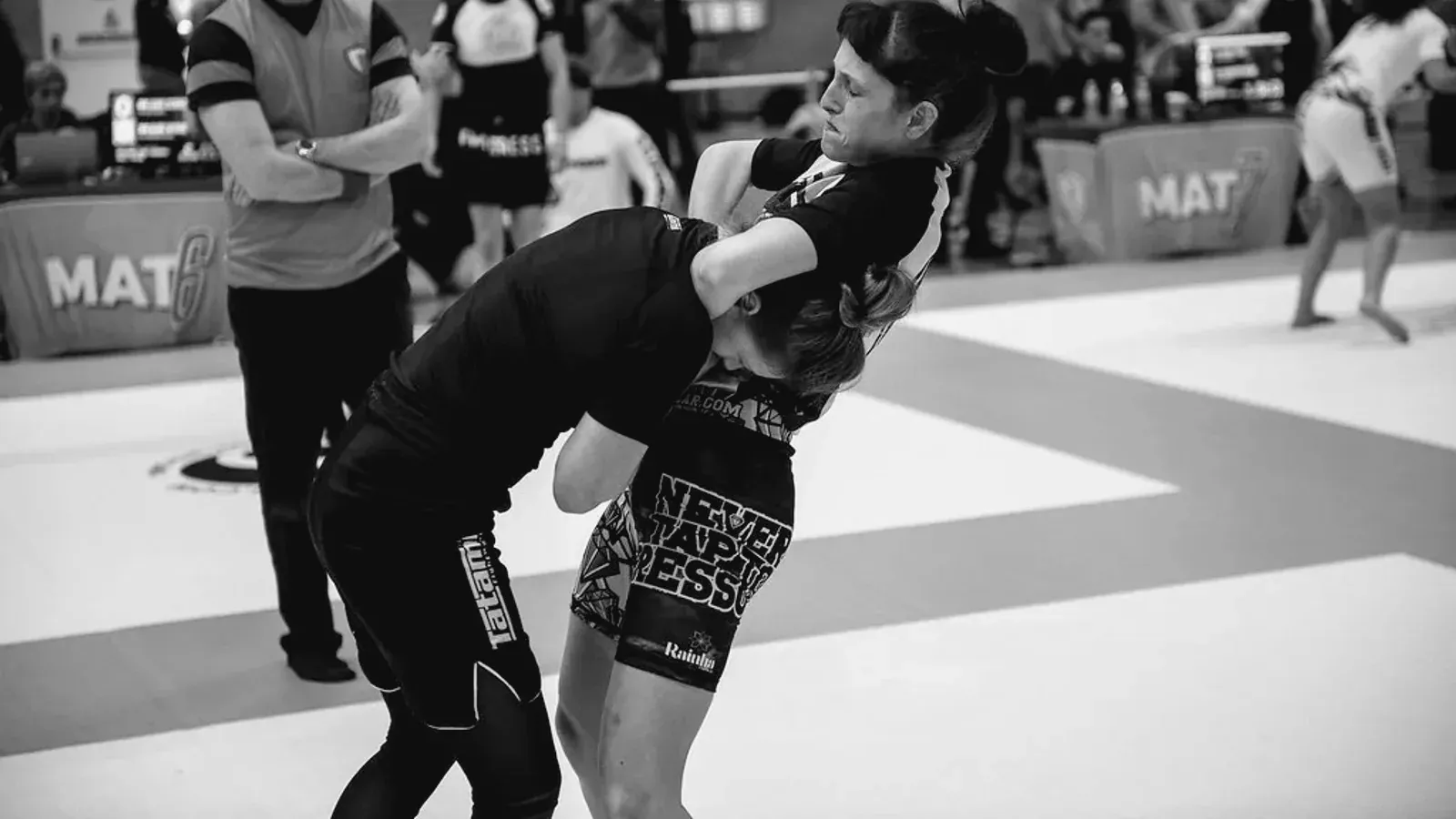
attacktheback · Openverse (flickr) · Creative Commons Attribution 2.0
What “scissor sweep” means in no gi Brazilian Jiu Jitsu
A scissor sweep in no gi Brazilian Jiu Jitsu is best understood as a sweep you attempt from open guard: you are on your back using your legs to control and create leverage long enough to put the top player off balance and reverse the position. “Open guard” here means you are not locking your ankles around your partner, but instead using your legs to push, wrap, or hook for control.
That framing matters in no gi because you cannot rely on cloth grips, and open guard is a position that gives your opponent a clear strategic option: they can try to stand up or start passing. Open guard is therefore often used temporarily to set up sweeps or other techniques rather than being a place you sit without a plan.
When the scissor sweep applies
The scissor sweep applies when you can treat your guard as a control position rather than a loose, open space. In practical terms, it is the window where your legs are actually connected to your opponent’s posture and base, so that you can move them and create leverage.
Open guard is typically used to perform joint locks and chokeholds, and the legs can be used to move the opponent and to create leverage. If you are connected with your legs in a way that lets you move your opponent, you have the basic condition you need for a sweep attempt.
It also applies when you are using a guard configuration that entangles or dominates one of the opponent’s legs. Guard work where the bottom combatant uses the legs to entangle one of the opponent’s legs creates opportunities for powerful sweeps. Even if you do not label what you are doing as X-guard or another named position, the underlying idea is the same: controlling a leg narrows the top player’s ability to step out, change angle, or disengage.
If you want a broader map of where this kind of sweep fits, it helps to review the main types of guard in Brazilian Jiu Jitsu and then compare that to a general process such as how to do Brazilian Jiu Jitsu sweeps. The scissor sweep is not separate from guard work; it is one outcome you aim for from a connected open guard.
When the scissor sweep does not apply
It stops being a realistic option when your “open guard” is open in the unhelpful sense: you are on your back without meaningful control of distance, posture, or legs.
Open guard allows the opponent to stand up or try to pass the guard. That means if your legs are not controlling their movement, the top player can simply change the whole problem by standing, backing out, or beginning a pass. When that happens, the moment for a scissor-type sweep has usually passed and you need to re-connect, re-guard, or switch to a different guard that better manages the opponent’s attempt to stand or pass.
It also does not apply when the top player is already transitioning into a more dominant position through passing the guard. Passing the guard is the top player’s priority against any guard, and open guard in particular carries a bigger risk of being passed if you are not ahead of the exchange.
In other words: if you are late, and the top player is already beating your legs, clearing your frames, or changing angle around your hips, the sweep is no longer the correct task. Your task becomes guard retention and recovery, not sweeping.
What people get wrong about the scissor sweep in no gi
Treating it as a “move” you do, rather than a short phase of open guard
A common mistake is thinking the scissor sweep is something you can start whenever you feel like it, even when your open guard is not controlling anything. In open guard, your legs must actively move the opponent and create leverage. If your legs are disconnected, the top player has the built-in answers of standing or passing.
When you treat the scissor sweep as a separate technique instead of an outcome that depends on your guard connection, you end up attempting it from the wrong distance. In no gi, that distance error is punished quickly because disengaging is easier.
Ignoring the opponent’s ability to stand
Another common mistake is forgetting what open guard gives away. Open guard allows the opponent to stand up, and that is not a minor detail: standing changes the sweep problem entirely because it can remove the kind of base you were planning to cut across.
If you want to use a scissor sweep approach in no gi, you need to treat the opponent’s stand-up as the first problem you must prevent or immediately respond to, not an afterthought.
Trying to sweep without first dominating a leg
Sweeps are much easier when you limit how the top player can post or step. Guard positions that entangle one of the opponent’s legs create opportunities for powerful sweeps because they restrict movement and let you redirect weight.
When people fail repeatedly with a scissor sweep in no gi, it is often because their legs are not doing enough to control a leg line or manage the opponent’s base. They may be moving their own body a lot, but not actually dominating a leg or forcing the opponent to carry weight in a compromised stance.
Hanging out in open guard instead of using it to set something up
Open guard is often used only temporarily to set up sweeps or other techniques. A very practical error is staying there too long with no progression, letting the top player build a pass.
If your scissor sweep is not there, the correction is not to keep trying it from the same look. The correction is to treat open guard as a connector: you use it to get to another sweep, another guard configuration, or an attack that makes the top player react.
Expecting no gi to work like gi
In no gi you do not have sleeves and collars to stabilise your angles. That pushes you towards leg-based control and careful distance management. If you try to recreate gi-style control ideas without cloth grips, you can end up with an open guard that looks busy but does not actually control the opponent’s posture or base.
A good way to check your thinking is to keep the principle from position before submission — what it actually means: you are trying to earn control that makes the next action possible, not skipping the control and hoping the next action lands anyway.
How to choose a better option when the scissor sweep is not on
If the opponent is standing or is about to stand, you need a guard or connection that addresses that directly. Open guard includes many positions where the legs are used to push, wrap, or hook without locking the ankles together. The practical point is not the name of the guard but whether your legs are actually controlling what the opponent can do next.
If your goal is consistent sweeping in no gi, build a small set of open-guard connections you can reach reliably and then decide whether a scissor-style sweep is the best reversal from that connection. Resources like how to build your own Brazilian Jiu Jitsu game and how to learn Brazilian Jiu Jitsu are useful here because the problem is often not one technique, but how you arrive at it.
Safety and training focus in no gi
Sweeps from open guard rely on leverage and on shifting your partner’s base. In training, prioritise control before you try to reverse: if you cannot control the opponent well enough to move them, trying harder tends to create scrambles rather than clean reversals.
This is especially relevant when training with a heavier partner, because open guard gives them the option to drive into a pass if your legs are out of position. If that is a recurring issue for you, how to train with bigger, stronger partners is a better next read than searching for a stronger version of the same sweep.