
Guide
Half Guard Game: How to Build One as the Bottom Player
Connect defence, attacks and recovery from bottom half guard. Practise one underhook route, recognise the reaction and record the position you reach.
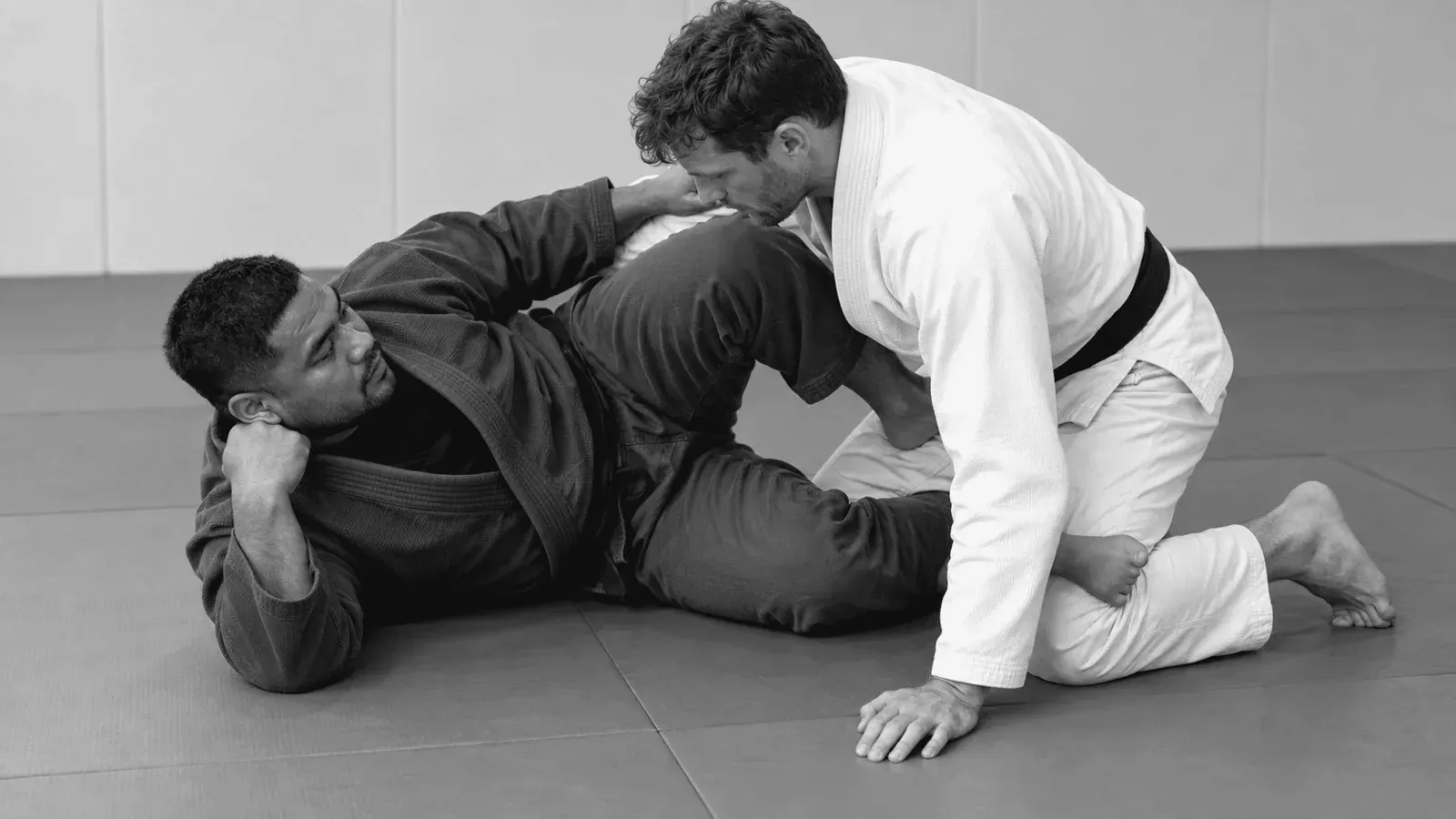
A half guard game is a set of connected decisions from the bottom while your legs control one of the opponent’s legs. A useful first plan has three branches: recover useful frames, attack when you can get underneath their upper body, and recover a fuller guard when the position deteriorates. Trapping a leg alone does not stop a pass.
Start with a small game you can test. One attack, one response to resistance and one defensive exit are easier to diagnose than a collection of disconnected sweeps.
Define the half guard you are practising
This plan starts on the bottom, partly on your side, with one of the top player’s legs between yours. It is not a deep-half or lockdown tutorial. Your coach can help you choose the leg configuration and frames that fit your current level.
An underhook is an arm threaded underneath the opponent’s arm. A crossface is upper-body pressure that turns your head away and makes it harder to stay on your side. Those controls matter because they affect whether you can move your shoulders and hips independently.
The academy half guard lesson explains the relationship between staying on your side, upper-body control and mobility. Use those checkpoints before adding attacks.
Your first branch: protect movement
Before attempting a sweep, check three things:
- Can you keep your head from being turned away?
- Can you maintain space with your forearms and knee rather than pushing with straight arms?
- Can you move your hips, or are you flattened with your shoulders pinned?
If the answer to the third question is no, practise recovering your frames first. Trying to launch an attack from a collapsed starting position hides the problem you need to fix. A useful reset for a beginner drill is “top has settled crossface and underhook”; stop there, discuss the lost checkpoint and restart with less resistance.
This is also where guard retention belongs in your game. Recovery is an intended branch, not a consolation prize after an attack fails.
Your attacking branch: underhook to a reaction
This connected route starts on your right side with the opponent’s right leg trapped. Your left knee sits just above their right hip. Keep your right elbow available as a base and use your left hand to check their right arm before entering.
- Thread your left arm underneath their right arm and bring your left shoulder close to their right hip. With that underhook, grip their belt in the gi.
- Pull your knees towards your chest and scoot underneath their hips. Place your left foot inside their right leg; your right leg stays available as the driving base.
- Off-balance them towards your left. Your right leg drives while the left leg blocks their trapped leg from stepping out.
- If they base to stop that direction, rock back the other way and rise through your right elbow to your knees. Keep the left-leg connection. Block their far leg with your right hand and drive into them, clearing your right leg so they cannot catch it in half guard.
- Settle on top before treating the sweep as complete. Rising to your knees alone is a come-up, not the finish.
The illustrated half guard series shows this specific orientation. Practise the first direction and the come-up branch cooperatively; do not turn the opponent’s knee against a planted foot.
Your recovery branch: when the underhook is denied
If the opponent drives back into you and removes the attacking space, the same series uses an open-guard recovery: release the half-guard leg connection as space allows and bring your shins between you, towards their biceps. Do not force the attacking branch after losing its start.
In practice, record the first lost checkpoint: upper-arm control, shoulder-to-hip connection or the trapped leg. Recovering a familiar guard family gives you a planned destination. If flattened, restore frames and mobility before trying to free the leg; do not wrench a trapped knee to escape.
Choose the branch from the actual half-guard configuration
Use the following decision sheet for this particular underhook series. It does not apply unchanged to deep half, lockdown or half butterfly.
| What you can feel | Decision in this game | Check before moving on |
|---|---|---|
| Your shoulders are flattened and your head is turned away | Work on frames and restoring side-facing mobility; postpone the sweep | You can move the hips without twisting the trapped knee |
| You are on your right side, but the left underhook is denied | Retain a useful frame and look for space to recover guard | Your shins can enter the space rather than being forced against weight |
| Left underhook and shoulder-to-right-hip connection are available | Scoot underneath and test the first leftward off-balance | The left foot controls inside their trapped right leg; right leg can drive |
| They widen or post their base against the leftward sweep | Use the come-up branch, rising through the right elbow | Keep the underhook and leg connection instead of reaching with both hands |
| They drive back and remove the attacking space | Leave the attack and recover the shins-inside guard described above | Recover space first; do not yank the trapped leg free |
This sheet is deliberately more specific than a general game-building framework: it identifies which side, leg connection and base response change this half-guard sequence. Ask a coach to check the starting geometry before adding resistance.
Diagnose a failed branch
A sweep can fail before the opponent meaningfully counters it. Separate these failures when you practise:
The underhook never connected. If your left arm reaches underneath but the left shoulder remains far from the hip, the sweep is missing its starting connection. Return to the entry rather than adding more pull with the arm.
The off-balance produced a base, but you continued the same direction. The series has a come-up precisely because a widened base changes the available route. Have your partner give that one reaction predictably until you recognise it.
You came to your knees but lost the leg before controlling the far base. Stop at that intermediate position and have the coach check the leg connection and right-hand far-leg block. Standing up is not evidence that the sweep finished.
You recovered space but kept hunting the original attack. Practise ending that repetition in your chosen open guard. Reconnecting another guard is a successful defensive outcome for this branch.
These are suggested troubleshooting categories for the illustrated series, not claims that every half-guard problem has the same solution. Add a second sweep only after you can identify what your current route fails against.
Test the game in three small rounds
Use these suggested constraints with a cooperative partner. Stop on any tap, discomfort or unsafe neck pressure.
Round one: maintain the start. Top tries to settle upper-body control; bottom tries to retain frames and mobility. Do not add sweeps yet. Reset when either player clearly reaches their objective.
Round two: recognise one reaction. Begin with the underhook available. Top either bases against your first off-balance or leans away. Bottom names the reaction and follows the coach-taught sweep or come-up. Stop at stable top position or a clear lost connection.
Round three: choose attack or recovery. Top may deny the underhook. Bottom must decide whether to restore the attacking connection or recover another guard. The objective is a timely decision, not forcing the original move.
Increase resistance after both partners understand the rules. Change one constraint at a time so you can tell what caused the failure.
Record the decision that needs work
A useful note looks like this:
Start: right-side half guard. Top controlled my upper arm. I kept trying the underhook from too far away. Next practice: regain the frame first, then test whether I can connect my shoulder to the hip.
This is an original example training note. Use your own side, grips and outcome. Record the position you actually reached, not just “sweep failed.”
In your BJJ game planner, connect half guard to your selected attack, the reaction that changes it and the recovery guard. After a session, update one branch. Over time the map becomes a record of decisions you can make against resistance. After reaching top position, use guard passing drills to practise the next connection.