
Guide
What Muscles Does Brazilian Jiu Jitsu Work the Most?
Brazilian Jiu Jitsu is a ground-based grappling sport, and the positions that define it, guard, top control and north-south, place the heaviest and most repeated demand on the hips, core, shoulders, neck and grip. The pattern of common injuries in the sport, at the knee, shoulder and neck, points to the same areas as those under the greatest sustained load.
The hips and core carry the heaviest, most constant load
Brazilian Jiu Jitsu is a ground-based grappling sport, and its central position is the guard, where the player on the bottom uses their legs to control the distance and angle of the player on top. Whether you are retaining guard from underneath or trying to pass it from on top, the work of shifting weight, closing gaps and resisting rotation runs through the hips and core rather than the arms.
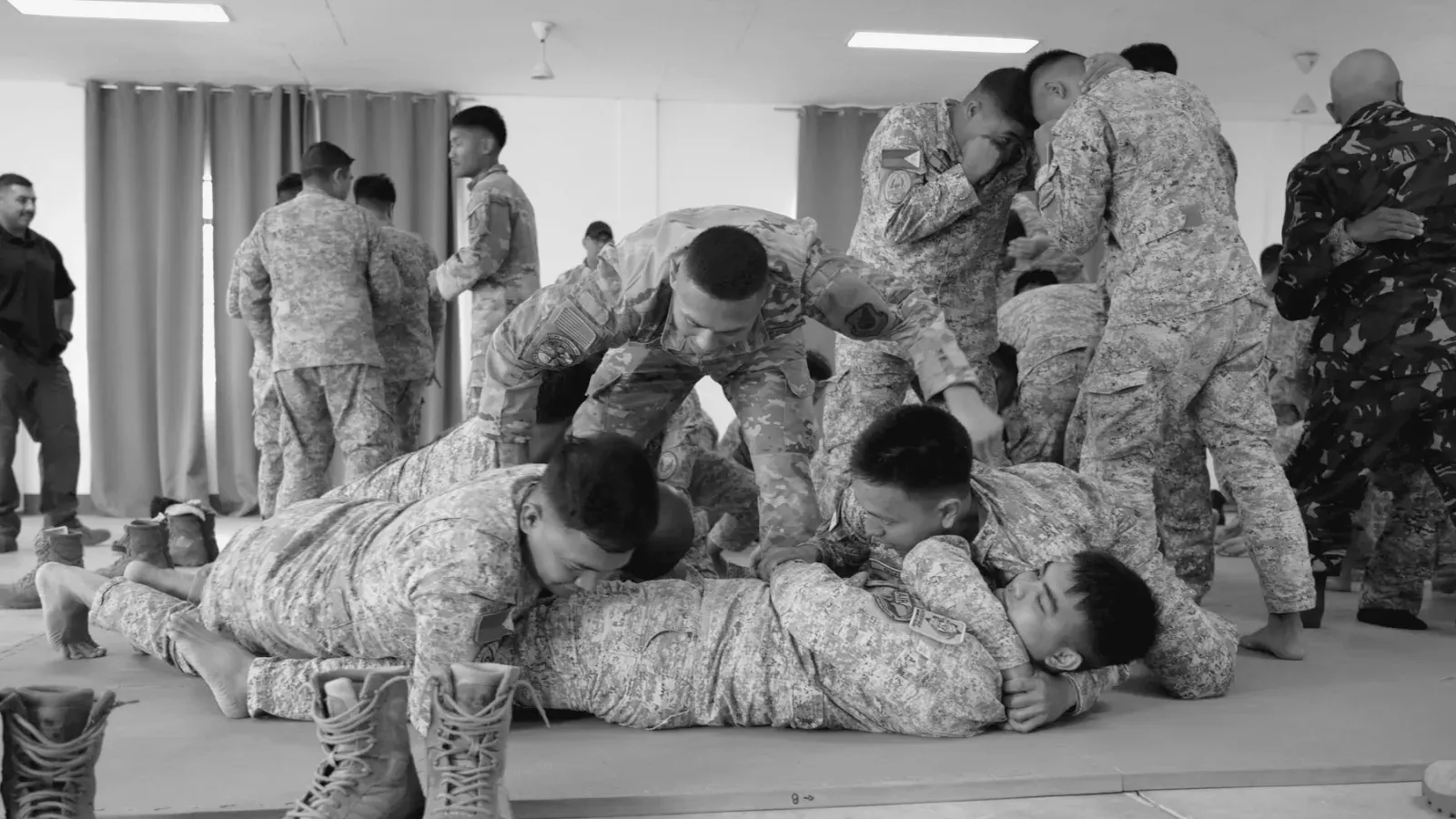
From the top of most controlling positions, including north-south, the aim is to bring the hips down towards the mat. This produces what is known as dead weight, pressure created by body weight and hip placement rather than by pushing or pulling with the arms. Holding a dominant position this way for the length of a round places sustained load on the hip flexors, the glutes, and the deep muscles of the abdomen and lower back that keep the spine stable under pressure.
The same muscles do the work in reverse from the bottom. Escaping a pin or executing a sweep such as the scissor sweep (see how to scissor sweep in Brazilian Jiu Jitsu) depends on hip movement and leg drive to shift an opponent’s balance, with the arms doing comparatively little of the work. The knee is also exposed through these exchanges, which is one reason ACL tears are among the most common injuries in the sport: the muscles and connective structures around the knee and hip are loaded through ranges of motion a standing sport rarely demands.
The shoulders take repeated, direct strain
Joint locks are a defining feature of Brazilian Jiu Jitsu, and most competitions permit locks on the wrist, elbow, shoulder and ankle, since those joints tolerate the stress more safely than the knee, ankle in rotation, or spine, which most competitions ban or restrict. The shoulder sits at the centre of several of the sport’s most common submissions and defences. The kimura, a shoulder lock attacked from several positions including north-south, requires the attacker to control the arm through the shoulder girdle, and the defender to resist that rotation using the same muscles.
Rotator cuff tears are among the most common injuries reported by practitioners, which reflects how often the shoulder is loaded, both in attacking arm locks and chokes and in defending against them. Armbar attempts, whether from full guard (see how to armbar from full guard) or from mount (see how to armbar from mount), demand shoulder and upper-back control from both sides of the exchange: the attacker to isolate the arm and extend it under control, the defender to protect the joint by keeping the elbow tucked and the shoulder stable.
The neck and upper back stay under constant tension
Spinal disc herniation is among the most common injuries in Brazilian Jiu Jitsu, most often in the neck. This fits with how much low-level, sustained tension the neck and upper back carry through a typical round. Maintaining posture in guard, framing against an opponent’s pressure, and defending chokes, such as the north-south choke, all require the neck and upper back to hold position against steady resistance rather than move through a large range. That is a different kind of muscular demand from the shorter, more explosive effort involved in a sweep or a scramble.
Grip and forearms fatigue from constant contact
Wrist locks are among the joint locks most competitions permit, and defending against one, along with taking and breaking grips throughout a match, keeps the forearms and hands working almost continuously. In the gi, the uniform worn in one of the sport’s two main formats, grips are taken on the fabric of the jacket and trousers; without it, in the no-gi format, grips are taken on the limbs, the head, and through underhooks and overhooks (for more on the difference, see what is Brazilian Jiu Jitsu gi and no-gi). In both formats, the hands and forearms are gripping or resisting a grip for nearly the whole time you are engaged with an opponent, which is why grip fatigue is one of the first limits most people notice.
Training builds endurance in these muscles, not just strength
Sparring, known in the sport as rolling, and live drilling make up a significant part of training. Because rounds are repeated across a session rather than performed once, the hips, shoulders, neck and grip are trained mainly for endurance under sustained, live resistance rather than for a single maximal effort. This is closer to the demand of holding a plank for several minutes than to the demand of a one-off lift, and it is why fitness for this sport looks different from fitness built purely in a weights room.
When the pattern shifts
The muscles under the greatest load change with the ruleset. Where an organisation permits leg locks, the hips, knees and their surrounding muscles come under direct attack and defence in a way they do not where knee, ankle and spinal locks are banned or restricted, which is the case in most competitions. Where a format favours takedowns and standing exchanges, the muscles used to generate hip and leg drive from a standing position take on more of the work than they do in a match settled on the ground within seconds. The sport itself leans towards the ground: its development gave primary emphasis to ground fighting positions and manoeuvres, with the guard as the central working point, so standing leg drive plays a smaller part here than it does in judo, from which the sport descends.
What people get wrong about muscle work in this sport
The common assumption is that Brazilian Jiu Jitsu is mostly an arm-strength sport, built on pulling and gripping. The dead weight principle behind most top control contradicts that directly: pressure comes from hip placement and body weight, not from muscling a position with the arms. An armbar is not won, or defended, by bicep strength on either side of the exchange; it is won or defended by shoulder and hip positioning. That is also why a technically sound smaller athlete can hold a controlling position against a stronger one, and why the muscles that matter most in this sport are the ones that hold posture and pressure over time rather than the ones that produce a single burst of force.