
Guide
How to get better at Brazilian Jiu Jitsu
You improve at Brazilian Jiu Jitsu by training consistently, giving each session one specific aim, drilling the problems sparring exposes, and staying healthy enough to keep turning up. This guide sets out the sequence, when it applies, and the mistakes that most often slow people down.
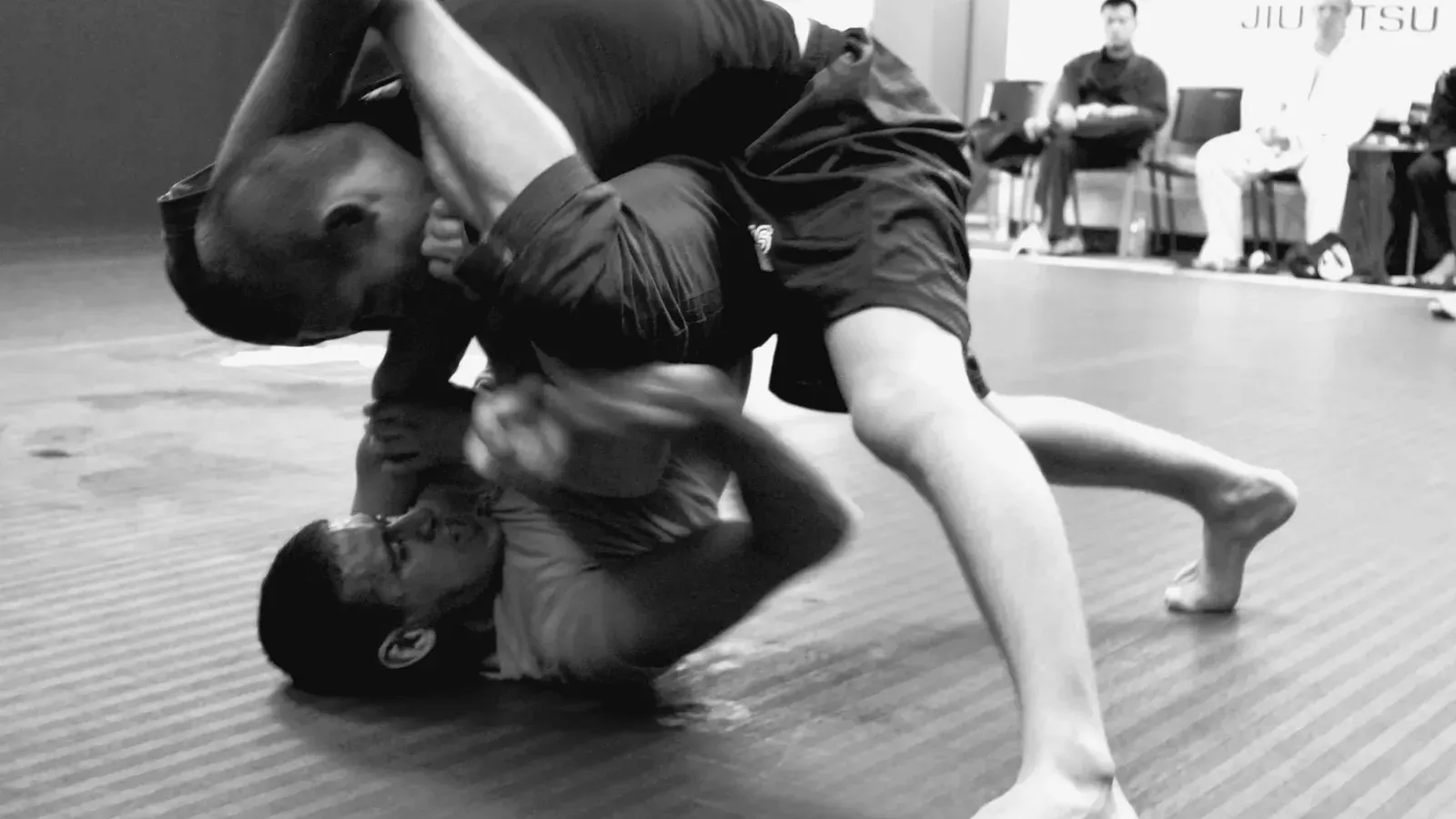
Mark Bonica from Durham, NH, USA · Wikimedia Commons · CC BY 2.0
.jpg)
Getting better at Brazilian Jiu Jitsu comes down to a loop: learn a small amount, test it against a resisting partner, find where it fails, and fix that specific failure. Repeat this for years without long breaks. Everything below is a way of making that loop tighter.
Build the loop: learn, test, fix
A class shows you a technique. Sparring (also called rolling: live practice against a partner who resists) tells you whether you can use it. Drilling, which means repeating a movement cooperatively so it becomes automatic, is how you close the gap between the two.
Most improvement happens when you connect all three. If you only attend classes, you collect techniques you have never tested. If you only spar, you keep repeating the same habits, good and bad. If you only drill, you never learn when a movement works and when it does not.
The sequence
1. Attend regularly and protect that routine
A schedule you can sustain beats a burst of hard training followed by a layoff. Pick a number of sessions you can keep up through a busy month, not your best week.
Take rest seriously too. If you are too tired to train, you learn less and put yourself and your partners at more risk.
2. Pay attention in class
When the instructor shows a technique, note the starting position, the goal of the movement, and the two or three details that make it work. Positions and goals transfer to other situations. A memorised list of steps does not.
Ask questions when a detail is unclear. Your instructor can tell you things about your own game that no article can.
3. Give each round one job
Before you spar, decide what you are working on. It might be keeping your guard when your partner passes, escaping from the bottom of side control, or getting to a particular grip. Choose one thing and stay with it, even if it costs you the round.
This works because winning every round teaches you very little. You keep doing what already works. A specific aim makes you practise the positions that are weak.
Positional sparring is a useful tool here. You start from a set position, such as one partner in closed guard, and work only from there. You get many more repetitions of the situation you want to improve than you would in a full round.
4. Spar at a pace that lets you think
Rolling at full intensity every time makes you tense and rushed. You rely on strength and speed, which tend to fail against larger or fitter partners. Rolling at a lighter pace lets you notice what your partner is doing and choose a response.
Control matters. Do not force a submission through a partner who has no time to react, and tap early yourself when you are caught. A tap is your partner’s or your own signal to stop, and honouring it promptly keeps you both training. Tapping early is not a failure. It keeps you available for the next session.
5. Turn losses into a short list
After training, note what happened. You do not need a long journal. Write down the position where you got stuck, the submission that caught you, or the sweep you kept missing. Then bring that specific problem to your instructor or a training partner, and drill it.
Over a few weeks this list shows you patterns. If you keep being passed in the same way, that is your next priority, not another new technique.
6. Drill the fundamentals
Basic movements underpin almost everything else: hip escapes, bridging, framing, posture in guard, and controlling grips. Drill them until you do not have to think about them. They are unglamorous, and they are what let you stay calm in a bad position.
When you drill a technique with a partner, start slowly and add resistance gradually. Both of you should be able to stop at once if something feels wrong.
7. Train against different people
Roll with partners of different sizes, ages and styles. A partner who is heavier, lighter, more flexible or more defensive will each expose something different. If you only train with the same one or two people, you learn to beat them, which is not quite the same as learning Brazilian Jiu Jitsu.
When this applies, and when it does not
The loop works at any level, but the emphasis shifts. Beginners gain most from regular attendance, learning the basic positions, and staying safe while sparring. More experienced practitioners benefit from targeted problem-solving, because the easy gains have already been made.
If you compete, add practice under the rules of your event. Rulesets differ on which submissions are allowed, how points are scored, and whether you wear a gi (the traditional jacket and trousers) or train without one. Check the rules of the organisation running your competition, and prepare for those rules specifically.
If you train mainly for fitness or enjoyment, the same principles still apply, but you can loosen the structure. Consistency and safe training partners matter more than a detailed plan.
What people get wrong
Collecting techniques. Learning a new move every week feels like progress, but it is not if you cannot use the ones you already have. Fewer techniques, understood well and tested often, serve you better than many you half remember.
Treating sparring as a contest. If every round is about winning, you avoid the positions where you are weak. You end up with a game built around your strengths and a large blind spot.
Relying on strength and speed. These can work against beginners and smaller partners, but they cost energy and tend to fail against skilled opponents. Learn to move efficiently in the position you are in instead of muscling out of it.
Training through injuries. Ignoring a sore joint or a stiff neck can turn a small problem into weeks away from the mat. Stopping early costs less than stopping late.
Comparing your progress with others. People arrive with different athletic backgrounds, schedules and bodies. What is useful is whether you are better than you were a few months ago, and whether you can now do things in sparring that you could not before.
Skipping the boring parts. Fundamentals, drilling and review are not exciting, but they are where most of the improvement is hiding.