
Guide
BJJ Terms: A Practical Glossary for Your First Months on the Mats
Brazilian Jiu Jitsu terms are the shared vocabulary for safety signals, positions, transitions, movements and submissions. This guide orders them by what a new trainee needs first and flags where gyms and rulesets use words differently.
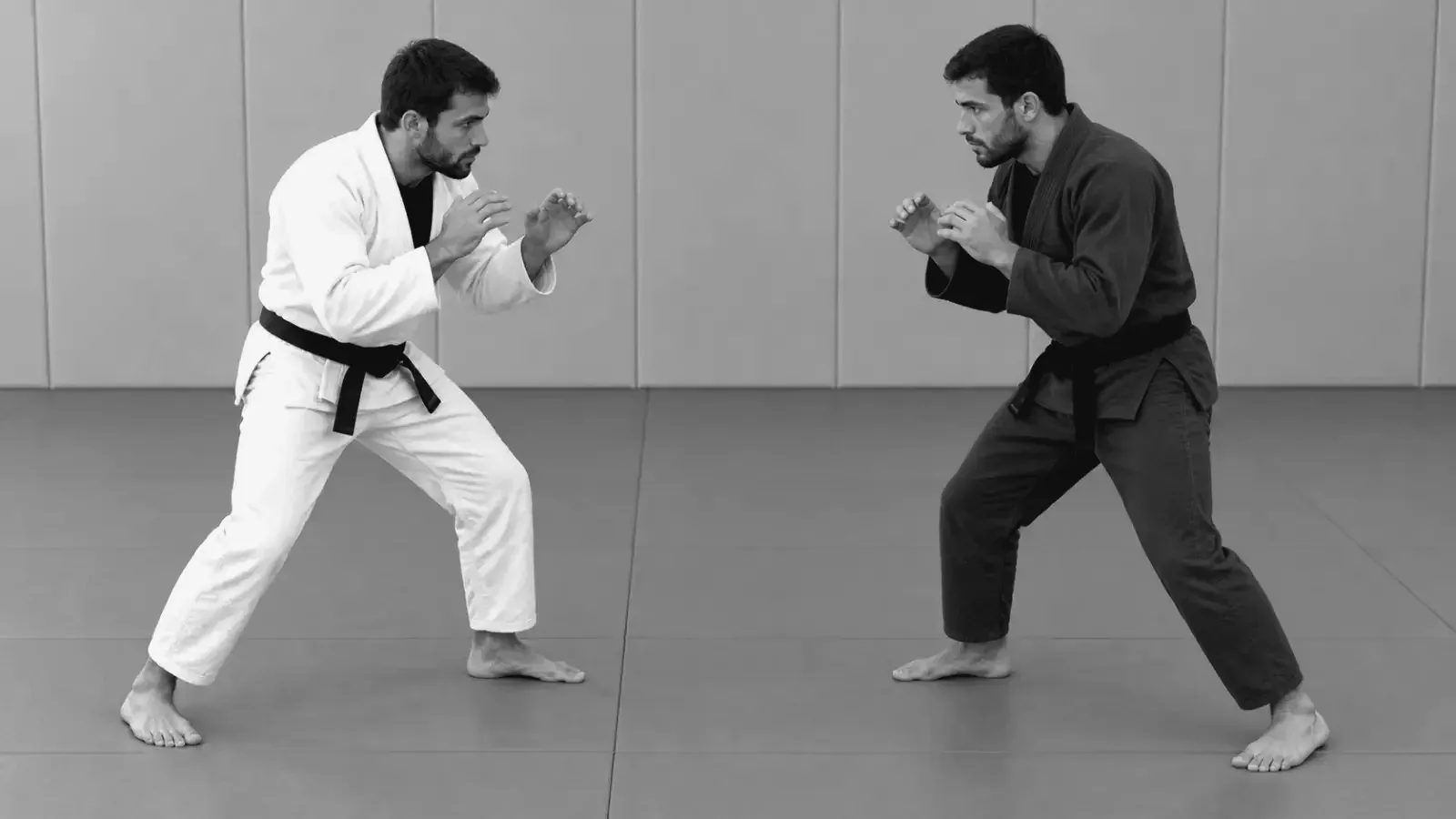
You do not need the whole vocabulary before your first class. Start with the words that keep you and your partner safe, then add positions, and let the rest arrive through drilling. Coaches can use slightly different names for the same movement, so when a term is unclear, ask what it means and watch the demonstration.
The lists below are grouped by when you are likely to need them. For longer alphabetical references, the glossaries from Student of BJJ and Legion San Diego are useful to keep open in a tab.
Safety and class vocabulary
Tap is the signal to stop. You can tap your partner, the mat or your own body with a hand, tap with a foot if your hands are trapped, or say “tap” out loud. Whoever is applying the technique releases immediately. You do not need to wait until it hurts: tap when you know you are caught or want the action to stop.
Drill means practising a technique repeatedly with a cooperative partner. Roll means live practice, where both people make decisions and offer resistance. Rolling is not a real fight. The point is to practise timing, control, escapes and submissions with someone who has to train again tomorrow. Many gyms let you sit out a round or keep drilling instead, so ask about yours.
Gi is the jacket, trousers and belt worn in gi training. No-gi is the same sport in fitted athletic clothing, so there is no fabric to grip for control or submissions.
Positions
A position is the relationship between you and your partner at a given moment. Control starts there, which is why positions come before submissions in most beginner curricula.
Guard is a family of positions where the person underneath controls the person on top with their legs and body position. The main types:
- Closed guard (also called full guard): the legs wrap around the partner’s hips or waist with the ankles crossed behind them.
- Open guard: the legs are not locked, so you use feet, legs, grips and distance instead.
- Half guard: you have trapped one of the top person’s legs.
- Butterfly guard: you sit against a kneeling partner with a foot inside each of their knees.
- De La Riva: a named open guard, using a leg hook around the outside of an opponent’s standing leg. Reverse De La Riva uses a different hook orientation; it is not simply a mirror image.
Mount is a top position over your partner’s torso, with a knee on each side. Side control is a top position across the torso. North-south is a top position where the two of you face opposite directions. Knee on belly and turtle complete the list most beginners meet early.
Back control means controlling from behind, usually with your hooks in. Hooks here means your feet, placed around the partner’s hips or legs. Do not confuse hooks with overhooks and underhooks, which are arm controls. An underhook threads your arm underneath the partner’s arm. An overhook wraps over their arm. The names describe the arm connection, not the position of your feet.
Control is not the same as a finish. Position alone does not end a round.
Transitions: pass, sweep, reversal, escape
A guard pass takes the top person beyond the bottom person’s legs and into a controlling position such as side control. A guard counts as passed when the top person has disentangled from the legs and secured a dominant position above them.
A sweep starts from guard and puts the guard player on top. Many people use the word for any bottom-to-top change, but some coaches separate it from a reversal, which changes position from somewhere other than guard. Check how your coach uses each word.
An escape gets you out of a bad position or a submission threat. A takedown brings the action from standing to the ground with control. A sprawl is a defensive movement that takes the legs away from a leg attack and brings the hips back or down.
Fundamental movements
These are the words you will hear most in drills.
- Bridge: raising your hips from a position on your back. A bridge-and-roll combines that movement with a turn.
- Shrimp (hip escape): a hip movement that creates space from your back.
- Frame: using the structure of your arms or legs to create and keep space. It is not pushing with all your strength.
- Base: your ability to stay balanced and hard to tip over.
- Posture: how you organise your head, spine, hips and limbs for the task. Good posture in closed guard looks different from posture during a guard pass.
- Pressure: controlled body weight and direction that limit movement. It never excuses ignoring your partner’s safety or a tap.
Submissions
A submission is a controlled technique intended to make your partner tap. A choke targets the neck. The names you will hear most:
- Armbar: controls and extends the elbow.
- Kimura and Americana: bent-arm shoulder locks with different orientations.
- Triangle: the legs form a configuration around the neck and one arm.
- Rear naked choke: usually finished from back control.
- Arm triangle, darce and anaconda: related chokes that wrap the arms around the neck with one of your partner’s arms trapped inside.
- Bow and arrow: a collar choke from the back, using the gi collar and positional control.
- Heel hook: a leg lock. Ashi garami, a leg entanglement, is the starting point for many leg-lock submissions.
Knowing a name is not permission to try the technique. Learn the control, the finishing direction and the release from your coach, and apply submissions gradually so your partner has time to tap.
When these terms apply, and when they do not
Most terms above are stable across gyms: a closed guard is a closed guard. Three things shift.
First, naming varies. Sweep versus reversal is one case. Ashi garami and single leg X are another, and the former is more often used when both people’s hips are on the mat.
Second, scoring terms belong to rulesets. A body triangle is a leg configuration around the torso, not the same as two separate back-control hooks. Check the event’s official rules before attaching a score to either position.
Third, gi and no-gi change what is possible. Grips on the jacket or collar, such as a collar sleeve grip, only exist when there is fabric to hold.
What people get wrong
- Treating tapping as failure. It is a routine safety and learning skill, and a good partner releases at once.
- Treating rolling as a fight. It is live practice with cooperation built into the goal.
- Mixing up hooks, overhooks and underhooks. Hooks are feet; the other two are arm controls.
- Assuming every coach uses a word identically. Ask, then follow the demonstration.
- Memorising names before learning to move. Names attach to movements, so bridge and shrimp matter more in week one than the name of a berimbolo.
Use vocabulary in a training note
After your next class, pick five to eight terms you heard and write each with a one-line definition in your own words in your training notes. Then pair every position or movement term with one drill, and ask your coach about that drill next session. That pairing is a practice plan, not a guarantee of progress, but it ties each word to something your body has done.
For example, organise a note as position → grip → action → reaction → next decision: “Half guard → underhook attempted → tried to come up → partner flattened me → next practice is restoring the frame.” This is an original example of recording an observation, not a prescribed technique sequence.
Save the unfamiliar term beside the position in your game planner and use training notes to retain the coaching cue. Ask your coach to confirm the name and meaning before using it to plan another move. Compare mount variations and back control to distinguish a name from the connections holding a position.