
Guide
Turtle in Brazilian Jiu Jitsu: Bottom Escapes and a Top Back Take
Understand early turtle escapes, a controlled back-take branch and the difference between early contact and established back control. Practise decisions and record the next position.
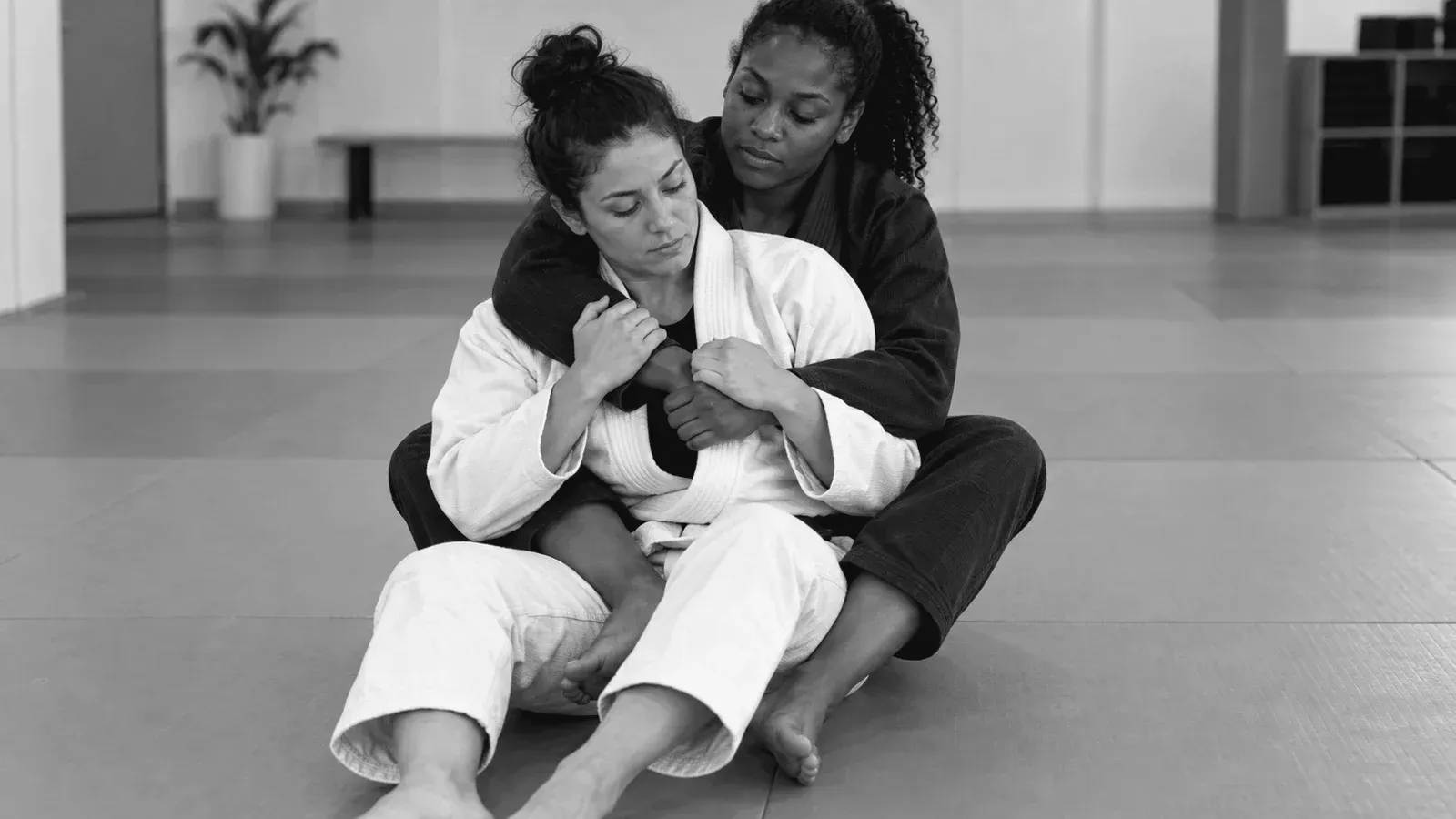
Turtle in BJJ means a kneeling, compact position with the opponent able to attack from above or behind. It can be a deliberate transition or a recovery after a scramble. It is not automatically safer than staying in guard: the useful choice depends on the grips and control your opponent already has.
Your immediate question is: can I recover guard or stand before they establish back control? From the top, the question is how to turn temporary access to the back into stable control.
Know which turtle problem you have
A compact turtle keeps elbows and knees close; a wider base gives more room to stand or move but also offers openings for grips and hooks. Protect your neck and avoid resting your weight on your head. If the opponent already has a seatbelt, hooks or a choke grip, deal with that control before attempting the early exits below.
A seatbelt means one arm over a shoulder and the other under the opposite armpit, with hands connected across the chest. A hook is a foot placed inside a thigh from behind to help control the hips. Neither term means the opponent has completed a submission.
Bottom: wrist control, then recover guard or stand
These early exits start with the opponent above you, before established hooks. With both hands, control the wrist of their arm nearest your face. Place your head against the inside of that arm’s armpit and maintain contact without loading your neck.
For the sit-down, first move your head and upper body away from the opponent by roughly a quarter turn. Keep the wrist as you retreat, sit to your hip and bring your knees between you to recover guard. Sitting directly beside them leaves them connected to your back.
Alternatively, use the contact to shift their weight off you and rise while maintaining the wrist control. The grip limits their options; it does not guarantee that another takedown is impossible. Stop if your neck takes the pressure or your partner controls your back.
Use the original illustrated escape lesson with your coach to check the orientation. After recovery, your next task is retaining guard.
Top: an early back-take branch
Start beside a compact turtle, with your weight controlled over their hip rather than their neck. Work to unbalance them onto a hip. When they remain supported on an elbow, connect a seatbelt and insert the available upper hook. Keep chest-to-back contact as you turn together onto your backs, then establish the second hook. Finish the drill at stable back control, before attempting a submission.
If they turn their shoulders to face you, follow into a stable pin rather than pulling on the neck to rescue the back take. If you cannot create the initial opening under light resistance, reset and have your coach check your angle; do not wrench a closed elbow apart. The academy turtle lesson illustrates the different reactions in its turtle chapter.
Practise decisions before adding resistance
Try a short session with separate objectives. These are suggested practice constraints, not fixed requirements.
- Recognise the start. Have your partner show early top contact, then an established seatbelt. Say which escape problem you are facing before moving. Reset each time.
- Choose an exit. The top partner offers light pressure without hooks. Bottom attempts either guard recovery or a controlled stand. Record whether you regained a useful position, not merely whether you moved.
- Build top control. Practise the cooperative back-take branch, stopping at two hooks. On the next repetition, bottom turns to face top so that top must accept a pin instead.
- Add one reaction. Ask your partner to resist only the first movement. Increase freedom after you can identify why an attempt failed. Keep choke attempts out of this drill initially.
Release immediately on a tap or distress. A failed rep is information, not a reason to force the finish.
Turn turtle into a branch of your game
Use a simple note after each round:
- Starting control: early contact, seatbelt or hooks?
- Choice: recover guard, stand, take the back or settle into a pin?
- First obstacle: lost wrist, opponent stayed attached, no space for a hook?
- Outcome: actual position reached.
- Next practice: one obstacle to test with a cooperative partner.
For example, “I sat before creating distance; next session I will pause after the quarter turn and check whether my knees can come between us.” This is more useful than logging only “turtle escape failed.”
Connect the recovered position to a guard family and save the branches in your BJJ game planner. The aim is to know your next decision from either side of turtle, then test it in training.