
Guide
What is side control in Brazilian Jiu Jitsu?
Side control is a dominant ground grappling pin in Brazilian Jiu Jitsu where you control a face-up opponent from perpendicular top position. It applies when the bottom player’s legs are free and not controlling you, and it is often confused with knee-on-belly or treated as a guaranteed win rather than a control position you must maintain.
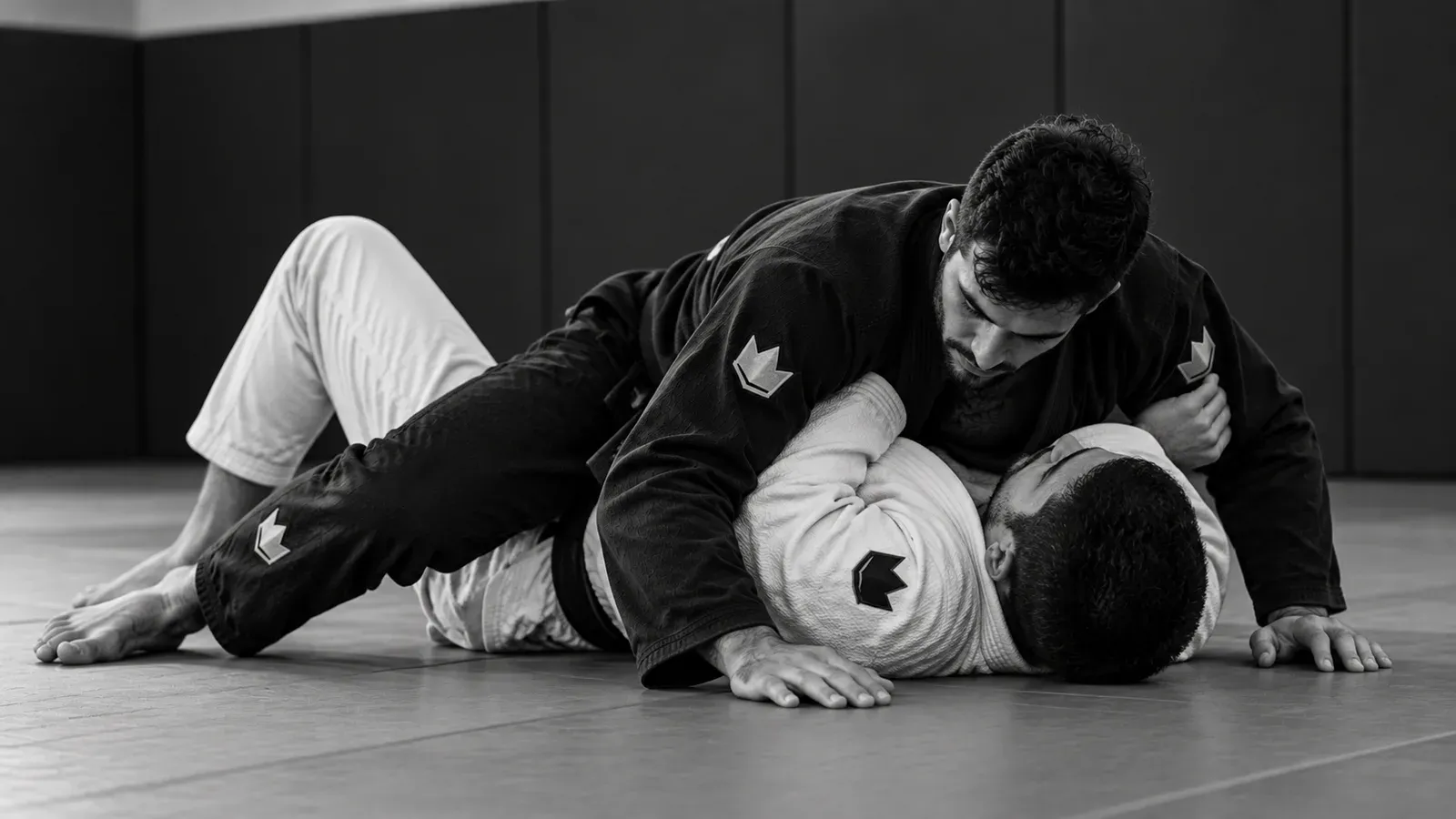
What side control is in Brazilian Jiu Jitsu
Side control (also called side mount or cross mount) is a ground grappling position where you are on top and lying across the opponent at a right angle while they are face up. A defining feature is that the bottom player’s legs are free and they exert no control over you with their legs.
In practical terms, the person on top is described as having side control because they are in a stable pin with the other person held underneath. From that pin, the top player can work towards strikes, submissions, or a transition to mount in contexts where striking and positional progress matter.
Control in side control is established by controlling the opponent’s head and/or arms. In Brazilian Jiu Jitsu, that is the core idea: you are not simply lying on someone, you are stopping their ability to turn, frame, or bring their legs back into play.
When side control applies, and when it does not
Side control applies when you have passed the guard and the bottom player is flat or mostly face up, with their legs no longer wrapped around you or entangling your legs. If the bottom player’s legs are free but not controlling you, you are in the positional category described as side control.
It does not apply when the bottom player is using their legs to control you in a guard. In Brazilian Jiu Jitsu, “guard” means the practitioner is on their back controlling an opponent with their legs. A simple example is half guard, where the bottom player controls one of your legs with their legs, preventing you from passing to side control or full mount.
It also does not apply when you have moved to knee-on-belly. Knee-on-belly (also called knee ride) is a modified side pin that is distinctly separated from side control. It is characterised by controlling the opponent with one leg out for base and balance and the other leg placed across the opponent’s torso, pinning them to the ground.
Knee-on-belly is described as a mobile pin rather than a static pin, and is considered a more dominant position in many grappling formats. It is also described as being worth additional points because it provides a greater striking platform than traditional side control and is closer to achieving the mounted position. Those details matter because they explain why people will sometimes treat knee-on-belly as “just side control”: it is related, but it is not the same position.
What makes side control work: control and pressure
Side control is commonly taught as a pin, but the sources describing it focus on what you control rather than listing a single fixed body shape.
You establish control by controlling the opponent’s head and/or arms. Upper-body control is also described as wrapping your arms around the opponent’s chest or neck. Those ideas are not separate options in practice so much as the same theme: you are managing the opponent’s upper body so they cannot turn into you, get onto their side freely, or connect their elbows and knees to recover guard.
As with most top controlling positions in Brazilian Jiu Jitsu, pressure is applied by bringing your hips downwards towards the ground, generating what is referred to as dead weight. That is the simplest useful description of how side control feels when it is done well: your weight is directed into the opponent through your hips while your upper-body grips stop them from turning.
Common variants you will see called “side control”
There are many variants of the side control position. In day-to-day training, you will often hear different names for positions that still fall under the broad idea of top cross-body control.
A well-known variant is kesa gatame (scarf hold). Kesa gatame is performed from side control by turning slightly sideways, spreading the legs for stability, encircling the opponent’s head with one arm, and holding the opponent’s other arm close to your chest.
Another related position is kata-gatame (shoulder hold). It is a pinning hold where the opponent is hugged around the head with one of their arms pinned against their neck. It is often seen as a chokehold because it is easy to compress the neck by squeezing; in that case it is referred to as an arm triangle choke (also called a side choke).
Brazilian Jiu Jitsu also uses names like reverse side control (sometimes called switch-base) for other variants. The important point, especially as a beginner, is to understand what stays consistent: you are on top, across the body, and preventing the bottom player from using their legs to control you.
What people get wrong about side control
One common mistake is treating side control as a single exact shape rather than a category of control. The sources describe side control by relationship and function: perpendicular top position, the bottom player face up, and the bottom player’s legs not controlling the top player. That description leaves room for variation, which is why so many variants exist.
Another mistake is confusing side control with knee-on-belly. Knee-on-belly is clearly separated from side control, has a distinct leg configuration, and is described as a mobile pin with different advantages, including a greater striking platform and proximity to mount. If you are trying to learn positional awareness, you should name it correctly so you can understand why it is scored and played differently in many formats.
A third mistake is assuming side control is the end of the exchange. Side control is described as a dominant pin, but it is also described as high priority for the bottom combatant to escape or sweep, including by entangling the top player’s free legs to obtain half guard or guard. That means you should treat side control as something you must maintain, not something you have once and keep automatically.
Finally, people often overlook that side control is about control and safety, not just pressure. In Brazilian Jiu Jitsu more broadly, pressure is increased in a controlled manner and released if the opponent cannot escape and signals defeat by tapping. That same attitude applies whenever side control leads into a submission such as the arm triangle from kata-gatame: you control first, apply pressure in a controlled way, and respect the tap. For more on that decision in training, see tapping early in training.
Where side control fits in your overall Brazilian Jiu Jitsu development
Brazilian Jiu Jitsu is a ground-based fighting style that focuses on taking the opponent down, gaining a dominant position, and then using techniques to force submission. Side control is one of the clearest examples of that “dominant position” step: it is a stable top pin that sits between passing the guard and advancing to mount or submissions.
If you are building a coherent approach to training, it helps to treat side control as one of your core top positions and to connect it to guard passing and to transitions such as mount or knee-on-belly. A broader framework for organising positions and priorities is covered in How to build your own Brazilian Jiu Jitsu game.