
Guide
Joe Rogan and Brazilian Jiu Jitsu rolling: what applies to you
Rolling is live, resisted sparring in Brazilian Jiu Jitsu, and it works the same way whoever is on the mat, famous or not. This guide explains when rolling applies to you, when it does not, and the mistakes people make when they copy what they have seen from public figures.
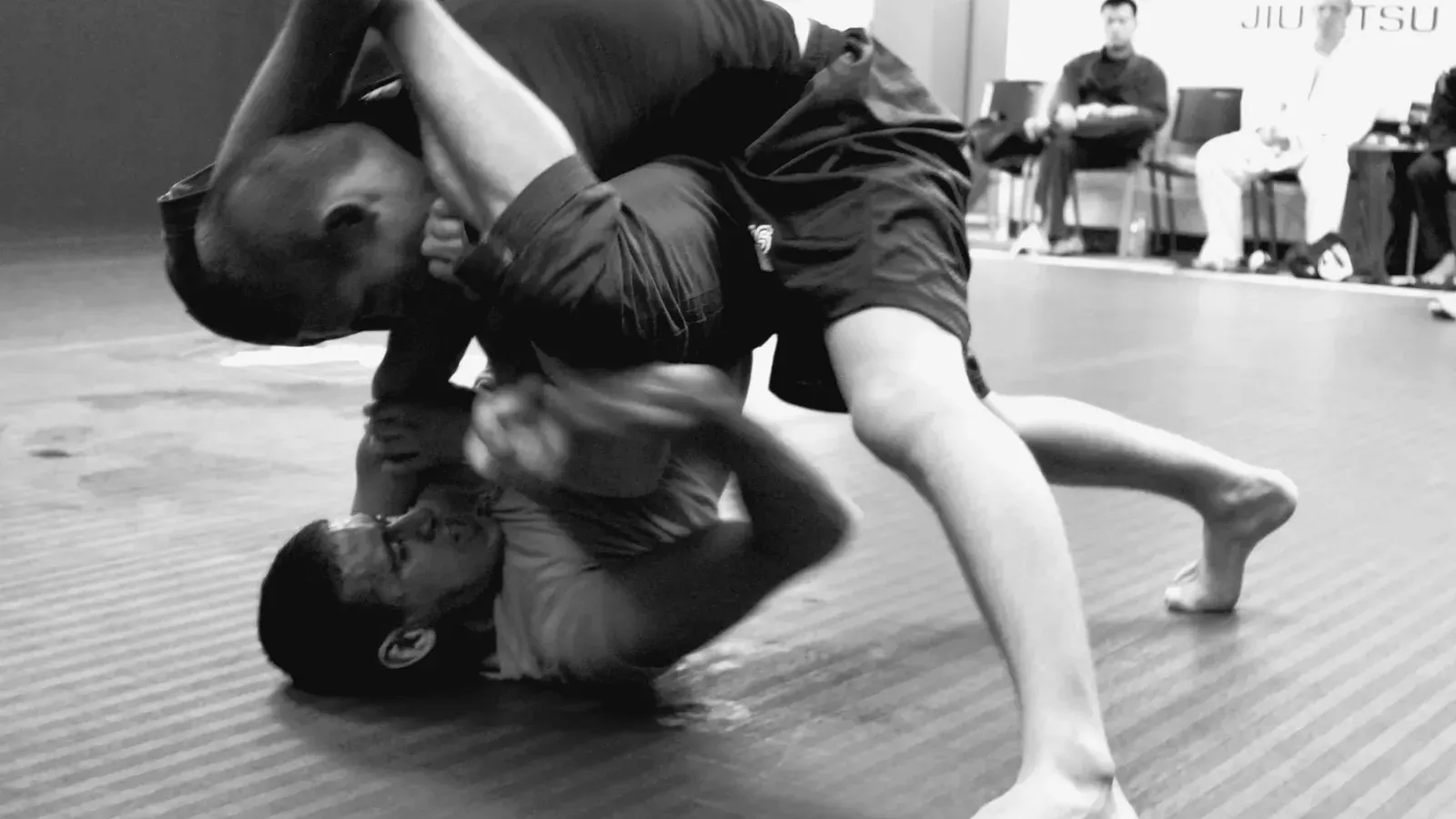
Mark Bonica from Durham, NH, USA · Wikimedia Commons · CC BY 2.0
.jpg)
Rolling is live sparring in Brazilian Jiu Jitsu. You and a partner start from an agreed position, usually standing or on your knees, and each tries to control and submit the other while the other resists. It is separate from drilling, where your partner gives you a set amount of resistance so you can repeat a movement.
People searching for Joe Rogan and rolling usually want one of two things: what rolling is, or what rolling looks like for someone with a high public profile. This guide answers the first. It makes no claims about any individual’s training, because nothing here has been verified about that. What follows holds for anyone who steps on the mat.
What rolling is, in practical terms
A round of rolling runs for a fixed time, commonly a few minutes, and ends when the timer sounds or when someone taps. A tap is a signal, made with your hand or foot on your partner or the mat, or spoken aloud, that you submit and the hold must be released at once. Tapping is what makes it safe to apply real pressure in practice.
The goal in a round is not to beat your partner at all costs. It is to test what you have learned against someone who is trying to stop it. For a fuller definition, see what rolling means in Brazilian Jiu Jitsu.
When the idea of rolling applies to you
Rolling applies whenever you train Brazilian Jiu Jitsu at a gym that includes live sparring. That covers most gyms, and it covers you whether you are a first-week beginner or a long-term competitor. The details change with your level, but the principle does not: you put your technique under resistance.
It applies in both the gi (the traditional jacket and trousers) and no-gi (shorts and a fitted top). The grips differ, and so does the pace, which is covered in what actually changes between gi and no-gi.
It also applies to the origin of the sport’s public profile. According to the Ultimate Fighting Championship’s history, its early competitions were meant to identify the most effective martial art in contests with minimal rules and no weight classes. Rorion Gracie was one of its founders, and the tournament drew on a Gracie family video series showing Gracie jiu-jitsu students against practitioners of other arts. Live, resisted grappling was central to that story, which is one reason rolling is so closely tied to how the sport is seen.
When it does not apply
Rolling does not apply in these situations:
- Your first sessions, if your gym eases you in. Many gyms have new students drill first and roll later, or roll only with a controlled partner. That is a gym decision and a sensible one.
- When you are injured. A sore joint, a suspected rib injury or a skin infection is a reason to sit out. Tell your coach and your partner before the round, not during it.
- When you are learning a new movement. Drilling is the better tool, because rolling gives you too few clean repetitions. The case for using both is laid out in drilling versus rolling.
- Competition and sparring are not the same thing. A match under a tournament organisation’s ruleset is a different event from a training round. Competition rules vary between organisations, so check the rules of the specific event you enter.
- Watching someone else roll. Footage of a public figure rolling tells you very little about what rolling should look like for you. You do not know the context: the partner, the agreed intensity, the purpose of the round.
What people get wrong about rolling
Treating it as a fight
The most common mistake is rolling as if a win were at stake. In a training round, nobody is keeping score. If you rely on strength and speed, you tend to win rounds against people who are less fit and learn nothing, then lose to people who are more technical. Rolling at a pace where you can think is how skill develops.
Refusing to tap
Tapping late is the quickest way to get hurt, and it makes training partners unwilling to work with you. Tap as soon as you recognise the submission is set, not when it hurts. A tap costs you a few seconds and a bruised ego. An injured joint costs you weeks away from training.
Applying submissions fast
If you are the one finishing a hold, control comes first and the partner’s safety is part of the technique. Take the position, set the hold, and then apply pressure slowly enough that your partner can tap before damage is done. Joint locks such as the Americana from side control are applied from a stable position and finished gradually, never with a jerk. Release the moment you feel a tap.
Assuming more rolling means faster progress
More live rounds do not automatically make you better. Without drilling, without rest and without a sensible training schedule, you repeat the same habits and pick up injuries. How much you should train depends on your recovery and your life outside the gym, which is covered in how often a beginner should train.
Copying what a public figure appears to do
A famous name makes rolling look glamorous or aggressive, depending on what you have seen. That impression is not a training plan. Your gym’s rules, your coach’s instructions and your own physical condition decide how you should roll.
How to roll sensibly
Start each round by agreeing the pace with your partner if you do not know them. Slow, technical rolling is a legitimate choice, and so is a harder round if both of you want one.
Keep your neck, elbows and knees in mind. Do not twist out of a lock you have already lost, and tap rather than escape at the cost of a joint. If a partner is rolling too hard for your level, say so, or finish the round and choose someone else next time.
After each round, make one note: a position you were stuck in, or a submission that caught you. Take that to your next drilling session. That loop of rolling, noticing and drilling is the whole practical use of live sparring.