
Guide
How often should a beginner train Brazilian Jiu Jitsu?
The number matters less than most people think, and consistency matters far more. Here is the reasoning, including why more is not simply better in the first year.
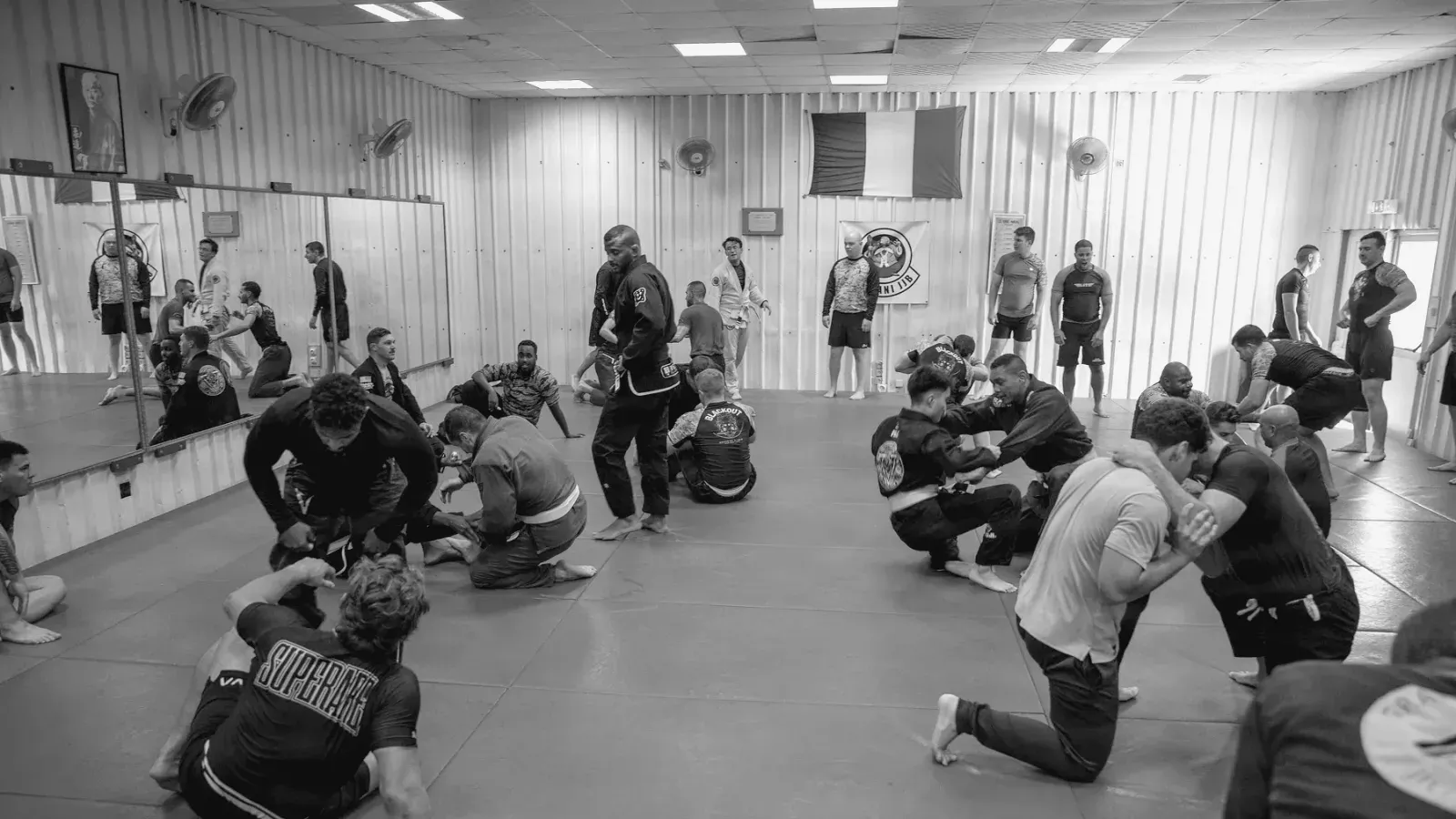
Two to three times a week, for most people, for the first year. That is the short answer and it is fairly uncontroversial. The reasoning is the useful part, because it explains why more is not simply better at the start — and why the number matters far less than whether you keep to it.
Why two is the floor
Once a week is enough to enjoy it and not really enough to improve. The gap is long enough that a good part of each session goes into recovering what you had at the end of the last one, and progress becomes very slow — slow enough that a lot of once-a-week beginners quietly conclude they are not suited to the sport.
They usually are. They are just on a schedule that hides improvement.
If two is genuinely impossible, once a week is still worth doing. Calibrate your expectations to it, and do not read the slow progress as a verdict on your ability. One session a week for three years still makes you a competent grappler; it just takes three years to feel like it.
Why three is the target
Three sessions gives you enough repetition for things to stick between classes while still leaving recovery days. It is where most people find the sport stops feeling like being permanently lost.
The mechanism is simple: with two days between sessions you still remember what happened last time. With five, you are re-learning. Three sessions a week means most of your training is building on something rather than rebuilding it.
It also fits most people’s lives, which matters more than it sounds. A schedule you can hold for two years beats an ambitious one you abandon in March.
Why more is not automatically better in year one
Five or six sessions a week is a normal load for an experienced grappler. For a beginner it tends to cause problems, for reasons that are mostly physical.
- Your body has not adapted yet. Grappling loads joints, neck, fingers and connective tissue in ways nothing else does, and connective tissue adapts far more slowly than muscle does. Beginner injuries cluster heavily in people who added volume quickly. Fingers and neck in particular take months to catch up.
- You are wildly inefficient. A beginner spends far more energy per round than an experienced person, because most of the effort is going into tension rather than movement. Six sessions of that is a much larger load than six sessions looks like on a calendar.
- You cannot yet absorb that much. More input does not help when you are already saturated. Two sessions you have thought about beat five you rushed through.
- Enthusiasm is not a fuel supply. The first months are exciting and it is easy to over-commit. Burnout at month four is extremely common, and it looks exactly like a sudden loss of interest rather than like fatigue — which is why people misdiagnose it as “I guess it wasn’t for me”.
None of this is an argument for training less than you want. It is an argument for adding volume gradually rather than starting at the top.
A schedule that works
Two shapes that hold up for most people:
Two sessions: something like Tuesday and Thursday, or Tuesday and Saturday. Avoid scheduling them on consecutive days if you can — the recovery gap is doing real work at this stage.
Three sessions: Monday / Wednesday / Friday, or two weekdays plus a weekend open mat. The weekend session tends to be longer and more social, which helps with the thing that actually determines whether you keep going.
If your academy runs a dedicated fundamentals class, weight your first six months toward it. Mixed classes are more fun and less useful when you understand nothing.
When to add more
Reasonable signals that you can handle another session a week:
- You are not still sore from the previous session when the next one arrives.
- You are recognising positions instead of meeting each one fresh.
- You have been consistent at your current frequency for at least two or three months.
- You want to on a normal Tuesday, rather than only in the glow after a good class.
Add one session, hold it for a month, and see. This is dull advice and it works.
Signs you are doing too much
Worth knowing, because they are easy to mistake for something else:
- Persistent joint soreness — especially fingers, neck and lower back — that does not clear between sessions.
- Getting ill more than usual.
- Sleeping badly after evening training.
- Dreading a class you normally look forward to.
- A run of sessions where you feel like you are getting worse.
The last two are the ones people ignore. Both usually mean take a week down, not push through.
What matters more than the number
Consistency, by a wide margin. Someone who trains twice a week for three years will be far better than someone who trains six times a week for four months and stops. The sport rewards accumulated time more than intensity, and almost everyone who becomes good does so by being unremarkable for a very long time.
Second: what you do with the sessions. Three sessions where you are deliberately working on something specific are worth more than five where you turn up and roll. Frequency without direction produces a plateau at a higher volume.
The honest complication
Life does not run on a schedule. You will miss weeks — work, illness, travel, injury. This is normal and it is not the thing that stops people.
What stops people is treating a missed fortnight as evidence that they have fallen off, and then not going back. The return session after a break is always bad; it is bad for everybody; it does not mean anything.
Going twice a week for a year, with a few gaps, puts you comfortably ahead of almost everyone who started when you did — most of whom will not be there. And once you are training regularly, the question quietly becomes how you would know you are improving, which turns out to be harder to answer than it sounds.
If you have not started yet, what happens in a first class is the more useful place to begin.