
Guide
Jocko Willink and Brazilian Jiu Jitsu rolling: what applies and what does not
Jocko Willink is a retired Navy SEAL officer and Brazilian Jiu Jitsu black belt who instructs in San Diego, and rolling is the live, resisted sparring every student does. This guide separates what is established about him from what governs how you should roll, including the safety habits that matter around leglocks.
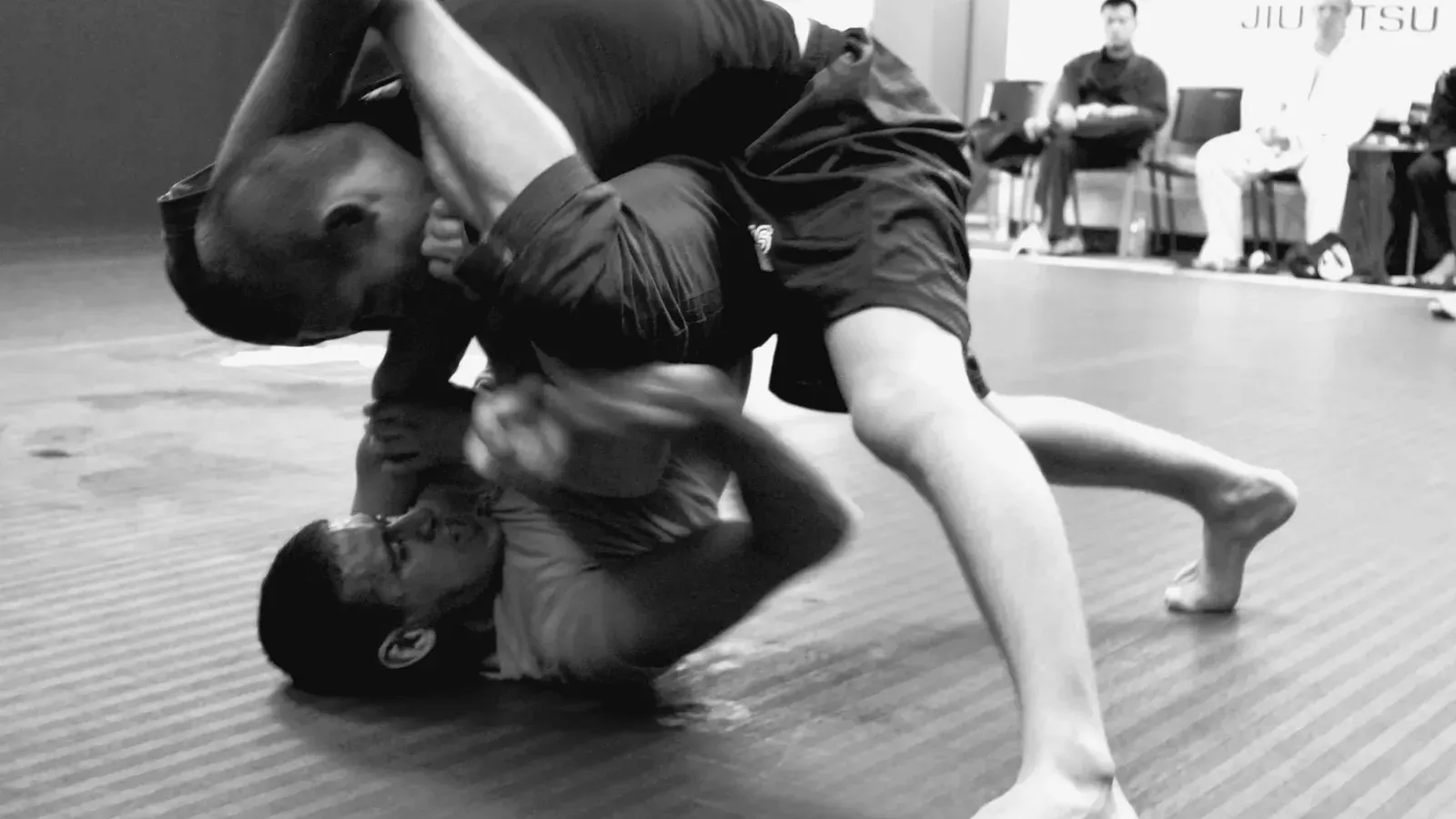
Mark Bonica from Durham, NH, USA · Wikimedia Commons · CC BY 2.0
.jpg)
Jocko Willink is a retired United States Navy SEAL officer, author and podcaster who trains and instructs Brazilian Jiu Jitsu. Rolling is the live, resisted sparring that every Brazilian Jiu Jitsu student does. The sources behind this guide establish who Willink is in the sport. They do not set out a distinct Willink method of rolling, so this guide does not invent one. What follows is what is known about him, then what governs rolling for you.
Who Jocko Willink is in Brazilian Jiu Jitsu
Willink began Brazilian Jiu Jitsu under Fabio Santos while still in active service and carried on training after he left the Navy. He received his black belt from Dean Lister, the MMA fighter and grappler. He has competed against well-known names such as Jeff Monson. In September 2022 he promoted his own daughter to blue belt.
He instructs jiu-jitsu at Victory MMA & Fitness in San Diego, where he also films his podcast. He hosts that podcast weekly with Echo Charles, who is himself a Brazilian Jiu Jitsu practitioner. He co-owns Origin USA, a company in Farmington, Maine, that makes apparel, supplements and fitness equipment, and is one of the few manufacturers of jiu-jitsu gis in the United States.
Outside the mat, he is best known for leadership work. He co-authored Extreme Ownership with Leif Babin and co-founded the consulting firm Echelon Front. He also wrote the children’s book series Way of the Warrior Kid, which is intended to present the life lessons he took from SEAL training in a way that children can understand and use.
What rolling is
Rolling is sparring in which you and a partner each try to pass, sweep, control and submit while the other resists. It is not a fight and not a competition. The aim is to test what you have learned against a resisting person, and to learn from the exchange. Our guide to what rolling means in Brazilian Jiu Jitsu covers the format in more detail.
Rolling sits alongside drilling, where you repeat a technique against little or no resistance. Each teaches something the other cannot, which is the subject of drilling versus rolling.
When this topic applies
The name matters in three situations.
First, if you want to know who he is and how he came to the sport, the facts above answer that. He is a black belt with a competitive record who teaches, and he has a public profile through his podcast and his gi business.
Second, if you train at a gym he instructs at, his rules for that room are the rules. That is a statement about any instructor and their gym, not about him in particular.
Third, if you are choosing gear, his company makes gis, so his name may come up in that context. Whether a gi suits you is a separate question, and what changes between gi and no-gi training is worth reading first.
When it does not apply
It does not apply to the question of how you should roll on a given night. That depends on your gym’s rules, your experience, your partner’s experience and the ruleset you are training under. A beginner rolling with a partner of similar size and skill is in a different situation from a competitor preparing for an event, whoever their favourite black belt is.
It also does not apply to his leadership books or his children’s books. Those are about leadership and life lessons, and they contain nothing you can lift into a rolling session. The same goes for his SEAL service: it explains his public profile, but it is not a training method for the mat.
What people get wrong
Treating a famous name as a ruleset
A ruleset belongs to an organisation or to a gym, not to an individual. If you want to know what is allowed in your rolling, ask your own instructor. Sparring rules at a club are set by the club, and competition rules by whoever runs the event.
Assuming a hard background means hard rolling
People sometimes read military or combat credentials as a sign that rolling should be maximum intensity. Nothing in the sources says that. Rolling is a shared exercise, so the intensity is always something you and your partner are setting together, and your partner needs to be fit to train tomorrow.
Confusing the public figure with the practice
A large podcast audience says nothing about how any particular person rolls. The sources describe his career and his businesses, not a sparring style, so any detailed claim about how he rolls would be guesswork.
Forgetting that leglocks change the risk
Leglocks are the area where rolling most often goes wrong. A leglock is a joint lock aimed at the ankle, knee or hip. They appear in several combat sports, including Brazilian Jiu Jitsu, catch wrestling, mixed martial arts and submission wrestling, and are banned in some sports with joint locks, such as judo.
In training, leglocks are applied slowly and with control, and they are often not taken to full hyperextension. The submission is signalled before the lock is fully applied. Applied badly or with too much force, a leglock can damage muscle, tendon and ligament, and can cause dislocation or fractures. The heel hook, which twists the foot and passes torque from the ankle to the knee, is comparatively dangerous for this reason.
A toe hold is one of the simpler examples. It uses the hands to hyperextend or hyperrotate the ankle, typically by gripping the foot near the toes and twisting or pushing it while controlling the opponent’s leg. The control matters as much as the grip. If you cannot hold the leg still, you cannot apply the lock in a way your partner can respond to.
How leglocks differ from one another
Not every leglock carries the same risk, and it helps to know what you are being asked to defend. A kneebar works much like an armbar: the leg is trapped between your legs and your hips drive it straight, hyperextending the knee. A straight ankle lock isolates one leg, places the foot in your armpit and uses the forearm against the lower calf, with the hips moving forward to point the foot. A heel hook, as above, twists the foot and loads the knee.
The practical difference is how much the joint can tolerate. The ankle is a smaller joint, while the knee and hip are large ones attacked with leverage against big muscle groups. That is one reason a lock that feels slow on the ankle can be much less forgiving at the knee.
Rules also vary by setting. Leglock control positions such as the inside leg triangle and the leg knot are banned in Brazilian Jiu Jitsu competition, while others, including the snake guard, one-legged X-guard and 50/50 guard, have been adopted into modern competition as guards. A position that is fine in one event may be illegal in another, so read the ruleset of the specific event or gym instead of assuming.
Rolling safely whoever you train under
The habits that protect you and your partner are the same everywhere. Apply submissions slowly, as leglocks are applied in training, so your partner has time to respond and signal. Tap early yourself, because an injury costs far more training than a lost exchange. Work from your own instructor’s rules for what is permitted, since leglock rules differ between gyms and events.
How much rolling you do matters too. If you are new, how often a beginner should train is a better starting point than any individual’s example.
In short, learn about Willink if you are curious about the man, and keep your attention on your own gym’s rules when you roll.