
Guide
Is Brazilian Jiu Jitsu Training Dangerous?
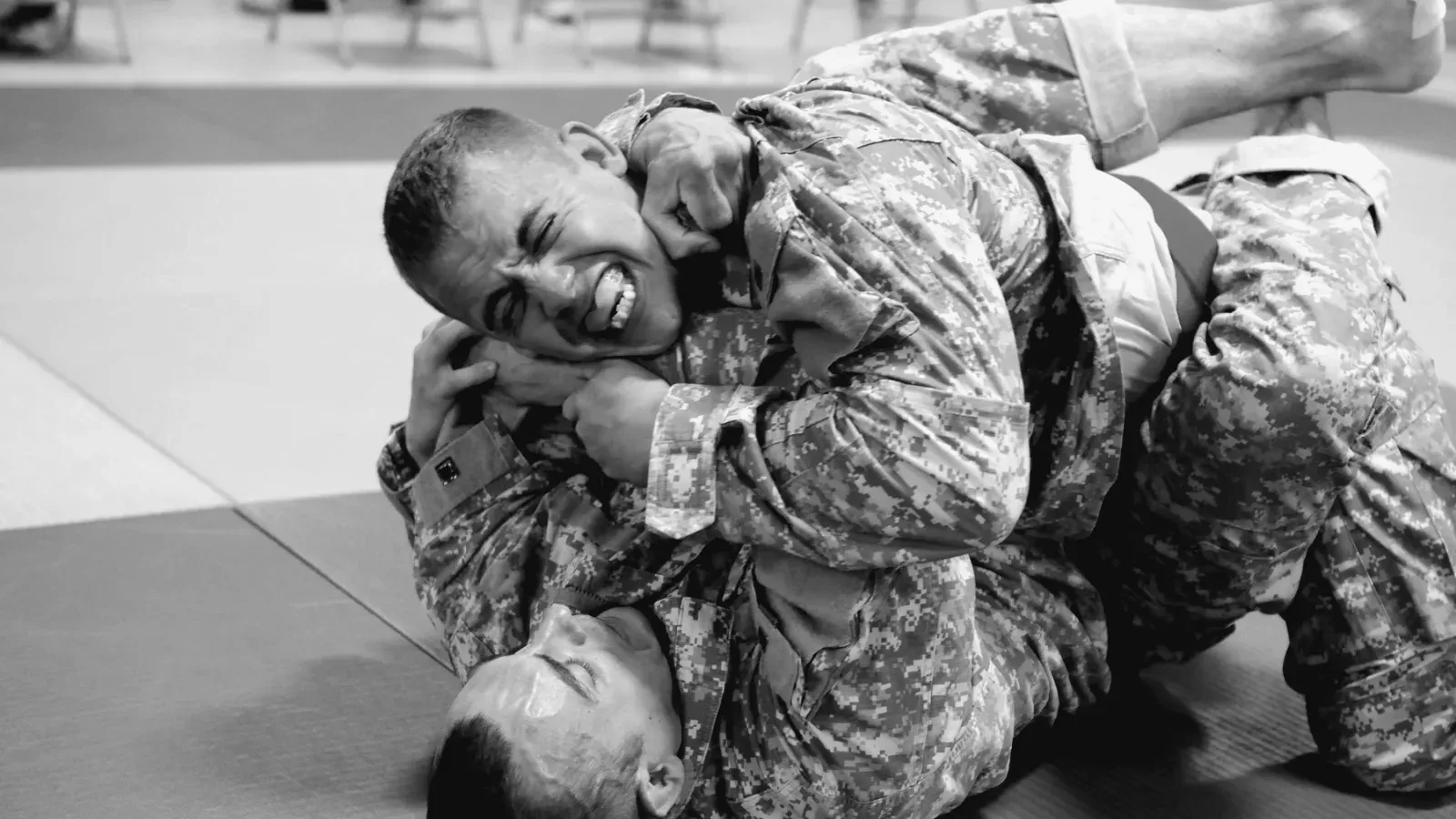
Brazilian Jiu Jitsu training carries a genuine risk of injury because sparring is done at full speed and full strength, similar to competition. That risk is managed by tapping before injury and by rulesets that ban the most dangerous techniques, so how dangerous a session is depends heavily on the techniques involved and whether you train gi or no-gi.
807th Medical Command (Deployment Support) · Wikimedia Commons · CC BY 2.0

Brazilian Jiu Jitsu training carries a genuine risk of injury, because sparring — known as rolling — is done at full speed and full strength, in a way that resembles the effort of competition. That risk is not left unmanaged. The sport’s core safety mechanism is the tap: you or your partner signal submission before a joint lock or choke causes lasting damage, rather than fighting through it. How dangerous a given session actually is depends heavily on the ruleset you train under, which techniques it permits, and how you and your partners choose to spar.
Why rolling carries real risk
Rolling is not a scripted rehearsal. Training at full speed and full strength is what makes it resemble a competition match rather than a demonstration, and that intensity is exactly what makes it effective preparation. Drilling vs rolling — why you need both sets out the difference: drilling repeats a technique against a compliant or lightly resisting partner, while rolling asks you to apply it against someone actively trying to stop you. The injury risk sits almost entirely on the rolling side of that line, because resistance, scrambles and fatigue are what turn a technique into something that can go wrong.
Takedowns bring a separate category of risk, since they involve impact with the mat rather than a joint lock or choke. Brazilian Jiu Jitsu descends from the wider family of jujutsu-derived grappling arts, and in jujutsu itself students are taught break-falling skills specifically so they can practise otherwise dangerous throws safely. That reflects a general principle worth applying to any grappling training: risk from a technique is managed by teaching the specific skill that makes it safe to repeat, not by pretending the risk is not there.
Physical conditioning is also treated as a core part of training, alongside technique work. That cuts both ways for risk: a fitter athlete tolerates the physical demands of rolling better, but conditioning sessions add their own load on top of the mat time already spent sparring.
The safety mechanism that controls it: tapping
Grappling sports built around submission holds treat the tap as central, not optional. Athletes are taught to recognise a dangerous position and submit before serious injury occurs, rather than waiting until a technique is fully locked in. This is what allows full-strength sparring to happen at all: a partner applying a joint lock or a choke is expected to stop the instant you tap, and you are expected to tap before the position becomes unsafe rather than testing how much you can take.
Which techniques carry the highest risk
Not every submission carries the same risk, and rulesets reflect that directly. Heel hooks and knee-reaping are banned in gi Brazilian Jiu Jitsu because they are considered exceptionally dangerous leg lock techniques, yet the IBJJF permits both under its no-gi rules. A joint lock such as the americana from side control sits in a different category: it is a standard part of gi and no-gi curricula alike, precisely because it does not carry that ban. The same tapping mechanism applies to submissions such as the armbar, where stopping the moment your partner taps is what keeps a controlled joint lock from turning into an injury.
This split matters for anyone weighing up how dangerous training actually is, because the honest answer depends on which techniques are in play on a given day. A gi class working standard submissions is not exposed to the same risk category as a no-gi session where leg entanglements and heel hooks are live.
Gi training, no-gi training, and what that means for risk
Traditionally, being promoted in Brazilian Jiu Jitsu requires training in the gi. Combined with the ban on heel hooks and knee-reaping in gi competition, this means the standard route through the belt system runs mostly through a ruleset that excludes the leg lock techniques considered most dangerous. No-gi, which refers to training or competition without the gi, is where those same techniques become legal under IBJJF rules. If you are trying to judge how dangerous your own training is, the honest answer depends partly on which side of that line you spend most of your time on.
Injuries that happen anyway
Even with tapping and ruleset restrictions in place, injuries occur, and many of them are repairable only through surgery, followed by an extended period of rehabilitation before a return to training. That reality sits against a long timeline: reaching black belt on a consistent training schedule takes around ten years for most practitioners. Across a decade of regular rolling, an injury and its rehabilitation is a realistic part of the journey rather than an exception to it. Why tracking your training changes what you learn is worth reading if you want a clearer record of how your body responds to training load over that kind of timescale.
What people get wrong about the risk
The most common mistake is treating Brazilian Jiu Jitsu as a single, uniform level of danger, when the risk is concentrated in specific places: certain technique categories, certain rulesets, and full-resistance rolling rather than drilling. A related mistake is treating the tap as a sign of weakness rather than as the mechanism that makes full-intensity training survivable at all. Grappling arts outside Brazilian Jiu Jitsu show the same pattern from a different angle: sport jujutsu prohibits techniques such as scissor takedowns, necklocks and digital choking and locking precisely because they are considered too dangerous for regular training and competition, while permitting the rest of the art’s throws and holds. The pattern in both cases is the same — the most dangerous techniques are identified and restricted, rather than the whole activity being declared either safe or unsafe.