
Guide
Can an Armbar Break Someone's Arm?
An armbar is a submission that attacks the elbow joint, and it can injure or break an arm if force is applied after the opponent has tapped or cannot tap. In controlled training it is applied slowly and released the moment your partner taps, which is why serious damage is avoidable.
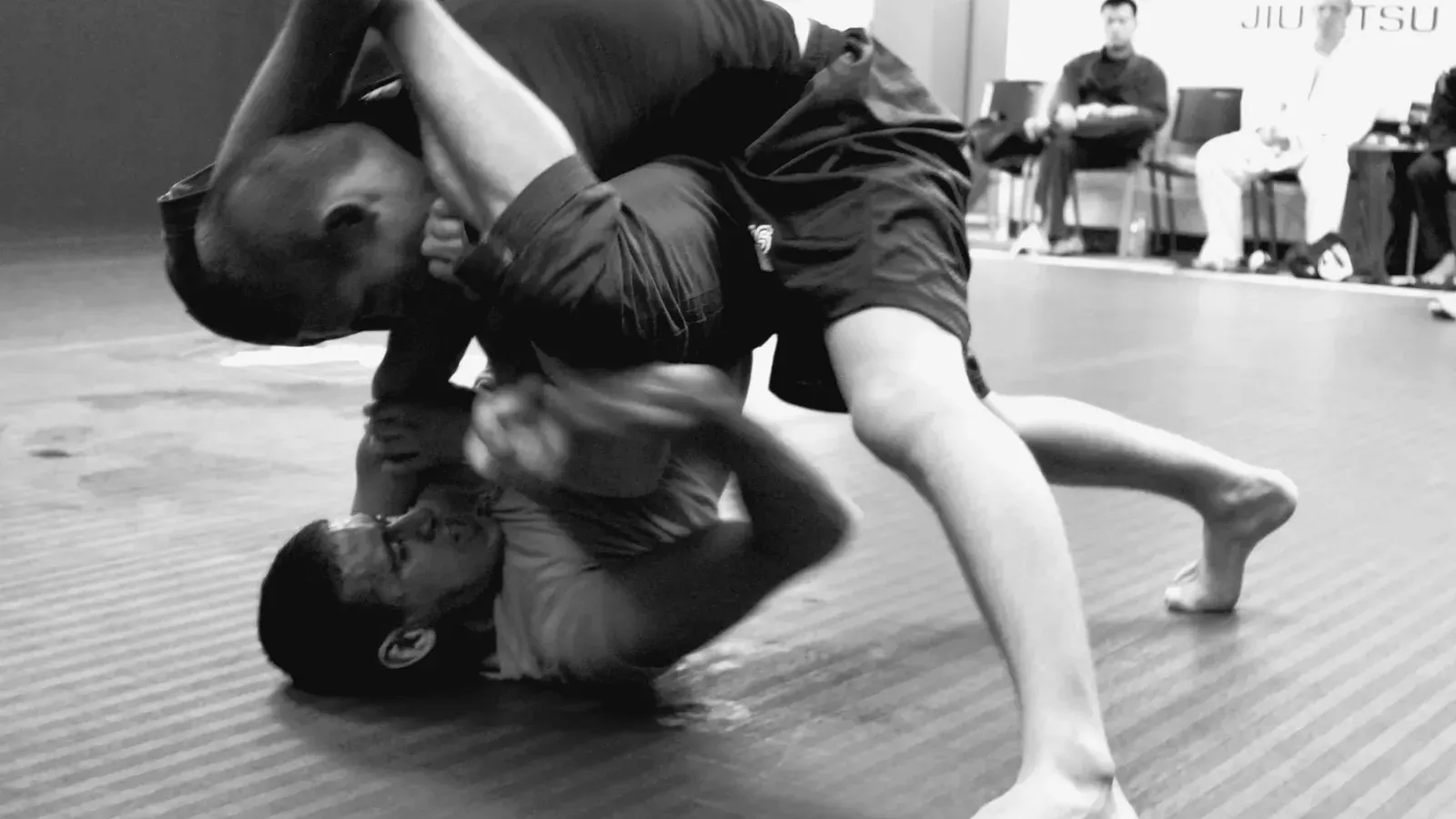
Mark Bonica from Durham, NH, USA · Wikimedia Commons · CC BY 2.0
.jpg)
An armbar is a submission hold that forces an opponent’s arm straight and levers against the elbow joint. The elbow is built to bend one way, so pressure that pushes it the other way is what makes the hold work. Yes, that pressure can injure or break an arm. Whether it does depends almost entirely on how the person applying it behaves once the hold is locked in.
When an armbar can injure an arm
The risk is real when three things combine: the arm is fully straightened, the hips or body are pressing it against the joint, and the person applying the hold keeps adding force. At that point the joint has nowhere to go.
In practice, that combination becomes dangerous in a few situations:
- Your partner has tapped and you do not release straight away.
- You finish the hold with a sudden jerk rather than building pressure gradually.
- Your partner cannot signal, because the tap is missed or the arm being tapped with is the one under attack.
- Your partner is stubborn, or cannot judge how close they are to the limit, and does not tap early enough.
The common thread is that the injury comes from the finishing pressure, not from the position. Getting into an armbar position is not what harms the arm. Committing to the finish against a resisting or unaware partner is.
When it does not apply
A well-controlled armbar in training is designed to end with a tap, not with an injury. A tap is the agreed signal that the hold has worked and should be released. If you apply the finish slowly, the hold gives your partner time to recognise it and tap before the joint reaches its limit. If you release immediately when they do, the armbar is a harmless way to end a round.
The hold also does nothing to an arm that is not straight. An armbar depends on extending the elbow, so a bent arm is not under the same stress. Much of the contest in any armbar attempt is over whether the defender can keep the elbow bent, which is why the finish is often not available even when the attacker has a good position.
The article you are reading describes what the hold does, not how to construct it. This page does not give a step-by-step entry, because a safe entry depends on the starting position and on the ruleset of the class or event you train under. Ask your coach for the sequence and the rules that apply to you.
What people get wrong
Believing it always breaks the arm
The armbar has a reputation for snapping arms because a few dramatic finishes get replayed. Most armbars in practice end with a tap. The arm breaks when the person applying the hold ignores that signal or overrides it, not because breaking is what the hold is for.
Believing the finish needs speed or strength
The finish does not need a violent burst to work, and a burst is what removes your partner’s chance to tap. Controlled pressure is enough to show the hold has worked. Speed adds risk without adding information.
Believing position and submission are separate skills
Many injuries come from people who rush to the finish before securing the position that makes the finish controlled. If the position is loose, the arm can slip and the pressure lands unpredictably. Control comes first, and the position before submission principle explains why.
Believing it is only a ground technique
Armbars are often thought of as something that only happens after a long ground scramble. In competition they also come out of standing exchanges. Ronda Rousey, who is known for her string of victories by armbar in mixed martial arts, is considered a master at initiating throws from the clinch to set up armbars, and she has a judo background. A throw that lands you in control of an arm is one route into the hold.
Believing it is a modern invention
The armbar has a long record as a finishing hold in contests between different styles. A 1905 fight between the French savateur Georges Dubois and the judo practitioner Ernest Regnier was won by Regnier by submission with an armbar.
It has also long been part of how martial arts appear in popular culture. Bruce Lee’s films are known for popularising a range of techniques, including grappling and the armbar, alongside kicks and weapons such as the nunchaku.
What this means for your training
Tap early. If you feel the arm straightening with pressure on the elbow and you cannot bend it, tap rather than test whether you can hold out. Tapping costs you a round; ignoring the risk can cost you months.
When you are applying the hold, treat the tap as final. Release at once, without finishing the movement first. Apply pressure gradually so your partner has time to react, and stop if your partner says stop or goes limp.
If your partner is much less experienced than you, slow down further. They may not recognise the hold, may not know when to tap, or may panic and thrash instead of signalling.
For how injuries from armbars can affect other joints, see whether an armbar can dislocate a shoulder. For a wider look at risk in the sport, read whether Brazilian Jiu Jitsu training is dangerous, and for how submissions compare on pain, see which submission hurts the most.