
Guide
Best Brazilian Jiu Jitsu Takedown Instructional
The best Brazilian Jiu Jitsu takedown instructional is judged by whether it draws on an established grappling base such as judo, wrestling or sambo, whether its takedowns suit the ruleset you train under, and whether it teaches the position you take after landing the takedown. Judged on those three points, an entry-only instructional built on the wrong base for your ruleset is not doing the job, no matter how it is marketed.
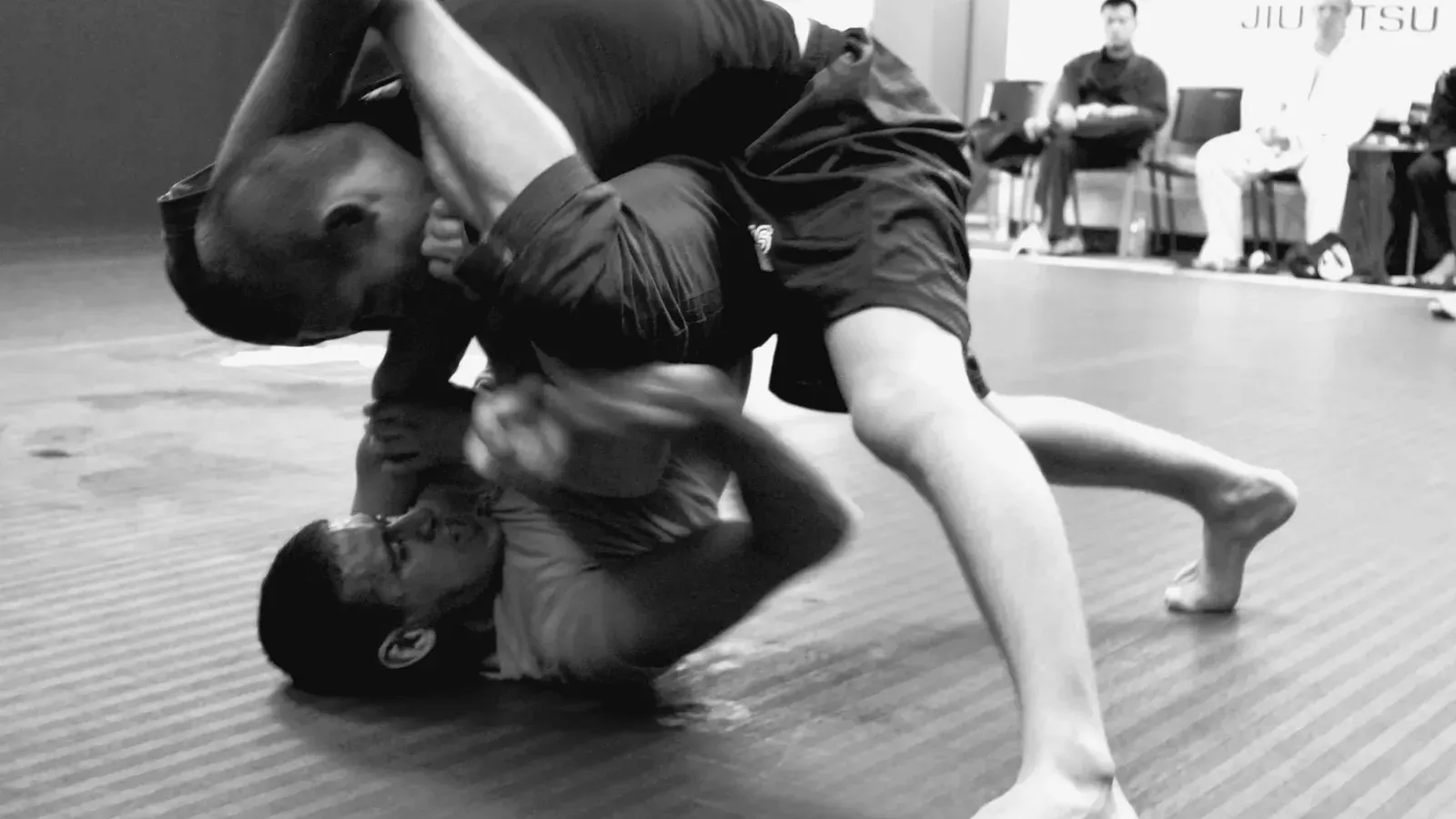
Mark Bonica from Durham, NH, USA · Wikimedia Commons · CC BY 2.0
.jpg)
The best Brazilian Jiu Jitsu takedown instructional is not defined by a single throw or a famous name attached to it. It is defined by whether it draws on a proper grappling base such as judo, wrestling or sambo, whether it is honest about which ruleset its takedowns actually work under, and whether it carries on past the takedown itself into the position you land in. An instructional that stops at the mat has only taught you half the job, because a takedown that does not set up control is not much use once you are down there with an opponent who knows how to scramble straight back up.
What a good Brazilian Jiu Jitsu takedown instructional actually teaches
A takedown, in grappling terms, is any technique that brings a standing opponent to the ground under your control. The instructional worth your time treats this as one movement with two halves: the entry that gets the opponent down, and the follow-through that keeps you in charge once you are both there. Judging an instructional only on how sharp the entry looks tells you nothing about the second half, and the second half is where most of the value sits.
The grappling styles takedowns are drawn from
Takedown ability in grappling and mixed martial arts is built through clinch work, meaning close-range contact used to control an opponent’s posture and grips before attempting to put them down. Judo, freestyle wrestling, folkstyle wrestling, Greco-Roman wrestling, catch wrestling, sanda and sambo are all trained specifically to improve clinching, takedowns and throws. Muay Thai clinch work, by contrast, is trained to improve the striking side of the clinch rather than the takedown itself, so an instructional built around Muay Thai clinch entries is solving a striking problem, not a grappling one, even though the grips can look similar on video.
Sambo deserves particular attention if you train with leglocks in mind. Sports sambo is built around pinning and explosive takedowns that transition quickly into leglocks, which makes it a natural source for instructionals aimed at the leglock-heavy end of no-gi grappling rather than at classical gi throws. A wrestling or judo-based instructional, by comparison, tends to serve you better if your priority is landing in a stable top position rather than moving straight into a leg attack.
Why the ruleset changes which takedown works
Not every grappling base transfers cleanly, and the reason comes down to what the ruleset allows you to attack. Greco-Roman wrestling forbids attacks on the legs, which makes it harder to complete a takedown when the legs are off limits, and this is part of why Greco-Roman technique is used less often in mixed martial arts than styles that do permit leg attacks, such as freestyle and catch wrestling. The same logic applies to choosing a takedown instructional for Brazilian Jiu Jitsu. If the instructor’s base style forbids leg attacks, you inherit that gap the moment you compete under a ruleset that allows them, and the reverse is also true.
Brazilian Jiu Jitsu does not apply one rule to every takedown across every competition. Whether a specific entry is even legal, such as the scissor takedown, depends on the rules of the event you are training for, so it is worth checking whether the scissor takedown is legal before you build a takedown game around it.
What happens after the takedown matters as much as the entry
Mixed martial arts names several strategies that begin with the same takedown and diverge afterward, and the split is useful for judging an instructional. Submission-seeking is the strategy of taking an opponent to the ground with a takedown or throw and then applying a submission hold to force them to submit. Ground-and-pound instead takes the opponent down to obtain a dominant position and then strikes them repeatedly with fists, hammerfists and elbows. Clinch-fighting keeps the exchange going from a clinch hold that also stops the opponent moving away, mixing in knees, stomps, elbows and punches while looking for the takedown or throw.
Sport Brazilian Jiu Jitsu has no striking, so ground-and-pound and clinch-fighting do not transfer directly, but the underlying point does: a takedown is only worth what you do with the position afterward. An instructional worth following treats the takedown as the opening move toward a dominant position and a finish from there, in line with the position before submission principle that runs through the sport, rather than treating the takedown as the whole lesson.
What people get wrong when choosing a takedown instructional
The most common mistake is buying an instructional for its stand-up striking clinch rather than its grappling clinch, on the assumption that any clinch teaches takedowns. Muay Thai clinch work is built to improve striking at close range, not to put an opponent on the ground, so it will not deliver the takedown volume a wrestling or judo-based instructional will.
The second mistake is confusing a takedown with a sweep. A takedown starts from your feet against a standing opponent. A sweep starts from underneath, usually from guard, and reverses the position without either person having been standing. If what you actually need is offence from your back rather than offence on your feet, Brazilian Jiu Jitsu sweeps are a separate subject with their own instructional needs.
The third mistake is treating an entry-only instructional as complete. If the material stops the moment the opponent’s back or hip touches the mat, it has not taught you the takedown as it is actually used, since every serious strategy built on a takedown, whether ground-and-pound, submission-seeking or clinch-fighting, is defined by what happens next rather than by the entry alone.
Building the base an instructional cannot give you
An instructional can show you the mechanics, but the clinching, timing and explosiveness behind a good takedown come from repetition against a resisting partner, which is closer to wrestling practice than to Brazilian Jiu Jitsu sparring in a gi. Supplementing instructional study with dedicated wrestling work, of the kind covered in how to improve wrestling for Brazilian Jiu Jitsu, builds the base that makes the instructional’s technique usable under pressure. If that cross-training happens on a wrestling mat rather than a Brazilian Jiu Jitsu mat, it is worth checking whether wrestling shoes are appropriate for Brazilian Jiu Jitsu before you carry the habit across. Between sessions, drilling entries and footwork alone is also possible, and the approach is covered in how to train Brazilian Jiu Jitsu by yourself.