
Guide
Is the scissor takedown legal in Brazilian Jiu Jitsu?
Whether the scissor takedown is legal depends on the ruleset you are competing under. It is prohibited in sport jujutsu, and you should confirm the specific Brazilian Jiu Jitsu rulebook for your event.
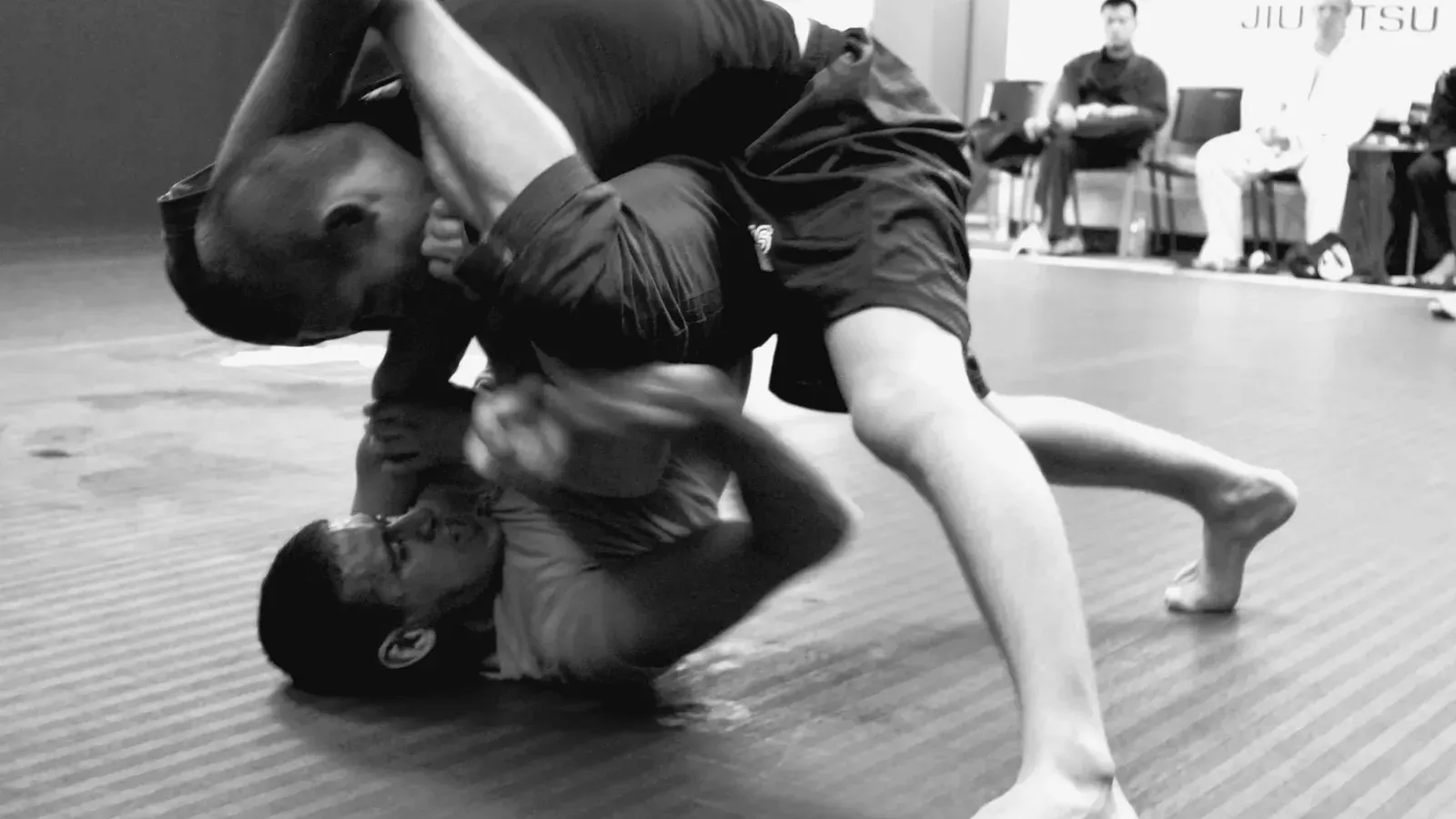
Mark Bonica from Durham, NH, USA · Wikimedia Commons · CC BY 2.0
.jpg)
What “legal” means for a scissor takedown
“Legal” is not a property of the technique on its own; it is a property of the ruleset you are using. A move can be allowed in one sport format and banned in another, even where the names are similar.
That matters here because the only verified rules information we have is about sport jujutsu, not about any particular Brazilian Jiu Jitsu competition organisation. The most accurate answer therefore changes depending on what you mean by Brazilian Jiu Jitsu in practice: a specific competition rulebook, an academy’s safety rules for sparring, or a self-defence-oriented class format.
Brazilian Jiu Jitsu itself sits inside a wider family tree of grappling sports influenced by older jujutsu and judo-derived systems. That overlap is one reason people assume a technique’s legality carries across from one sport to another, when in reality it is the rule text that decides.
When the scissor takedown is not legal
Under sport jujutsu, scissor takedowns are prohibited. The same source groups scissor takedowns with other potentially dangerous techniques that are also prohibited there.
If you are training for, entering, or refereeing under sport jujutsu rules, you treat the scissor takedown as not permitted. In that setting, the question is settled by the ruleset itself, not by the fact the technique exists in other grappling styles.
When the scissor takedown may be legal (and what you must check)
Brazilian Jiu Jitsu exists across multiple rulesets (different competition organisations, and different gym policies). From the supplied sources, we cannot state a single, universal Brazilian Jiu Jitsu rule on scissor takedowns. So “is it legal in Brazilian Jiu Jitsu?” only becomes answerable once you specify the ruleset.
In practice, you need to check:
- the exact competition rulebook you are entering (the organisation matters)
- any additional event-specific safety rules
- your gym’s training rules, which may be stricter than competition rules
If your goal is to use the technique in competition, do not rely on what a training partner says is allowed. Use the written rules for that event.
The situations where the answer changes in real life
The same person can get different answers to “is it legal?” within the same week, because they are moving between contexts with different rule priorities.
If you are preparing for a sport jujutsu event, the scissor takedown is prohibited and that is the end of the matter for that training camp. If you are preparing for a Brazilian Jiu Jitsu event, you need the rulebook of that specific competition organisation before you can say anything reliable.
In day-to-day training, “legal” often means “permitted in this room today”. Many academies set their own safety restrictions for sparring and drilling that do not track any one competition ruleset. You may be told a technique is “not allowed” in the gym even if a competition might allow it, because the gym is trying to manage injury risk, class size, mat space, or mixed experience levels.
The opposite can also happen: a move may be informally tolerated in a permissive training culture, but you still cannot assume it will be acceptable at the event you are entering. That gap gets wider when you visit other gyms, train at camps, or drop into open mats where the host room has different expectations.
Another common situation change is mixed-intent sessions. A class might be marketed as Brazilian Jiu Jitsu, but run with an emphasis on self-defence, stand-up rounds, or a particular competition coming up. In each case, the instructor may impose limits that are not about what is “true Brazilian Jiu Jitsu”, but about what fits that session’s purpose and safety level.
You also see the answer change when people use “Brazilian Jiu Jitsu rules” as shorthand for “grappling rules”. Because Brazilian Jiu Jitsu and other derived sport forms sit close together historically, people conflate them. That is exactly where the sport jujutsu prohibition becomes important: it shows that even closely related grappling formats can draw the legal line in different places.
How to apply this in training without guessing
Because the source explicitly flags scissor takedowns as potentially dangerous in the sport jujutsu context, you should treat “is it legal?” as only one of the questions you must answer before using it with resistance.
Before you try to use a scissor takedown in sparring you need clarity on three separate points:
- Ruleset permission: Is it allowed under the rules you are training for today?
- Gym permission: Is it permitted in your academy’s sparring and drilling policy?
- Partner permission: Does your partner agree to train that kind of takedown today?
Those are not the same question. In a well-run session, you get an explicit yes to all three. If any one of them is unclear, you avoid the technique and pick something that is clearly within the session’s scope.
If you are not sure which ruleset is being used for a class, you can ask a direct, narrow question: whether the room is following a named competition rulebook today, or whether there are any takedowns the coach wants excluded as a safety policy. That keeps the discussion practical, rather than turning it into an argument about what is or is not “real Brazilian Jiu Jitsu”.
If you are using training to prepare for a tournament, treat the rulebook as part of your preparation. You do not just look for one line that says “legal” or “illegal”; you also look for how the rules define allowed and prohibited actions around standing grappling, and what the organiser expects referees to penalise. Where the rule text is ambiguous or uses a different name for the same movement, you ask the organiser or referee team for their interpretation for that event.
What people get wrong about scissor takedown legality
The most common error is treating “Brazilian Jiu Jitsu” as if it has one unified ruleset. It does not. Without naming the organisation whose rules you mean, any yes/no answer is incomplete.
A second mistake is assuming that because a technique exists in a related art, it must automatically be permitted in Brazilian Jiu Jitsu competition. The sport jujutsu prohibition is a clear example of how related grappling formats can still prohibit whole categories of techniques they consider potentially dangerous.
A third mistake is confusing three different uses of the word “illegal”:
- Illegal in a specific competition ruleset (a refereeing issue)
- Not allowed in this gym (a coaching and safety policy)
- Not advised with this partner today (a consent and risk decision)
People often argue past each other because they mean different things by the same word.
Another trap is relying on anecdote. Even if somebody is speaking honestly about their own competitions, their experience may not match the rules you are about to compete under. The more you travel between tournaments and gyms, the more you should treat “is it legal?” as a question that always needs the organisation named.
Finally, some people treat legality as the only filter that matters. The sport jujutsu source frames scissor takedowns as potentially dangerous; that alone is enough reason to handle the topic with care in training, regardless of what a tournament might allow.
A note on wins, pins, and why rules language matters
One verified point that helps you read rulebooks accurately is that a submission induced by a legal pin is considered a legitimate win (in the context given by the source). That is relevant because many rulebooks define not just what techniques are legal, but what kind of control must be established for a result to count.
The practical takeaway is that you should read legality in two layers:
- whether the technique itself is permitted
- whether the position and control you use to create the finish is recognised as a valid setup under that ruleset
If you are unsure what a rulebook means by a position that precedes a submission or stoppage, read it literally and cross-check how the rules define control and legal setups. This guide may help: putting position before the finish.
What this article cannot claim from the supplied sources
Because the provided source material does not describe the scissor takedown’s mechanics, and does not provide a Brazilian Jiu Jitsu organisation’s rule, this article cannot:
- give a step-by-step technical description of a scissor takedown
- state which belts, age groups, or divisions may or may not use it in Brazilian Jiu Jitsu
- state whether it is scored, penalised, or treated as a slam or reaping-type action in any specific Brazilian Jiu Jitsu ruleset
To get a definitive answer for your situation, identify the exact competition organisation (or training rules) you mean, then check that rulebook for the technique name and any related prohibitions. If the rulebook uses different terminology, you still do not guess: you ask the organiser or referee team how they interpret the rule text for that event.