
Guide
The First 10 Brazilian Jiu Jitsu Submissions You Should Learn
Recognise ten common submissions, choose two compatible attacks and practise their position-to-control-to-finish checkpoints with a coach.
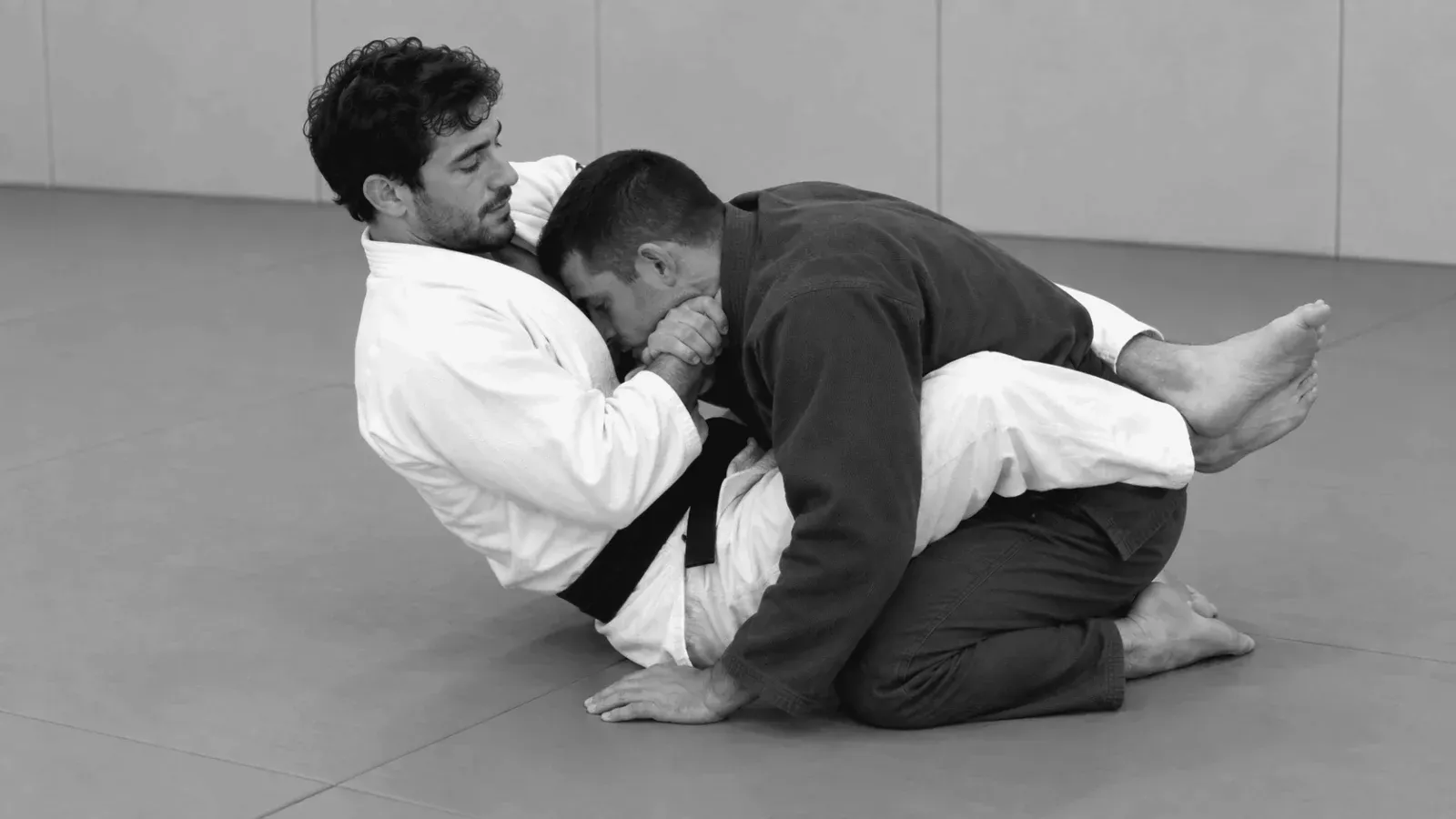
The first ten submissions you learn should form a useful learning menu, not a race to collect ten finishes. Start with attacks from positions you already reach, then connect position, control and submission. The ten below cover common upper-body attacks in gi and no-gi; your coach should choose the order and permitted techniques for your class.
There is no universal ranking that makes the same ten moves best for every beginner. This list gives you a practical way to organise your learning, with a clear starting position for each attack. It is an orientation guide, not ten complete finishing tutorials.
Ten attacks to recognise
- Rear naked choke — back control. A no-gi-compatible choke that uses the arms around the neck. Learn back control before focusing on the finish.
- Armbar — guard or mount. A straight-arm submission. Choose one starting position first so you can recognise the arm-isolation problem.
- Triangle choke — guard. A leg-based choke around the neck and one arm. Learn the entry and angle with controlled partner practice.
- Kimura — guard or side control. A bent-arm attack using a figure-four grip. It also gives you a connection for positional transitions.
- Americana — side control or mount. Another bent-arm submission, with a different arm orientation from the kimura. Do not treat the two names as interchangeable.
- Guillotine — front headlock or guard. An attack around the neck from the front. Learn which variation your coach is teaching rather than improvising neck pressure.
- Arm triangle — mount or side control. An arm-assisted choke around the opponent’s neck and one arm. Position and pressure control come before the finish.
- Cross-collar choke — closed guard or mount. A gi attack using collar grips. It belongs in a gi learning plan, rather than being copied unchanged into no-gi.
- Bow-and-arrow choke — back control in the gi. A collar-assisted back attack. Learn how to retain the back while changing grips and position.
- Omoplata — guard. A leg-assisted shoulder lock that can also lead to positional changes. Practise controlling the partner before attempting the submission.
The illustrated submission catalogue shows these families and variations. Use it to recognise names, then work on the specific version taught in your class.
Choose two, not all ten at once
Pick one position you regularly reach and select two compatible attacks from it. For example, guard might give you an armbar and triangle learning pair; back control might give you a rear naked choke and a gi collar attack. These are examples for planning, not a promise that every defence to the first move automatically gives the second.
For each attack, answer four questions:
- What position must I establish first?
- What arm, neck or grip must I control?
- What reaction makes the attack available?
- Where can I safely go if it is blocked?
If you cannot answer the first two, ask your coach to slow down the entry. Learning a finish without its starting control makes it hard to reproduce during rolling.
Build a position-to-submission chain
A useful chain contains separate checkpoints. Mount is the position; isolating an arm is a control task; an armbar is the possible finish. Losing mount while chasing the armbar tells you something different from reaching the armbar but failing to control the elbow.
Begin with the position and stop at the first checkpoint. Add the next only when you can identify it consistently. The beginner technique framework is useful alongside this menu because escapes and positional movement belong in a beginner game too.
For detailed existing lessons, connect the menu to armbar from mount, armbar from closed guard and Americana from side control. Verify that the lesson’s start matches the position you are practising.
Practise control before pressure
Use a cooperative partner and the version demonstrated by your coach. First practise the entry without finishing. Next practise maintaining the position while your partner gives one agreed defensive movement. Only add finishing pressure after the grip and position are understood.
Apply pressure gradually. Release immediately on any tap, verbal signal or distress. Do not accelerate to beat the tap, force the neck into flexion, or use pain as proof that your positioning is correct. Agree which attacks are appropriate for the class and ruleset; a technique appearing in a catalogue does not mean it is permitted for every age, belt or event.
An early release or a reset is a successful safety decision. It still leaves you with useful information about where control was lost.
Record the missing checkpoint
After a session, write one specific observation for each of your two attacks. For example: “Triangle entry from guard; I caught an arm and the head but lost the angle when they postured. Next drill: pause after the entry and check the angle with my coach.”
Keep the move, starting position, defensive reaction and next practice together in your game planner. Add a third submission when it solves a recurring problem in that chain, rather than because it is the next name on a list. For one detailed arm-lock example, study the closed-guard kimura.