
Guide
Is it hard to learn Brazilian Jiu Jitsu?
Brazilian Jiu Jitsu is difficult in the early months because the positions are unfamiliar and live sparring exposes every gap in your knowledge. It is not gated by size, strength or flexibility, and most of the difficulty comes from how the art is taught and practised.
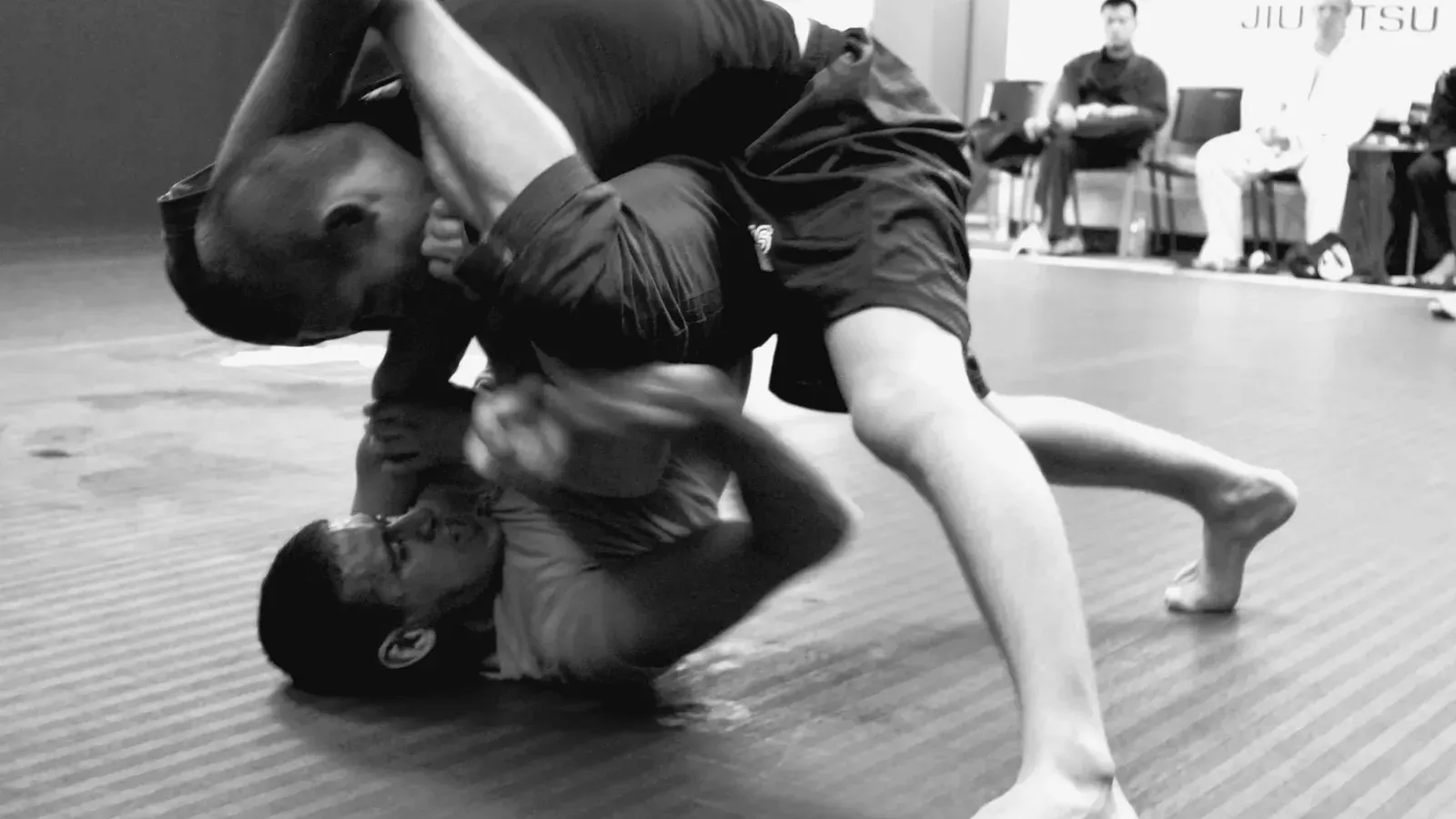
Mark Bonica from Durham, NH, USA · Wikimedia Commons · CC BY 2.0
.jpg)
Brazilian Jiu Jitsu is hard to learn at first, but not in the way most people fear. The difficulty is that you are learning a large set of unfamiliar grappling skills against partners who resist. It is not a fitness test you must pass before you begin. The art is based on the idea that a smaller, weaker person can defend against a bigger, stronger opponent by using leverage and weight distribution, so size and strength do not decide whether you can start.
What Brazilian Jiu Jitsu asks of you
Brazilian Jiu Jitsu is a grappling art focused on ground fighting and submission holds. You take an opponent to the ground, gain a dominant position, and then use joint locks, chokeholds or compression locks to force a submission. A compression lock is a hold in which an opponent’s muscle is compressed against a large, hard bone, commonly the shin or forearm, causing significant pain.
That description already explains why the early months feel difficult. There are many positions, each with its own escapes, attacks and transitions. Almost none of it resembles anything you do in daily life. You are learning a new physical vocabulary, and you learn it while a partner is trying to stop you.
When it is hard
It is hardest in the first stretch of training, and the difficulty comes from a few predictable sources.
Live sparring
Sparring, usually called rolling, and live drilling play a significant role in training. Rolling means you practise against a partner who is actively resisting. Technique that looked simple when demonstrated often fails under resistance, and you find out quickly which details you missed. This is uncomfortable for beginners, but it is the mechanism by which the skill develops.
Unfamiliar positions and breathing
Being held down, turned over or controlled by someone heavier is unusual for most people. Early on, much of your energy goes on tension and panic rather than movement. That wastes effort and makes you tire quickly. Fitness helps, but the tiredness beginners feel is often more about tension than conditioning.
The volume of material
You will meet new positions, names and sequences every week. Nobody retains all of it. A structured beginner programme helps because it repeats core ideas in a fixed order. A fundamentals class is designed for exactly this stage.
When it is not hard
Some of the things people worry about are less of a barrier than they expect.
Strength and size are the main example. Because the art rests on leverage and weight distribution, a technique done correctly does not depend on overpowering someone. Strength still matters in a live roll, and a heavier partner will still be difficult, but you are not excluded from learning because you are small or lightly built.
The choice of clothing is also flexible. Brazilian Jiu Jitsu can be practised in a gi or without one, which is called no-gi. In no-gi training, rash guards are used. If one format suits your body or schedule better, you can begin there.
You also do not need to compete. The art can be used for self-defence, sport, physical fitness, building character or as a way of life. Learning it for fitness alone is a legitimate reason to train, and it changes what “hard” means for you. Hard is then a matter of turning up and improving, not of winning.
What people get wrong
Believing you must get fit first
Many people wait until they feel fit enough to start. Training is itself the most direct way to build the specific fitness the art uses. Waiting mostly delays the learning. If you have an injury or a medical condition, speak to a doctor and to your instructor before you begin.
Confusing being tapped with failing
A tap is a signal that a hold has been applied and the partner should release. Being tapped often, especially by more experienced people, is normal for a beginner and carries information about what to fix. Tapping early is also a safety habit, not a weakness. A submission is only safe when the person applying it controls the movement and the person caught in it taps in time.
Expecting steady, visible progress
Progress in Brazilian Jiu Jitsu is uneven. Some weeks you feel you understand nothing, and then a position that confused you becomes clear. It is a mistake to judge yourself week to week. Many people who leave do so during the frustrating early stretch, which is covered in why people quit.
Assuming it is a test of aggression
Some newcomers think you need to be aggressive or willing to fight. In a training room, the practical skill is control: holding a position without harming your partner, applying a submission slowly, and releasing on the tap. Calm, technical partners are usually the ones people most want to train with.
Treating every roll as a contest
If you try to win every round, you tend to rely on strength and speed, which are the very things the art is meant to reduce your need for. Rolling with the aim of trying a position, or surviving in a bad one, teaches far more. Sparring is a way of testing what you have learned, and the result of a single round matters much less than what you take from it.
How to make it easier
The simplest way to make it easier is to reduce what you try to learn at once. Pick a small number of positions and revisit them repeatedly. Ask your instructor which few ideas matter most for your current level, and focus on those.
Attend regularly instead of occasionally. Because the material builds on itself, two sessions a week over many months teaches more than an occasional burst. Turn up when you feel tired, since some of the best learning happens when you cannot rely on effort.
Use the training structure your gym offers. A beginner class covers fundamentals in order, and an open mat gives you unstructured time to practise and roll at your own pace. If you want a step-by-step approach to the whole process, there is a guide on how to learn Brazilian Jiu Jitsu.
Finally, look for a training room where hard training and looking after each other go together. Some gyms and teams place value on team unity and on letting members train hard and freely with their teammates. A room that manages both is one where a beginner can afford to make mistakes.